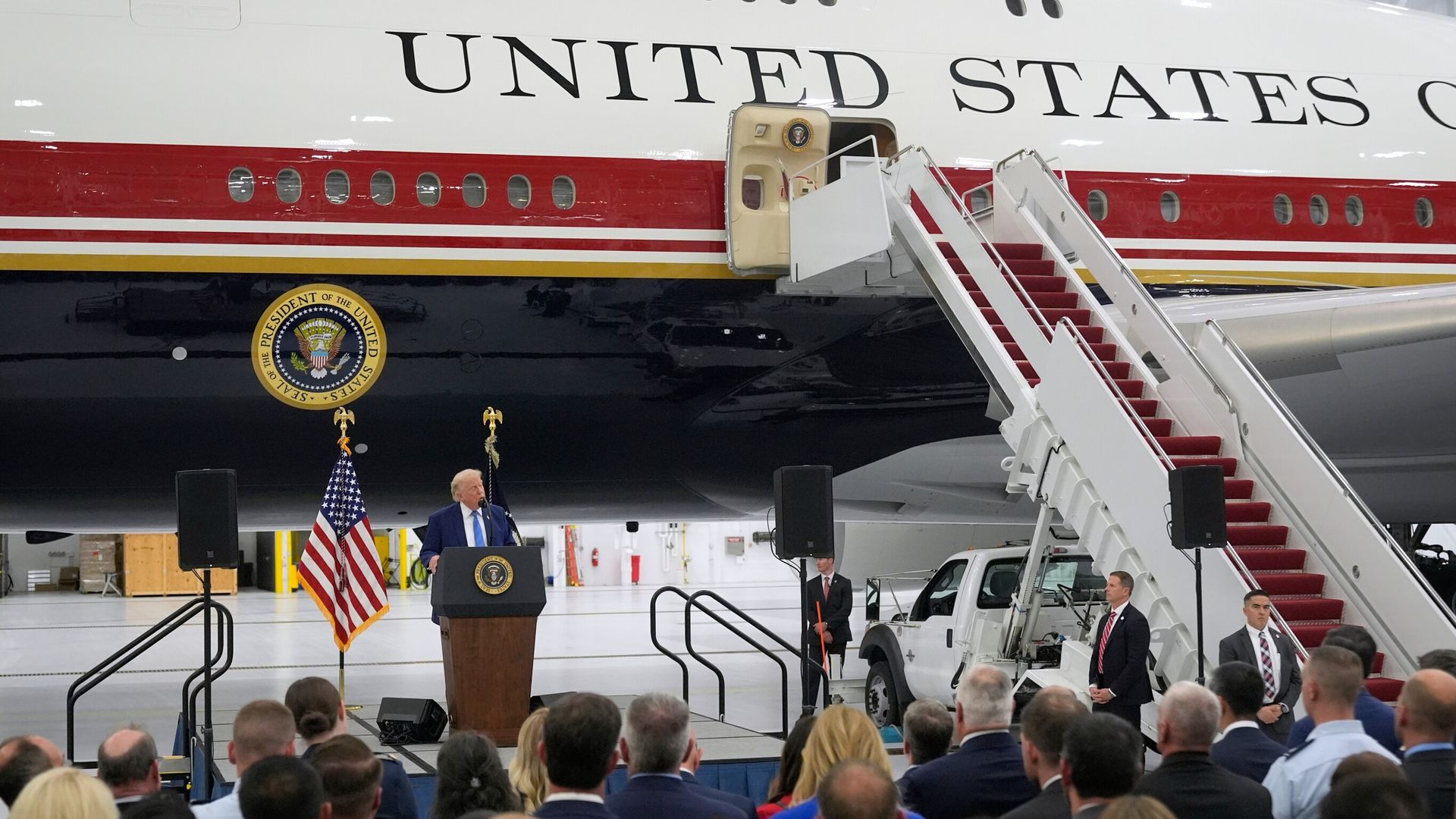
A standard federal rule dictates that no American official may accept an unsolicited gift valued at more than $50 from a foreign national. Yet, a $400 million Boeing 747-8 jumbo jet decorated in fresh red, white, dark blue, and gold paint just rolled out of a secure military hangar at Joint Base Andrews as the newly commissioned centerpiece of the United States presidential airlift fleet.
The transaction sidestepped normal diplomatic protocol through a specific, highly unusual arrangement. Under a legal memorandum drafted by Attorney General Pam Bondi and White House counsel David Warrington, the aircraft was accepted on the explicit condition that ownership will transfer to the Donald J. Trump Presidential Library Foundation upon the conclusion of his term in 2028. By structuring the transaction as a temporary national asset destined for a private historical repository, the administration bypassed statutory restrictions on foreign gifts. This maneuvers the aircraft directly into active military service as a temporary "bridge" transport.
The Secret Price of the Flying Majlis
The true financial ledger of this aircraft reveals that a free plane is rarely free. The Pentagon publicly insisted that retrofitting the Qatari airliner for the presidential mission would cost the American taxpayer less than $400 million. Aviation realities contradict this.
Converting a civilian commercial airframe into a hardened, flying command post capable of surviving an electromagnetic pulse from a nuclear detonation requires stripping the jet to its bare ribs. Classified defensive suites, encrypted satellite nodes, thermal flare countermeasures, and military-grade wiring packages cannot simply be bolted onto existing commercial bulkheads. Congressional oversight records reveal that an unpublicized transfer of $934 million was quietly diverted from the Air Force’s LGM-35 Sentinel intercontinental ballistic missile modernization program to fund the rapid retrofitting work managed by defense contractor L3Harris.
The Sentinel program is already years behind schedule. Diverting nearly a billion dollars from America’s ground-based nuclear deterrent to fast-track an interim executive transport highlights a dramatic realignment of defense procurement priorities.
Luxury Architecture Over Combat Readiness
While the exterior of the new aircraft, designated the VC-25B Bridge, matches the bold palette preferred by the commander-in-chief, the interior represents a distinct departure from traditional military design. Air Force procurement officials opted to prioritize rapid deployment over a full interior teardown, leaving the layout designed by the Swiss aviation group AMAC and French designer Alberto Pinto fundamentally intact.
Traditional Air Force One layouts resemble flying office complexes. They are characterized by utilitarian meeting rooms, tight corridors, and dense rows of high-backed seats meant for staff, secret service details, and the traveling press corps. The Qatari configuration features:
- An expansive main bedroom and separate guest quarters.
- Intricate sycamore and rare wacapou wood cabinetry.
- Custom silk rugs from Tai Ping Carpets.
- Modern lay-flat premium seating across both decks.
The Air Force maintains that leaving the luxury finishings intact saved time. Stripping the interior to match the precise workspace specifications of the outgoing VC-25A fleet would have added years to the timeline. Instead, the current layout forces a rotation of senior military advisors and press personnel to operate from within a flying palace built for Gulf royalty.
The Logistics of a White Elephant
The operational mathematics of a Boeing 747-8 introduce serious long-term liabilities to the military budget. Flying the outgoing, 1990s-era presidential jets costs roughly $180,000 to $200,000 per flight hour due to specialized logistics, continuous security detailing, and military maintenance standards.
The Air Force must now run a dual-fleet operation. The single Qatari jet will operate alongside the surviving legacy VC-25A while Boeing continues its multi-year, delayed work on two permanent, purpose-built presidential 747s slated for delivery in 2027 and 2028. The total cost for those two permanent planes has already ballooned from $3.7 billion to more than $5 billion. Running three separate technical training pipelines for pilots, technicians, and specialized mechanics across two entirely different generations of the Boeing 747 platform creates an immense burden on the Presidential Airlift Group.
The political justification for accepting the jet centers on absolute necessity. The existing presidential fleet is old, and a series of mechanical failures—including a high-profile grounding in Davos, Switzerland—proved that the current planes are reaching the end of their structural lifespans.
The Qatari government had previously spent years attempting to sell this exact 747-8 airframe on the open commercial market without success. By gifting the luxury liner directly to the United States, Doha successfully cleared an expensive asset off its books while securing unprecedented diplomatic goodwill. The plane will make its formal public debut leading a massive military flyover across Washington DC on July 4, celebrating the nation's 250th anniversary. It represents a dramatic fusion of private luxury, creative legal engineering, and deep defense spending hidden in plain sight.