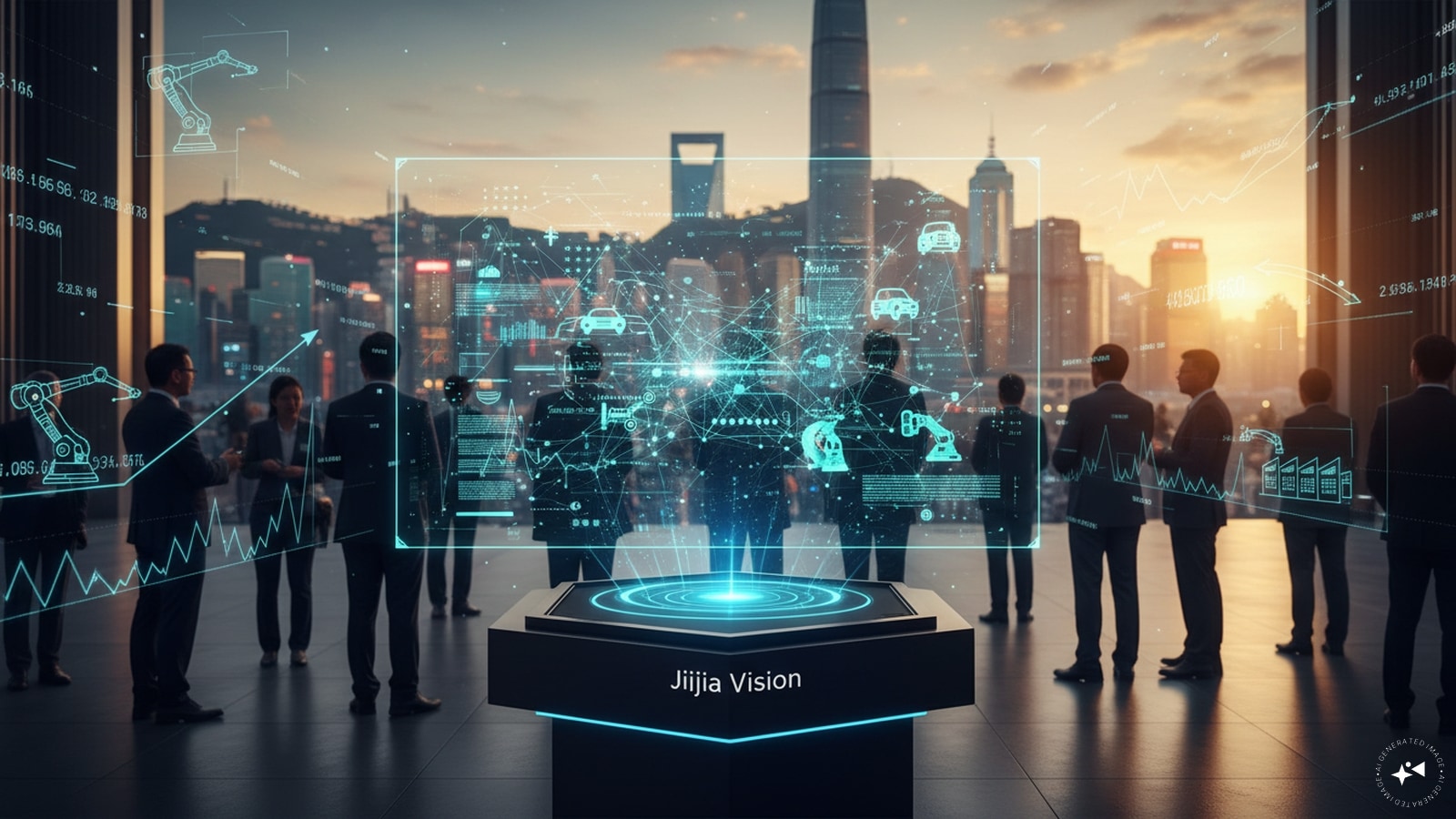
The Fluorescent Lights Don't Turn Off
At three in the morning in Beijing’s Haidian District, the air smells of cold jasmine tea and hot circuit boards. A young engineer named Lin sits motionless in front of three glowing monitors, her reflection suspended in dark glass. Outside her window, the neon skyline of China's technological nerve center dims, but inside the headquarters of GigaAI, nobody is sleeping.
Lin isn’t coding a simple chatbot to summarize emails or write basic computer script. She is feeding millions of hours of physical world footage—drone flights through torrential downpours, robotic arms fumbling with fragile glass, autonomous cars navigating chaotic intersections—into a machine learning system designed to comprehend the laws of physics.
This is the frontier of the "world model." And GigaAI is quietly racing to become the very first startup in this space to hit the global public stock markets.
The public debate around artificial intelligence often centers on conversational tools—software that speaks, writes, and generates images on command. But behind closed doors, the true space race among global technology giants isn't about teaching machines to chat. It’s about teaching them how the physical world actually works.
To understand why GigaAI’s push toward an initial public offering (IPO) is causing tremors from Shenzhen to Silicon Valley, you have to look past the financial filings. You have to look at what happens when software finally steps out from behind the screen and touches reality.
Beyond the Chatbox
Think about how a child learns that a glass falling off a table will shatter. Nobody hands a toddler a textbook on gravity, fluid dynamics, or structural integrity. The child knocks the glass over. The water spills. The glass cracks. The brain registers cause and effect.
Traditional large language models don't work this way. They read trillions of words about water, gravity, and glass, predicting the next plausible word in a sequence without ever understanding what it feels like for something to break.
World models aim to bridge that vast, perilous gap.
A true world model builds a spatial, physical intuition of reality. It simulates geometry, momentum, friction, and persistence. If an object rolls behind a couch, a world model knows it didn't cease to exist; it is simply occluded. For autonomous driving companies, advanced robotics manufacturers, and industrial automation firms, this distinction isn't academic. It is the difference between a self-driving vehicle making a safe split-second maneuver on an icy highway and a catastrophic navigation error.
GigaAI recognized this early. While competitors threw billions of dollars into refining text generation, GigaAI quietly assembled massive datasets of physical interactions, training neural architectures that predict physical outcomes before they happen.
Now, they need capital. Unimaginable amounts of it.
The Economics of Simulating Reality
Training a system to understand physics requires processing power that makes standard AI training look modest by comparison. High-resolution spatial video data, 3D sensor streams, and real-time physical simulations burn through graphics processing units at an astonishing rate.
Every minute Lin’s team runs a training cluster, the electricity meter spins like a turbine.
Going public isn't just a victory lap for GigaAI’s founders; it is a strategic imperative for survival. The capital markets offer a crucial lifeline—a way to secure the tens of thousands of specialized chips and immense data center capacity required to maintain a lead against deep-pocketed state-backed entities and Western tech conglomerates.
Consider the dynamic unfolding here:
- The Hardware Wall: Access to cutting-edge silicon remains tightly constrained by global trade friction, making efficiency and specialized optimization the primary weapons of Chinese AI teams.
- The Commercial Crunch: Enterprise clients don't want neat party tricks anymore. They want warehouse robots that don't drop boxes when the lighting changes, and simulation environments that accurately test industrial equipment before a single piece of steel is poured.
- The Valuation Pressure: Being the first dedicated world model startup to list publicly allows GigaAI to set the benchmark for how the financial world values physical-AI platforms.
By opening their books to global investors, GigaAI is making a bold statement: physical world simulation is no longer a speculative research venture. It is a commercial product with real market demand.
The Human Stack Behind the Code
It is easy to treat this high-stakes race as a mere clash of corporate balance sheets. But stand in the hallway of GigaAI's research center during a mid-day coffee run, and the human cost becomes starkly visible.
These engineers belong to a generation that came of age during China's massive mobile internet boom, only to realize that the rules of software have completely shifted beneath their feet. The old playbook—building an app, scaling user count, monetizing via ad impressions—is dead.
Today, success is measured in floating-point operations per second and physical loss functions.
Lin points to a video playing on her second monitor. It shows a simulated quadcopter attempting to land in an unpredictably changing wind field. In early iterations, the virtual drone spiraled out of control every single time, unable to comprehend sudden atmospheric pressure shifts. After months of fine-tuning the underlying physics engine, the simulated drone now tilts gracefully into the wind, counteracting the gust before it lands smoothly on a moving platform.
She smiles softly, her eyes bloodshot. "That took four months of our lives," she says quietly. "Four months so a computer could figure out how a breeze feels."
If GigaAI succeeds in its public market debut, it won't just be a victory for financial executives or early-stage venture capitalists. It will validate the brutal, unglamorous grind of thousands of researchers trying to teach silicon how to navigate the messy, unpredictable reality we inhabit every day.
The Unseen Horizon
The race for the first world model IPO is ultimately about who gets to build the digital foundation for the physical future. Whichever firm commands the deepest reserves of public capital will dictate how smart factories operate, how autonomous machines navigate our streets, and how virtual simulations mirror our day-to-day lives.
As the sun begins to rise over Beijing, casting a cool violet light across the rows of silent desks, Lin finally saves her work and pushes a updated model checkpoint to the cluster. Millions of virtual objects instantly begin tumbling, flying, colliding, and settling across thousands of remote servers.
The market bell will ring soon enough on a public exchange thousands of miles away, but inside these walls, the work of teaching machines how to walk through our world has already begun.

:max_bytes(150000):strip_icc():focal(749x0:751x2)/Arnold-Schwarzenegger-Joseph-Baena-032926-a90f8d3315fc44a6aebc6d7bb44bda01.jpg)