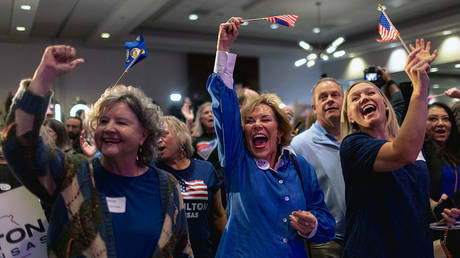
A midterm election does not pick the next president. It exposes the structural weaknesses of the party in power and forces the opposition to confront its own internal divisions before the primary season begins.
That is the real takeaway from the 2026 midterm cycle, even as political commentators rush to frame the results as a straightforward preview of 2028. Notice the framing in typical post-election coverage, such as headlines suggesting that a "midterm blue wave just made 2028 a lot more interesting." While a strong Democratic showing in a midterm cycle naturally shifts the immediate balance of power in Congress and statehouses, treating a midterm surge as a direct forecast for a presidential race ignores decades of American electoral history. Midterm electorates are smaller, older, and disproportionately driven by frustration with the sitting administration, whereas presidential electorates are broader, less predictable, and shaped by the specific nominees at the top of the ticket.
To understand what the 2026 results actually do to the 2028 presidential race, you have to look past the raw seat counts and examine the mechanics of coalitions, state-level infrastructure, and the historical trap of over-interpreting off-year momentum.
The Structural Illusion of the Midterm Wave
Every two years, political analysts treat midterm elections as referendums on the White House. They are right about the present and usually wrong about the future.
In almost every modern midterm cycle, the party holding the presidency loses ground. Voters frustrated by inflation, legislative gridlock, or executive overreach show up in November to apply a check on the administration. Meanwhile, supporters of the sitting president often stay home, lacking the immediate urgency of a presidential ballot. When the opposition party capitalizes on that asymmetry—whether Republicans in 2010 and 2014 or Democrats in 2018—the resulting wave reshapes Congress and creates an aura of inevitability around the winning party's upcoming presidential prospects.
History shows how quickly that aura evaporates. Barack Obama suffered what he called a "shellacking" in the 2010 midterms, losing 63 House seats to a Tea Party wave, yet he won re-election comfortably two years later. Bill Clinton faced a historic Republican takeover of Congress in 1994 before cruising to a second term in 1996. Even when a midterm wave does precede a change in the White House, as it did in 2006 ahead of the 2008 election, the presidential race is ultimately decided by economic conditions and candidate dynamics that barely existed two years earlier.
The 2026 midterms follow this familiar pattern of thermostatic public opinion. When one party controls the executive branch, public sentiment tends to swing back toward the opposition as a corrective measure. A strong Democratic performance in 2026 demonstrates that the party can mobilize its base and win back disaffected swing voters in key congressional districts. It does not prove that those same voters have settled on a unified vision for 2028, nor does it guarantee they will turn out in the same numbers when a different set of issues dominates the national conversation.
How Congressional Gains Reshape the Primary Battlefield
Where the 2026 results genuinely alter the 2028 trajectory is inside the Democratic Party itself. Winning removes the immediate pressure for ideological soul-searching, and that can be a double-edged sword.
When a party loses badly, it is forced to rebuild its message from the ground up. When it wins—especially on the back of anti-incumbent sentiment—different factions immediately claim credit for the victory. Progressive organizers argue that high base turnout and populist economic messaging carried the day. Moderate lawmakers from swing districts counter that pragmatic, centrist positioning made the difference in suburban battlegrounds. Both sides have data points to support their claims, and neither side is inclined to compromise heading into a presidential primary.
The Governorship Factor and the 2028 Bench
The most concrete impact of the 2026 midterms on 2028 lies in the statehouses rather than on Capitol Hill. Governors are the traditional proving grounds for presidential contenders because executive experience allows them to build a governing record outside the partisan gridlock of Washington.
A strong Democratic showing in gubernatorial races across battleground states accomplishes two critical tasks simultaneously:
- Building the Candidate Pipeline: Democratic governors who win re-election or flip key states in 2026 immediately enter the top tier of 2028 presidential speculation. Their ability to win statewide in competitive environments gives them an instant credibility advantage over senators or cabinet officials who have never run a state government.
- Controlling Election Infrastructure and Fundraising Networks: Statehouses come with institutional power. Governors influence redistricting battles, appoint key state officials, and command donor networks that can be activated two years later. Having friendly executives in swing states gives a presidential nominee an organizational backbone on the ground long before the general election campaign officially begins.
At the same time, governing comes with exposure. A governor elevated by a 2026 wave now has two years to manage state budgets, respond to local crises, and take positions on divisive cultural and economic issues. Every decision made in a state capital between 2027 and 2028 becomes opposition research for primary rivals and general election opponents alike.
The Divided Government Trap
If the 2026 midterms leave Washington with divided government, the strategic calculus for 2028 shifts dramatically. Divided government changes what voters expect from both parties and alters how prospective presidential candidates position themselves.
For the party holding the White House, losing control of one or both chambers of Congress ends its ability to pass major partisan legislation. The administration's focus shifts to executive actions, judicial appointments, and using the veto pen to block opposition bills. In that environment, the incumbent party's 2028 standard-bearer often runs against a "do-nothing" Congress, blaming legislative gridlock on the opposition's refusal to govern responsibly.
For Democrats buoyed by midterm gains, newfound congressional power brings responsibility. Voters who backed Democratic candidates to check the administration will expect tangible results on kitchen-table issues like housing costs, healthcare affordability, and inflation. If the new congressional majority spends two years focused solely on oversight investigations and messaging bills that die on the president's desk, swing voters who powered the 2026 wave can easily sour on both parties by 2028.
Consider a hypothetical scenario to illustrate this dynamic. Suppose a newly empowered congressional majority passes a sweeping economic package designed to appeal to its base, knowing full well the president will veto it. While that strategy energizes core supporters and helps candidates raise money online, independent voters in swing states often view it as political theater. Two years later, when those same independent voters are asked to choose a president, they may decide that neither party is serious about solving practical problems.
Demographic Shifts Beneath the Headline Numbers
Raw election night totals often mask the underlying coalition shifts that actually determine presidential races. To read the 2026 results accurately, strategists look closely at margin changes among specific voting blocs rather than just who won or lost a given seat.
Over the past decade, American politics has undergone a steady realignment defined by education and geography. Voters with college degrees have moved increasingly toward the Democratic Party, turning once-reliable Republican suburbs into Democratic strongholds. Meanwhile, working-class voters without college degrees—across racial lines—have drifted toward the Republican coalition, making rural areas and post-industrial towns far harder for Democrats to contest.
The 2026 midterms test whether those trends are continuing or starting to plateau. Even in a strong Democratic cycle, strategists examine whether the party's gains came primarily from running up massive margins in affluent, college-educated suburbs or from clawing back support among non-college-educated voters in the Midwest and Sun Belt.
The distinction matters enormously for 2028 because of the Electoral College. A coalition built overwhelmingly on urban and suburban turnout can easily win the national popular vote and flip dozens of House seats, yet still fall short in the specific battleground states required to reach 270 electoral votes. Conversely, even modest improvements among working-class voters in states like Pennsylvania, Michigan, and Wisconsin can fundamentally alter the presidential map, regardless of what happens in safe coastal districts.
The Youth and Hispanic Vote Variables
Two groups warrant particular scrutiny in post-2026 analysis: younger voters and Hispanic voters. In recent cycles, both demographics have shown greater volatility than traditional party loyalties would suggest.
Younger voters frequently drive midterm surges when motivated by specific issues, yet their turnout rates remain consistently lower than those of older cohorts. Furthermore, younger men and younger women have diverged sharply in their political preferences, creating a gender gap that complicates uniform messaging.
Similarly, Hispanic voters are not a monolith, and their voting patterns vary widely by region, generation, and economic priority. Gains or losses among Hispanic voters in South Texas, South Florida, and the Southwest offer distinct clues about how economic messaging—particularly around small business growth, inflation, and border policy—is resonating. A midterm result that relies on older, high-propensity suburban voters to offset softness among younger or working-class voters sends a warning signal to any 2028 campaign planning to replicate the same playbook.
Why Republican Strategists Are Not Panicking Yet
While a midterm setback forces the party in power to play defense, seasoned Republican operatives rarely view off-year losses as fatal to their 2028 prospects. They understand that the structural dynamics of a presidential year favor a reset.
First, a presidential election brings millions of low-propensity voters back into the electorate—voters who skip midterms entirely because they feel disconnected from routine congressional politics. When those voters return in 2028, the electorate looks fundamentally different from the one that cast ballots in November 2026.
Second, the 2028 cycle guarantees an open or transitional dynamic at the top of the ticket, depending on term limits and succession battles. A new presidential nominee can distance themselves from unpopular aspects of the current administration while claiming credit for its successes. That flexibility allows a party to refresh its brand in ways that incumbent members of Congress cannot during a midterm year.
Third, opposition parties often overreach after a strong midterm. Believing they have a broad mandate for sweeping change, winning coalitions frequently push policies that alienate the center of the electorate. Republican strategists know that two years of intense congressional oversight and partisan conflict in Washington can quickly turn the political tide back in their favor, allowing them to run in 2028 against what they will frame as opposition overreach.
The Money and Media Echo Chamber
Modern political coverage amplifies the significance of midterm results because the campaign industry never stops running. Within hours of the final polls closing in 2026, cable networks, podcasts, and donor networks pivot directly to the 2028 presidential primary.
This compressed timeline creates a distorted feedback loop. Donors rush to back the winners of high-profile 2026 races, mistaking regional campaign talent for national presidential viability. Media outlets manufacture early horse-race narratives based on hypothetical polling conducted two years before a single primary ballot is cast. Prospective candidates feel pressured to establish shadow campaigns, hire consultants, and travel to early nominating states immediately after the midterms, leaving little time for actual governance.
Yet history repeatedly shows that early frontrunners emerging from midterm cycles rarely survive the grueling reality of a presidential primary intact. Voters in Iowa, New Hampshire, South Carolina, and Nevada test candidates under intense scrutiny that bears little resemblance to a midterm campaign. Weaknesses that went unnoticed in a favorable midterm environment—a thin policy record, an inability to connect on retail campaign stops, or vulnerability on a specific vote—are ruthlessly exposed once the primary field narrows.
What Actually Matters Between Now and 2028
Stripping away the partisan spin, the 2026 midterm results serve as a diagnostic tool rather than a crystal ball. They reveal where each party's organizational machinery is working, which messages are breaking through with undecided voters, and which rising leaders can handle the pressure of a competitive campaign.
For Democrats, the challenge over the next two years is translating midterm momentum into a durable national coalition that works under presidential turnout conditions. That requires resolving internal debates over economic populism versus suburban centrism without fracturing the base, while proving that newly won congressional and gubernatorial majorities can deliver practical results.
For Republicans, the task is diagnosing whether 2026 losses stemmed from temporary dissatisfaction with the incumbent administration or deeper structural vulnerabilities in key swing districts. Adjusting policy priorities and candidate recruitment ahead of 2028 will determine whether the midterm setback was a routine historical speed bump or the beginning of a longer realignment.
The voters who decided the 2026 midterms sent a clear message about their dissatisfaction with the status quo in Washington, and by 2028, both parties will have to prove they actually listened.