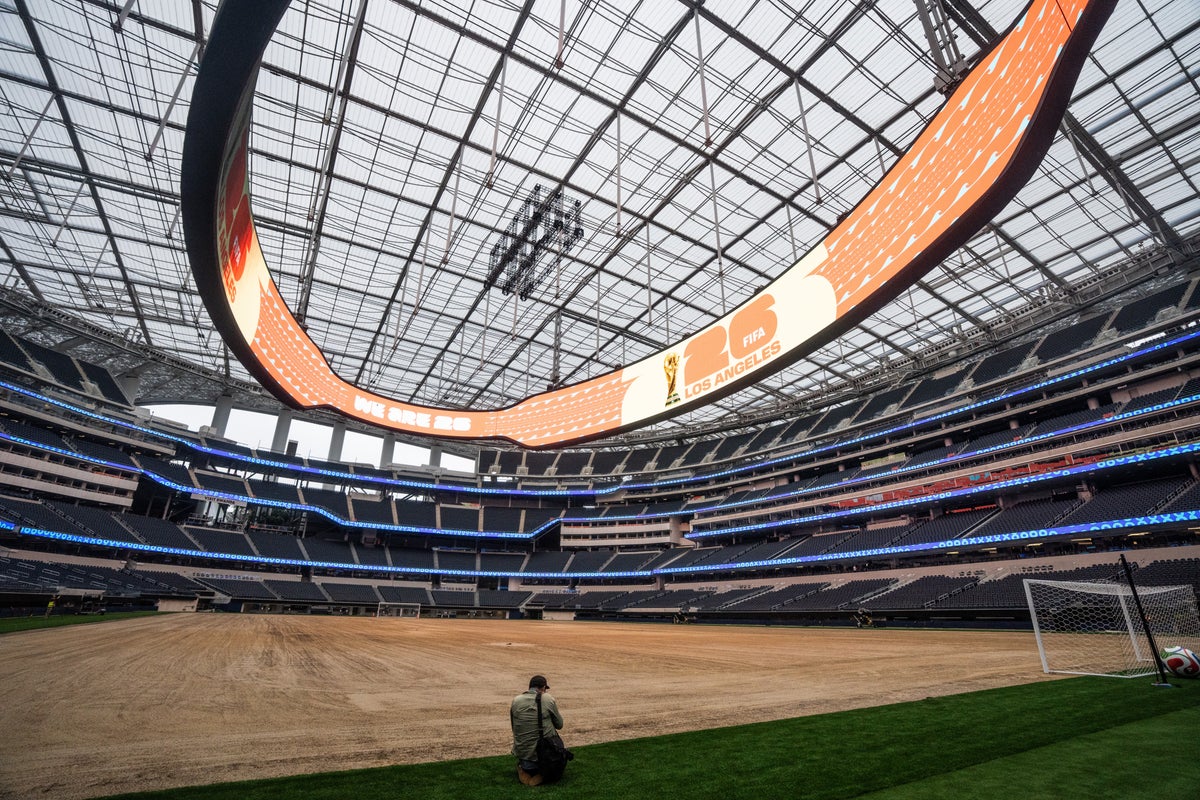
The sports media cycle is currently obsessed with a clock. Specifically, a 30-day countdown to the first match of the World Cup in Los Angeles. The narrative is as predictable as it is exhausting: "Will the grass be ready?" "Can they grow a world-class pitch in a month?" "Is the stadium falling behind schedule?"
This isn't journalism. It’s a misunderstanding of modern agronomy and high-stakes infrastructure disguised as a "ticking clock" drama.
If you think a 30-day window for laying a pitch is a "crisis," you aren't paying attention to how the elite side of the industry actually functions. I’ve seen projects where $10 million was burned because people panicked about aesthetics over structural integrity. The reality is that the "wait" for the grass isn't a delay. It is a strategic, calculated necessity. The panic is a byproduct of people who think a soccer pitch is just a bigger version of their backyard lawn.
The Myth of the Sacred Rooting Period
Most pundits argue that grass needs months to "take hold." That was true in 1985. In 2026, it is an antique notion.
We aren't throwing down seeds and praying for rain. We are installing sophisticated, engineered living systems. High-end stadium pitches for events of this magnitude use thick-cut sod—often 2 to 3 inches deep—which brings its own weight and stability to the party immediately.
When you lay thick-cut hybrid turf, the "rooting" isn't the primary stabilizer; the sheer mass of the sod and the synthetic fibers integrated into the root zone are. You could play a match on it 48 hours after installation if the drainage layer was dialed in correctly. Waiting 30 days isn't "cutting it close." It’s an luxury.
The obsession with long lead times is actually a risk factor. Lay a pitch too early in a multipurpose stadium environment and you expose it to:
- Stagnant airflow leading to fungal pathogens.
- Construction dust from final stadium touches clogging the drainage pores.
- Unnecessary irrigation cycles that weaken the plant's natural resilience.
The "just in time" delivery of the pitch is a feature, not a bug.
The Hybrid Reality vs. The Organic Fantasy
People love the idea of "natural grass." FIFA demands it. But "natural" is a marketing term in the 21st century.
A modern World Cup pitch is a machine. We use systems like SISGrass or Desso GrassMaster, where millions of synthetic fibers are injected 20 centimeters deep into the sub-base. This creates a mechanical anchor.
$$S = m + i$$
In this simplified view, the Stability ($S$) of the pitch is the sum of the organic Mass ($m$) and the Interlocking synthetic fibers ($i$). Even if the organic roots haven't fully matured, the $i$ component provides the shear resistance necessary to prevent players from "digging holes" during a slide tackle.
The competitor's article cries about the "missing grass" as if the stadium is currently an empty sandbox. In reality, the most important work—the installation of vacuum ventilation systems, sub-air heating, and specialized irrigation sensors—is already done. The grass is just the carpet you lay once the house is built. You don't put the carpet down while the painters are still on ladders.
Why 30 Days is the Sweet Spot for Los Angeles
Los Angeles presents a unique microclimate challenge. You have high light intensity but a stadium bowl that creates massive shadows. If you install that grass 90 days out, you spend 60 days fighting the stadium’s own geometry to keep the grass alive using expensive grow lights that simulate the sun's spectrum.
Why bother?
By keeping the sod at the farm—under optimal, wide-open conditions—until the last possible second, you ensure the plant arrives in peak health. It’s like keeping a race car in a climate-controlled garage instead of idling it at the starting line for three hours.
The Real Problem Nobody is Talking About: The Soil Profile
The media asks "Where is the grass?" They should be asking "What is the sand?"
A World Cup pitch fails because of the perched water table, not because the grass was "late." If the USGA-spec sand used in the root zone doesn't perfectly match the hydraulic conductivity of the sod being brought in, you get a "layering" effect. Water hits the interface and stops. The pitch becomes a swamp, the turf slides, and you have a disaster on global television.
I have seen venues spend millions on the "best grass" only to have it fail because they didn't account for the physical capillary action between the farm soil and the stadium sand. That’s the technical nuance that decides a World Cup final. The 30-day timeline is irrelevant if the physical chemistry of the layers is wrong.
Breaking the Premise: "People Also Ask"
Can grass grow in 30 days? Wrong question. The grass is already grown. It's been growing for 18 months at a specialized turf farm. The question is: "Can the sod survive the transplant stress?" The answer is yes, provided the stadium’s sub-air system can manage the temperature of the root zone from day one.
What happens if the pitch isn't ready?
It will be "ready" in terms of looks within 72 hours. The danger isn't that it won't be there; the danger is that the stadium staff might over-manage it. The biggest threat to a new pitch is an over-eager groundskeeper with too much fertilizer and a heavy hand on the irrigation trigger.
Why is natural grass so hard to maintain in L.A.?
It’s not. It’s hard to maintain in a stadium. The bowl architecture kills airflow. Without airflow, you get "damping off"—a death sentence for new turf. The 30-day window reduces the time the grass has to suffer in a low-oxygen environment.
The Cost of the "Early" Illusion
If the organizers moved the timeline up to 60 or 90 days to satisfy nervous journalists, they would be burning money.
- Labor: 24/7 monitoring of a "vulnerable" early pitch.
- Electricity: Running UV grow light rigs (which cost thousands per day in utility fees).
- Chemicals: Preventative fungicides needed because the grass is stressed by its new environment.
It is a vanity expense. It serves no athletic purpose.
The Insider Verdict
The narrative that Los Angeles is "behind" is a fabrication. It’s a story sold to people who don't understand the difference between a lawn and a high-performance sports surface.
We are moving toward a world where "Modular Turf" is the standard. In the future, we won't even talk about 30 days. We will talk about 48 hours. We will see pitches grown in trays off-site and slotted in like Lego bricks the night before a match.
The "drama" of the 30-day mark is the last gasp of an outdated perspective on stadium management. Stop looking at the dirt. Start looking at the drainage specs and the light-reflection index of the stadium canopy. That’s where the real match is won or lost.
The grass is fine. Your understanding of it is what needs work.
Stop obsessing over the calendar and start respecting the engineering.