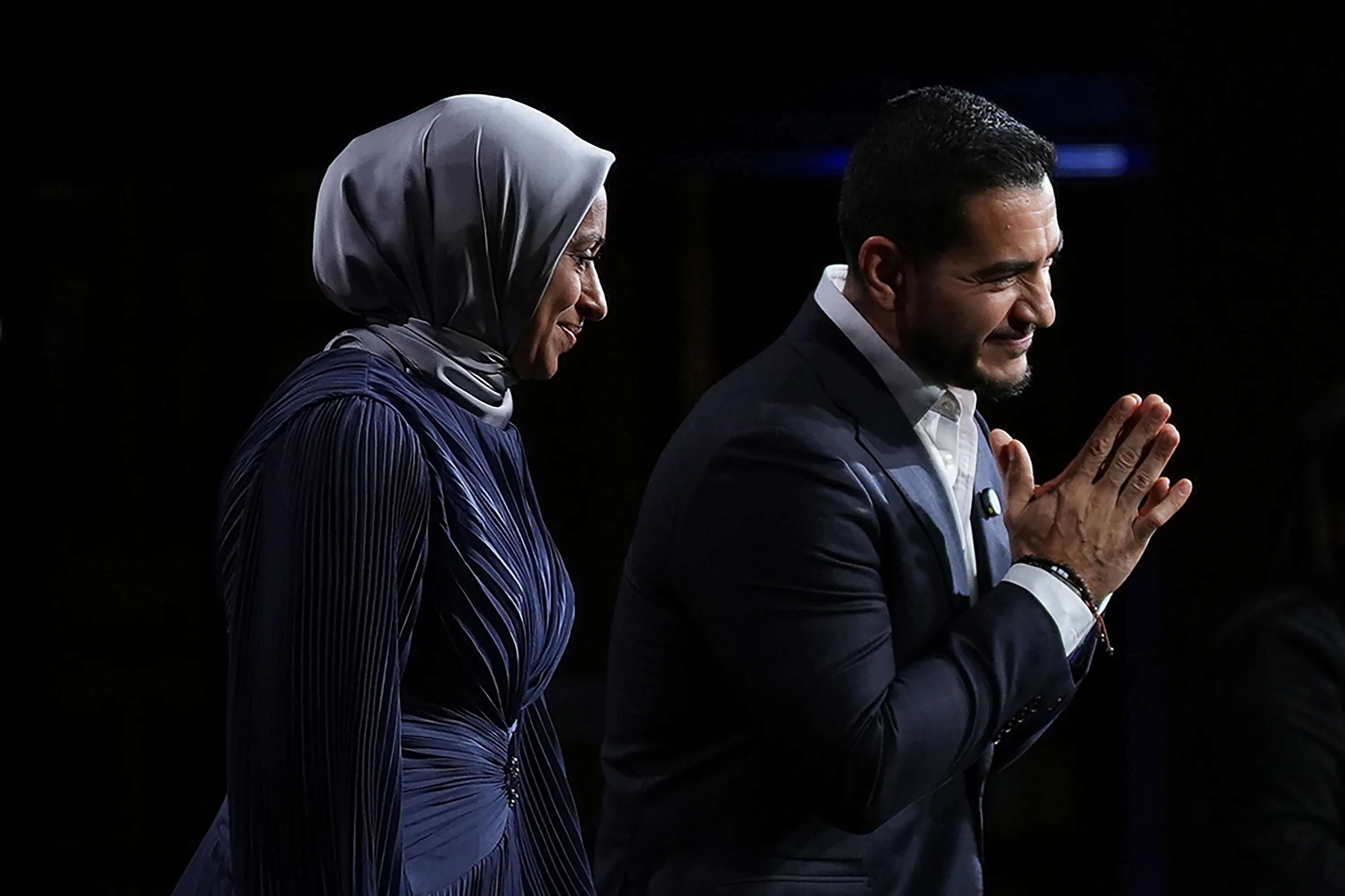
American foreign policy rarely produces genuine political shockwaves, yet Michigan progressive Abdul El-Sayed publicly welcoming a Donald Trump proposal to slash financial assistance to Israel qualifies as a seismic event. When an outspoken democratic socialist aligns himself with a conservative nationalist on one of Washington’s most fiercely guarded orthodoxies, the consensus in the capital is fracturing. El-Sayed did not merely nod along to the idea of reducing foreign outlays. He seized the opening to demand a total halt to American arms sales to the Israeli military, exposing a volatile new horseshoe dynamic in Middle Eastern diplomacy that threatens to upend decades of bipartisan orthodoxy.
The immediate catalyst for this unlikely convergence lies in the collision of two distinct political movements that have grown deeply skeptical of unconditional foreign entanglements. On the progressive left, figures like El-Sayed—a physician, former Detroit health director, and prominent voice in Michigan’s Democratic politics—view military aid through the lens of human rights, international law, and domestic accountability. On the nationalist right, Trump’s "America First" doctrine treats foreign assistance as a bad business deal, questioning why American taxpayers subsidize wealthy allies capable of funding their own defense. Both camps have arrived at the exact same destination via completely different ideological highways.
The Architecture of Unconditional Aid
To understand why this alignment rattles the political establishment, you have to look at the sheer scale and insulation of the U.S.-Israel security relationship. For decades, American military assistance to Israel has operated on a track largely immune to the standard congressional appropriations battles that ensnare other foreign aid packages. Under the current ten-year Memorandum of Understanding (MOU), signed during the Obama administration and spanning fiscal years 2019 through 2028, the United States pledged $38 billion in military aid. That breaks down to $3.3 billion annually in Foreign Military Financing (FMF) and an additional $500 million per year for cooperative missile defense programs like Iron Dome and David's Sling.
This money does not function like a standard wire transfer. Roughly three-quarters of those funds must be spent directly with American defense contractors, effectively subsidizing the U.S. aerospace and munitions industries while equipping the Israel Defense Forces (IDF) with advanced hardware like the F-35 Joint Strike Fighter. Until recently, questioning this arrangement on Capitol Hill was treated as political suicide. Lobbying groups, defense manufacturers, and entrenched foreign policy hands maintained an ironclad grip on the narrative, framing every dollar as an untouchable investment in regional stability.
El-Sayed’s intervention strikes directly at the moral and legal foundations of that system. By welcoming Trump’s willingness to put aid on the chopping block, El-Sayed is executing a classic political flanking maneuver. He is using the rhetoric of a conservative populist to legitimize a demand that the Democratic leadership has spent years trying to marginalize. If a former—or sitting—Republican president can openly float cutting off the financial spigot without triggering immediate institutional collapse, the Democratic establishment loses its primary excuse for inaction.
Michigan as the Epicenter of Foreign Policy Dissent
Geography matters here. Abdul El-Sayed is not operating out of a safe, coastal progressive enclave where foreign policy debates remain purely theoretical. He operates in Michigan, a critical swing state home to one of the largest Arab American and Muslim populations in the United States. Over the past several election cycles, voters in cities like Dearborn and Hamtramck have transformed American funding for Israeli military operations from a niche diplomatic issue into a decisive ballot-box litmus test.
During the 2024 presidential cycle, the "Uncommitted" movement in Michigan demonstrated that tens of thousands of reliable Democratic voters were willing to withhold their support over the Biden administration’s refusal to condition weapons transfers. El-Sayed was a central figure in translating that grassroots fury into coherent political pressure. He understands that for his constituency, talking about humanitarian pauses or diplomatic concern means nothing while American-made 2,000-pound bombs continue to ship out of U.S. ports.
By pivoting from financial aid cuts to a complete embargo on arms sales, El-Sayed is pointing out a critical distinction that most casual observers miss. Cutting direct financial grants saves taxpayers money, which satisfies the fiscal conservative impulse. However, Israel possesses a highly advanced, multi-hundred-billion-dollar economy and maintains substantial foreign currency reserves. Even if Washington zeroed out the $3.8 billion annual grant tomorrow, Tel Aviv could easily afford to purchase American weapons using its own national treasury. Stopping the cash flow without stopping the weapons transfers leaves the actual mechanics of warfare entirely intact.
The Legal Mechanics of an Arms Embargo
El-Sayed’s demand to halt arms sales relies on existing, albeit routinely ignored, American statutory frameworks. Federal law already contains strict prohibitions against providing security assistance to foreign military units implicated in credible human rights violations.
The primary mechanism is the Leahy Law, named after former Senator Patrick Leahy. It bars the State Department and the Department of Defense from providing military assistance to foreign security force units that violate human rights with impunity. Alongside it sits Section 620I of the Foreign Assistance Act, which explicitly prohibits furnishing assistance to any country that prohibits or otherwise restricts, directly or indirectly, the transport or delivery of United States humanitarian assistance.
For years, successive administrations have bypassed these legal tripwires through bureaucratic gymnastics, specialized vetting exemptions, and broad national security waivers. El-Sayed’s position strips away those procedural excuses. His argument is straightforward. If the United States enforces its own laws consistently, weapons shipments cannot legally proceed.
Why Trump’s Approach Differs Fundamentally
While El-Sayed and Trump share a momentary overlap in opposing automatic aid packages, treating their positions as identical would be a severe analytical error. Trump’s skepticism toward foreign aid is transactional, fluid, and deeply rooted in personal leverage. Throughout his political career, Trump has repeatedly argued that wealthy nations—from NATO allies in Europe to partners in East Asia and the Middle East—take advantage of American generosity.
In his view, aid is not an obligation; it is a negotiating chip. Trump has previously suggested converting foreign aid grants into high-interest loans, arguing that if the United States is going to bankroll foreign defense, American taxpayers should at least see a financial return. Furthermore, Trump’s posture toward Israel has historically swung between fierce rhetorical backing and sharp private frustration whenever Israeli leadership took actions that complicated his broader regional ambitions, such as the Abraham Accords.
El-Sayed’s opposition is structural and ideological, not transactional. He does not want to convert military grants into loans, nor does he want to use aid as a bargaining chip to extract diplomatic concessions on unrelated trade deals. He wants the military pipeline dismantled entirely. For El-Sayed, the issue is not that the United States is getting a bad return on its investment; it is that the investment itself implicates American citizens in overseas destruction while draining resources needed for domestic healthcare, infrastructure, and public education.
The Defense Industry Pushback
Any serious attempt to enact what Trump has floated and what El-Sayed demands faces a formidable wall of institutional resistance that extends far beyond ideological lobbying groups. The American defense industrial base is deeply woven into the congressional districts of both parties.
When Congress approves $3.3 billion in Foreign Military Financing for Israel, those dollars flow directly to facilities in Texas, California, Connecticut, and Missouri. Lockheed Martin builds the airframes. RTX manufactures the interceptors and guidance systems. Boeing produces the precision munitions kits. Cutting off aid and halting arms sales does not just impact a foreign government; it threatens union manufacturing jobs, corporate quarterly earnings, and campaign contributions across dozens of swing districts.
This economic reality explains why bipartisan majorities on Capitol Hill routinely vote to replenish munitions stockpiles even when public polling shows growing skepticism toward foreign intervention. Politicians who campaign on fiscal restraint or progressive values suddenly discover an urgent need for global security when a major defense subcontractor employs three thousand constituents in their home district.
The Fracturing of the Bipartisan Consensus
For nearly half a century, the U.S.-Israel relationship rested on a stable, predictable foundation. Democrats championed the partnership through the lens of shared democratic values and regional diplomacy, while Republicans framed it around strategic deterrence and evangelical affinity. Both sides agreed that questioning the material support underlying that relationship was off-limits.
That consensus is visibly eroding from both ends of the political spectrum simultaneously. Younger voters in both parties view foreign policy through radically different prisms than the Cold War generation that still dominates congressional leadership. Among younger Democrats, sympathy for Palestinian human rights has surged, turning unconditional military backing into a severe political liability. Among younger conservatives, a neo-isolationist streak—championed by influential media figures and populist lawmakers—views every foreign dollar spent as a betrayal of struggling American communities.
El-Sayed’s public embrace of Trump’s aid-cutting rhetoric is a deliberate acceleration of this trend. By highlighting the overlap, El-Sayed forces mainstream Democrats into an uncomfortable corner. If Democratic leaders attack Trump’s proposal as reckless or anti-ally, they risk alienating their own progressive base and validating the accusation that they care more about maintaining foreign war chests than addressing domestic crises. Conversely, if they validate the premise that aid should be cut, they concede ground to both their left flank and their primary conservative adversary.
Strategic Consequences in the Middle East
If the United States were to actually follow through on a dual track of slashing financial aid and halting arms sales, the geopolitical fallout across the Levant would be immediate and profound. Critics of El-Sayed’s position argue that such a move would create a dangerous power vacuum. They point out that Israel relies heavily on American precision-guided munitions, spare parts, and intelligence sharing to deter regional adversaries like Iran and Hezbollah.
Without continuous resupply from Washington, military analysts note that the IDF would face severe logistical bottlenecks within weeks of any high-intensity conflict. Proponents of the status quo warn that a perceived weakening of American backing could embolden hostile actors to test Israeli defenses, potentially triggering a wider regional conflagration that would ultimately draw American forces back into the region under far worse conditions.
There is also the question of geopolitical realignment. A complete rupture in U.S. arms sales would force Tel Aviv to seek alternative suppliers or aggressively expand its domestic weapons manufacturing capabilities. While Israel already boasts one of the most sophisticated indigenous defense sectors in the world, it cannot currently replicate the sheer industrial scale of American aerospace production. Turning toward other global powers for critical components would fundamentally alter the strategic balance Washington has spent decades cultivating in the Eastern Mediterranean.
The Domestic Political Calculus
Yet for figures like Abdul El-Sayed, those strategic warnings sound remarkably similar to the arguments used to justify decades of open-ended American military interventions in Iraq, Afghanistan, and Libya. The core thesis of the anti-interventionist left—and, increasingly, the nationalist right—is that unconditional security guarantees do not produce stability. Instead, they create moral hazard, insulating foreign governments from the diplomatic compromises necessary to achieve lasting peace.
El-Sayed’s willingness to publicly validate a Trump policy position signals that the old rules of partisan tribalism are breaking down on foreign policy. In an era defined by hyper-polarization, politicians usually avoid praising an ideological rival under any circumstances, fearing that even a qualified endorsement will confuse their voters or weaken their brand. El-Sayed calculated that the strategic value of breaking the bipartisan taboo on Israel aid outweighs the risk of being associated with Trump.
It is a high-stakes gamble that exposes the raw nerves of American politics. By linking Trump’s transactional nationalism with progressive human rights advocacy, El-Sayed has drawn a bright line across the political map, forcing both parties to defend why billions of American tax dollars and tons of lethal hardware continue to flow overseas without strings attached. Whether this strange-bedfellows coalition possesses the legislative muscle to overcome the entrenched power of the defense industry and congressional leadership remains an open question, but the era of automatic, unquestioned consensus is dead.


