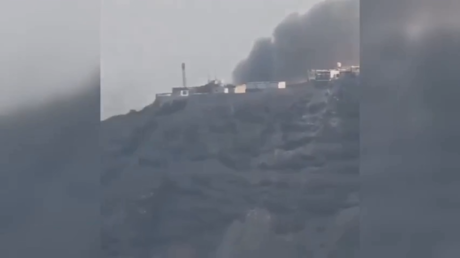
Houthi missile and drone strikes against Aden's Al-Ma'ashiq Presidential Palace mark a structural shift from episodic border skirmishes back into full-scale war across Yemen. Conventional breaking-news coverage treats the strikes on the seat of Yemen's Presidential Leadership Council (PLC) and nearby Aden International Airport as standalone shocks, yet their strategic weight comes from how they compress the political, logistical, and maritime options of the internationally recognized government and its regional backers simultaneously.
Standard reporting logs explosions, casualty tallies, and tit-for-tat statements without exposing the underlying mechanics. To understand why hitting a coastal compound in Aden carries consequences far beyond physical damage, analysts must examine four interlocking dynamics: the signaling value of attacking a de facto capital, the erosion of coalition cohesion and air-defense coverage, the chokepoint leverage linking Red Sea access to ground advances, and the operational trade-offs between a costly urban assault and a prolonged siege.
Why Strikes on Al-Ma'ashiq Palace Change the Strategic Calculus
Breaking-news dispatches typically frame a palace strike around immediate casualties and immediate retaliation. In geopolitical terms, a compound housing the executive leadership of the internationally recognized government serves a dual function: it is an administrative hub and a visible symbol of state legitimacy.
Hitting Al-Ma'ashiq Palace—alongside repeated strikes or near-misses at Aden International Airport—attacks sovereign visibility. Even when senior officials survive or physical damage is contained, demonstrating that long-range missiles and drones can reach the government's southern base alters diplomatic perceptions. Foreign envoys, aid agencies, and domestic factions reassess whether Aden can function as a reliable seat of authority or a secure logistics node.
Known Facts vs. Educated Hypotheses
A rigorous breakdown separates verified reporting from strategic inference:
- Known facts: Houthi forces launched missiles and drones toward Aden's Al-Ma'ashiq Presidential Palace and Aden International Airport in mid-to-late October 2026. The October 15 strike on the compound killed five people and wounded 16. Ground fighting has also intensified in southern and western Yemen, bringing Houthi forces closer to Aden and straining routes around besieged cities such as Taiz.
- Educated hypotheses: The Houthis likely time stand-off strikes on Aden's political and transport nodes to coincide with ground pressure and cross-border exchanges with Saudi Arabia in order to raise Riyadh's bargaining cost for any renewed truce. A second hypothesis is that repeated pressure on Aden's airport and port approaches is designed to degrade reinforcement and resupply tempo rather than immediately secure every street inside the city.
The first cause-and-effect link often missed in headline summaries is command friction. When air defenses engage incoming drones and missiles over government districts, security forces divert attention from rear-area logistics and internal factional security. Even a low-casualty strike imposes high defensive expenditure and psychological strain on the defender.
The Deterrence and Coalition Fault Lines Behind the Escalation
The collapse of the relative calm that followed the 2022 truce did not happen in a vacuum. It reflects a shift in regional alignments, missile and drone reach, and concurrent pressures across multiple fronts.
Unlike the early phase of the intervention in 2015, when the Houthis briefly entered Aden before being pushed back amid active coalition air support and ground mobilization, the operating environment has fractured. Tensions between Saudi Arabia and the United Arab Emirates over rival Yemeni factions—culminating in the end of their partnership—have weakened unified backing on the ground. At the same time, Saudi forces face overlapping demands across Yemen's fronts, cross-border missile and drone threats, and broader maritime instability around the Strait of Hormuz.
The Cost Function of Stand-Off Strikes and Air Defense
In asymmetric missile and drone warfare, cost-exchange ratios drive sustainability. A defender relying on sophisticated interceptors and layered air defenses faces a steep marginal cost per engagement, whereas an attacker using ballistic missiles, cruise missiles, or one-way attack drones can impose disruption across wide distances at lower unit cost.
This asymmetry creates a second bottleneck: coverage dilution. Saudi-led coalition strikes can hit tunnel networks, launch sites, and military depots across Houthi-held governorates, yet mobile launchers, dispersed drone teams, and underground storage complicate complete suppression. When air-defense assets are stretched across domestic sites, coastal waters, and southern Yemen, gaps emerge around high-value diplomatic and transport targets.
Consider a stylized operational example. Suppose a defender maintains a fixed set of air-defense batteries and patrol assets to cover both a major port city and a forward defensive line eighty to one hundred kilometers inland. Pushing batteries forward to protect advancing ground troops leaves rear hubs like Aden's airport and palace compound more exposed to low-altitude drones or ballistic salvos. Pulling assets back to shield Aden eases pressure on the rear while increasing vulnerability along the forward defensive belt.
Chokepoint Leverage and Why Aden Matters Geometrically
Aden is more than a political headquarters; it sits near the southwestern mouth of the Red Sea, linking Yemen's southern interior to the Bab el-Mandeb corridor and broader Indian Ocean shipping lanes. Control over coastal strips, islands, and port access shapes both local military supply and regional maritime leverage.
When pro-government forces lose ground along the Red Sea coast—including renewed Houthi control over strategic maritime positions such as Perim Island—the operational map tilts. Coastal footholds allow an actor to contest sea lines of communication, complicate amphibious or naval resupply into southern ports, and flank overland approaches toward Aden.
Four Variables Governing the Southern Front
Evaluating whether the pressure on Aden leads to a full urban battle or a protracted standoff depends on four variables:
- Forward defensive depth: How effectively government units hold key approaches—such as positions in Lahij province—determines whether Houthi forces remain at stand-off range or gain direct artillery and ground pressure on Aden's outskirts.
- Maritime and air throughput: Keeping Aden's port and airport functional dictates whether fuel, food, ammunition, and medical supplies can enter without bottlenecking.
- Factional cohesion inside anti-Houthi ranks: Southern Yemeni forces and government-aligned units often have divergent political goals; unified command is essential to prevent localized collapses from cascading.
- External diplomatic and military bandwidth: Shifts in U.S., Saudi, and regional priorities—amid crises involving Iran, the Strait of Hormuz, and Gulf security—shape how much external support reaches Aden.
The third causal chain often overlooked is siege economics. In Yemen's conflict, cities do not always have to be stormed quickly to be pressured heavily. Restricting overland highways, threatening airport operations, and contesting coastal approaches raise the price of basic goods and fuel, eroding civilian resilience and political leverage over time.
Siege vs. Assault: Tactical Logic and Analytical Limits
A common question after strikes on Aden is whether the Houthis will attempt to seize the city outright or rely on encirclement and stand-off pressure. Historical precedent and urban terrain point toward caution before any full-scale storming of a dense coastal city.
In 2015, Houthi forces pushed into Aden and reached the presidential compound, only to be forced out rapidly amid local resistance and coalition air strikes. Dense urban districts, peninsular geography, and hostile local populations favor defenders in close-quarters street fighting while exposing advancing columns to concentrated fire and air interdiction.
Step-by-Step Operational Logic of a Coercive Campaign
From a purely military-political standpoint, a coercive campaign around Aden typically follows a sequential logic rather than a single decisive charge:
- Shape the outer ring: Advance along inland corridors and coastal flanks to isolate secondary routes and force government units into defensive positions.
- Degrade entry and command nodes: Use missiles and drones against symbolic headquarters, airports, and logistics hubs to disrupt coordination and raise perceived risk.
- Test air defenses and morale: Probe defensive layers repeatedly to expend interceptors, gather intelligence on radar and battery locations, and test local resolve.
- Convert territorial and strike pressure into bargaining terms: Use proximity to Aden—alongside cross-border pressure on Saudi Arabia—to demand concessions on blockades, troop withdrawals, or political arrangements.
Every strategic option carries sharp limitations and risks. Relying on heavy airstrikes and long-range barrages carries high civilian harm and escalatory risk without guaranteeing durable ground control. Conversely, attempting a rapid urban assault on Aden risks heavy casualties, prolonged attrition, and international backlash, while a slow siege risks deepening humanitarian suffering and hardening local opposition. No single military measure solves a conflict rooted in fragmented sovereignty and competing regional security interests.
Strategic Play for Aden's Defenders and Regional Backers
To prevent Aden from becoming isolated or politically paralyzed, government leaders and supportive partners should prioritize defensive triage and logistics hardening over grand counteroffensives that outrun supply lines. First, ring-fence critical nodes—Aden International Airport, port approaches, power and fuel depots, and core command sites—with dispersed, mobile air-defense and counter-drone coverage rather than concentrating protection on a single compound. Second, establish redundant sea and coastal supply pathways alongside clear deconfliction and protection protocols for humanitarian and commercial cargo so basic goods continue flowing even if overland roads or airfields face intermittent disruption. Third, align anti-Houthi ground units along realistic defensive lines—such as key approaches in Lahij—under unified command while pairing military containment with a credible diplomatic track that addresses blockade and ceasefire mechanics before humanitarian and economic conditions deteriorate further.