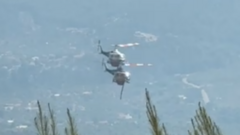
The fatal collision of two firefighting aircraft is not merely a tragedy of circumstance; it is a predictable outcome of high-density aerial operations within volatile, high-stakes environments. When analyzing such incidents, we move beyond the immediate event to examine the interplay between environmental physics, operational doctrine, and equipment constraints. The primary mechanism of failure in these scenarios is the compression of safety buffers caused by the urgent, localized demand for suppression capacity in complex terrain.
The Operational Environment and Collision Mechanics
Aerial firefighting often requires pilots to operate at the edge of the flight envelope. The physics of firefighting—dropping water or retardant—requires low-altitude, low-airspeed maneuvers in mountainous or uneven terrain. This creates three distinct operational pressures:
- Vertical Obstruction Density: Maneuvering in canyons or near ridgelines reduces the available lateral and vertical space, forcing flight paths into predictable "channels."
- Atmospheric Turbulence: The heat generated by a wildfire creates intense updrafts and downdrafts. These thermal columns render aircraft handling inconsistent, necessitating constant, high-frequency control inputs.
- The Proximity Requirement: Operational effectiveness is directly proportional to target accuracy. Delivering water from a higher altitude significantly increases evaporation and dispersion, forcing pilots to drop from lower levels to ensure payload impact.
When multiple aircraft operate in the same sector, the "deconfliction zone" shrinks. A tactical collision typically occurs when the synchronization between pilot visual cues and ground-based target designation fails, or when a pilot loses situational awareness due to the smoke-induced reduction in visual flight references (VFR).
The Economics of Tactical Risk
The decision to commit aerial assets to a fire follows a cost-benefit calculation that often favors urgency over absolute safety margins. Fire suppression is a time-sensitive utility. The "Extended Attack" phase of a fire—when initial suppression efforts fail—triggers a surge in resource demand.
The strategy hinges on the concept of "concentrated output." Commanders push for maximum density in fire retardant drops to stop the spread. This creates a bottleneck. When a, say, 20-minute window of favorable weather exists, every aerial unit is pressured to execute its mission immediately. This creates a massive accumulation of kinetic energy in a restricted airspace. The risk of collision is a function of the number of assets multiplied by the frequency of passes, divided by the available maneuvering volume.
Human Factors in High-Stress Systems
In aviation, the "Swiss Cheese Model" of error suggests that accidents occur when multiple safety layers align to allow a failure. In aerial firefighting, these layers are often thinner than in commercial aviation.
- Cognitive Load: Pilots must manage flight controls, monitor turbulent airflow, track ground crew signals, and maintain separation from other aircraft, all while contending with heat and smoke. This saturates the pilot's decision-making bandwidth.
- Normalization of Deviance: When pilots operate safely in tight formations repeatedly, the threshold for what is considered "risky" shifts. Procedures that were once documented as emergency measures become standard practice to increase efficiency.
- Communication Latency: In a high-noise, high-stress environment, the time required to verbalize a position or a move often exceeds the time available to avoid a collision. Pilots frequently rely on visual acquisition rather than radio-based separation.
Analyzing the Collision Event
In the case of the Greek incident involving the CL-215, the structural reality involves an aging airframe design. The Canadair CL-215 is a specialized aerial firefighting tool designed for scooping water from open water sources and dropping it on fires. These aircraft lack the sophisticated TCAS (Traffic Collision Avoidance System) suites found in commercial aviation because of the nature of the flight path—frequent, extremely low-altitude maneuvers would trigger constant, unnecessary alerts.
Instead, safety is managed through:
- Procedural Separation: Assigning specific altitudes or sectors to different aircraft types.
- Mission Staggering: Ensuring aircraft follow a set orbit or "race track" pattern.
When these patterns are disrupted—due to a change in wind direction, a sudden shift in fire behavior, or a radio failure—the entire system must reconfigure in seconds. If the re-sequencing of aircraft is not executed with absolute precision, the risk of interception increases exponentially.
Tactical Asset Allocation Constraints
The industry relies on a mix of fixed-wing aircraft and helicopters. Helicopters offer high precision but lower capacity; fixed-wing aircraft offer high volume but require more airspace to execute a run. Coordinating the two requires a tiered tactical approach:
- Fixed-wing dominance: Used for building large-scale containment lines with retardant.
- Rotary-wing precision: Used for "hot spotting" or targeting specific flames that escaped the main line.
The conflict arises when the two zones overlap. If a rotary-wing pilot moves into a fixed-wing drop path to address a flare-up, they enter a "collision corridor." The mitigation strategy must be a rigid enforcement of the "Incident Air Traffic Control" (IATC) protocol, where one designated lead pilot or a ground-based observer has unilateral authority to halt all movement. The failure of this authority structure is the primary antecedent to mid-air contact.
Resource Lifecycle and Operational Safety
Ageing fleets introduce another layer of risk. Maintenance cycles for aircraft subjected to the physical abuse of water scooping and low-level turbulence are more intensive than those for standard transport aircraft. Structural fatigue and the degradation of control surface responsiveness in older airframes reduce the margin for error. A pilot who needs a split-second climb to avoid an obstruction may find that an older airframe lacks the instantaneous power-to-weight performance of a modern system.
Recommendations for Operational Hardening
To decrease the probability of future collisions, agencies must implement a shift from reactive to systemic risk management:
- Mandate Digital Traffic Visualization: Deploy portable, lightweight ADS-B (Automatic Dependent Surveillance-Broadcast) units specifically tuned for low-altitude firefighting. While this will produce many nuisance alerts, it provides a crucial layer of situational awareness that the human eye cannot match in smoke-heavy environments.
- Standardize Airspace Geometry: Move toward "geometric separation" where mission profiles are pre-programmed into a digital map available to all pilots in the sector, preventing the drift of aircraft into unauthorized flight corridors.
- Limit Simultaneous Density: Instead of maximizing the number of drops per hour, cap the number of aircraft within a specific, high-risk sector. Accept a marginal increase in fire spread time as a necessary trade-off to eliminate collision risk.
- Decouple Suppression Tactics: Require a mandatory 30-second temporal buffer between the withdrawal of one aircraft and the entry of another, even if the terrain requires rapid, sequential drops.
The objective is to institutionalize delay. Speed in firefighting is the enemy of safety. By enforcing a mandatory operational tempo, the burden on the pilot to manage collision risk is reduced, allowing the focus to remain strictly on flight performance and fire suppression. Success in this field will be measured not by the speed of containment, but by the maintenance of separation integrity under the most extreme environmental conditions.