The convergence of industrial-scale solar production and traditional American agriculture represents a fundamental shift in land-use economics, yet the viability of this model is entirely dependent on the stability of federal tax credits and trade protectionism. When political administrations pivot on green energy mandates, the underlying financial models for "agrivoltaics" and utility-scale rural solar do not merely soften; they frequently collapse under the weight of high capital expenditure (CAPEX) and variable interest rates. The current friction between the American agricultural sector and shifting federal mandates is a study in policy-induced market distortion.
The Economic Logic of Dual-Use Land Management
Farmers opting for solar installations are engaging in a hedge against the volatility of commodity crop prices. The traditional agricultural revenue model is subject to biological yield risk, weather events, and global trade fluctuations. Solar leasing or ownership offers a predictable, fixed-income stream—effectively a 20-to-25-year annuity. Read more on a connected subject: this related article.
The decision to transition acreage from corn or soy to solar panels is governed by the Net Present Value (NPV) of the land. This calculation includes:
- Levelized Cost of Energy (LCOE): The total cost of building and operating the solar asset over its lifetime divided by the total energy produced.
- Solar Irradiance and Interconnection: The proximity to high-voltage transmission lines determines whether the energy produced can actually reach the grid without prohibitive infrastructure costs.
- Opportunity Cost of Agriculture: The lost revenue from crop production, minus the variable costs of seed, fertilizer, and diesel.
The Three Pillars of Solar Policy Risk
The transition from a supportive regulatory environment to one characterized by skepticism or outright hostility creates three distinct bottlenecks for the agricultural producer. Additional journalism by Reuters Business delves into similar perspectives on the subject.
1. The Investment Tax Credit (ITC) Erosion
The federal Investment Tax Credit has historically allowed developers and landowners to deduct a significant percentage of solar system costs from their taxes. When the executive branch signals a move away from these incentives or introduces sunset clauses, the internal rate of return (IRR) for a farm-based solar project drops below the threshold required by commercial lenders. Without the 30% ITC, many projects fail the debt-service coverage ratio (DSCR) tests required for financing.
2. Trade Tariffs and Supply Chain Inflation
The solar industry is uniquely sensitive to Section 201 and 301 tariffs on imported photovoltaic (PV) modules. When an administration imposes or increases tariffs on Chinese-made silicon cells—often under the guise of protecting domestic manufacturing—the immediate result is a spike in the CAPEX for American farmers. If domestic manufacturing capacity cannot meet demand at a competitive price point, the farmer is caught in a pincer movement: higher equipment costs and diminishing federal subsidies.
3. State-Level Preemption and Zoning Friction
While federal policy sets the financial tone, local "Home Rule" and state-level zoning laws dictate execution. Recent shifts in the political climate have emboldened local boards to pass restrictive ordinances or moratoriums on solar development to "protect agricultural character." This creates a fragmented regulatory environment where a project on one side of a county line is a viable asset, while the same project across the border is an illegal land use.
The Cost Function of Regulatory Uncertainty
Uncertainty acts as a silent tax on development. When a farmer enters a solar lease, they often sign an option agreement that can last three to five years before construction begins. During this "pre-construction phase," the developer is spending capital on engineering, environmental studies, and grid interconnection queues.
If the rules change mid-cycle—such as a change in the Department of the Treasury's interpretation of "domestic content" requirements—the project’s financial model must be entirely rebuilt. This often leads to the "zombie project" phenomenon: thousands of acres of farmland tied up in legal and financial limbo, neither producing food nor generating electricity.
Structural Vulnerabilities in Rural Interconnection
The American power grid was not designed for distributed generation in rural areas. It was designed for large, centralized power plants (coal, gas, nuclear) to push energy outward to population centers. Farmers attempting to "bet on solar" face the Interconnection Queue Bottleneck.
- Upgrade Costs: If a farmer’s local substation cannot handle the 20MW output of a new solar array, the utility often mandates that the farmer/developer pay for the substation upgrade.
- Thermal Constraints: During peak production hours (midday), rural lines can overheat if they are pushed beyond their rated capacity.
- Voltage Regulation: Fluctuations in solar output due to cloud cover require expensive inverter technology to prevent destabilizing the local distribution grid.
When federal support for grid modernization is de-emphasized in favor of fossil fuel parity, these infrastructure costs are shifted entirely onto the landowner and the developer, often totaling millions of dollars before a single panel is installed.
The False Dichotomy of Food vs. Fuel
Critics of rural solar often cite the loss of prime farmland as a threat to national food security. However, this argument ignores the Marginal Land Reality. Data indicates that most farmers are not putting their highest-yielding "Class I" soil under glass; they are targeting marginal areas with lower drainage capacity or poor nutrient profiles where the "solar crop" is more profitable than a low-yield corn crop.
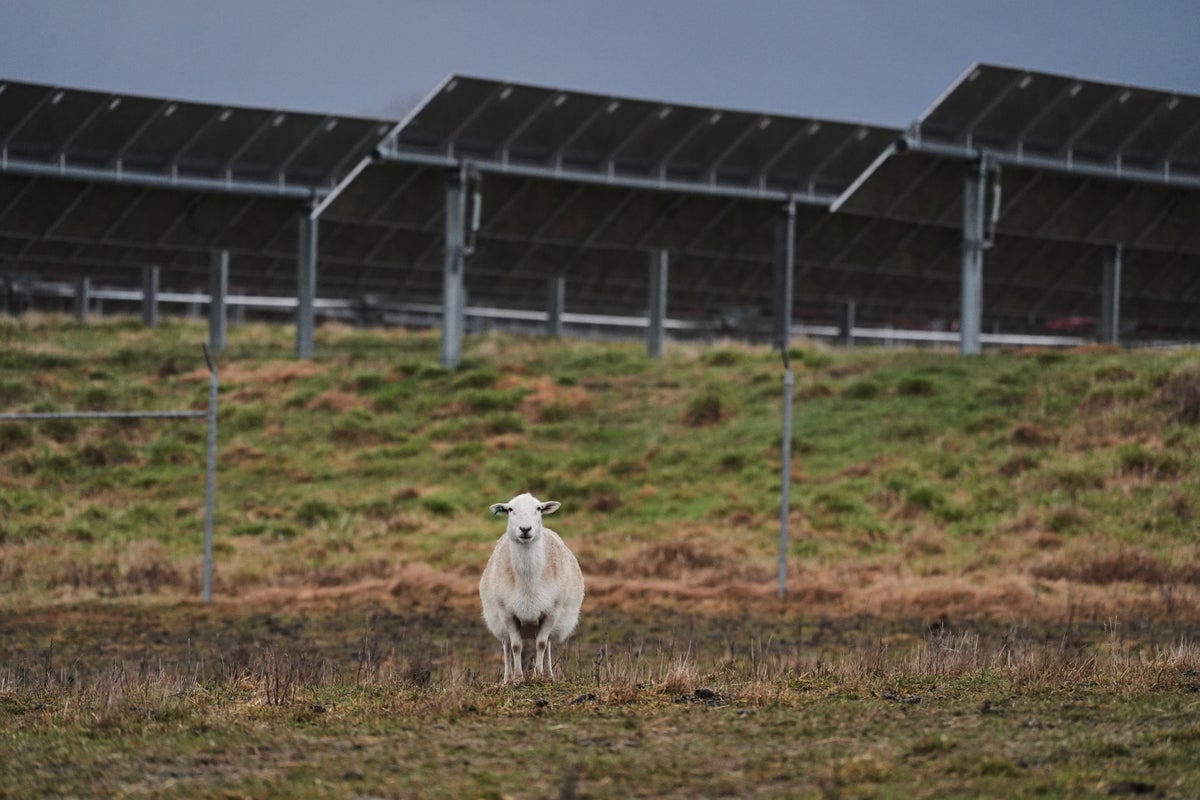
Furthermore, the emergence of Agrivoltaics—the practice of growing crops or grazing livestock beneath solar panels—challenges the zero-sum narrative. Sheep grazing, for example, serves as a dual-revenue stream and a biological maintenance strategy, reducing the need for mechanical mowing or chemical herbicides.
Logical Failure Points in Federal Pivot Strategies
When a new administration attempts to "change the rules" to favor traditional energy, they often overlook the legal durability of existing Power Purchase Agreements (PPAs). A PPA is a long-term contract between the energy producer (the farmer) and the off-taker (a utility or corporation).
A shift in federal rules cannot easily break these private contracts, but it can make the refinancing of these projects impossible. Most solar projects are financed with "mini-perm" loans that require refinancing every 5–7 years. If federal policy has shifted toward high-interest rates for renewables or has removed the tax equity markets by the time a farmer needs to refinance, the project faces a "maturity wall" that can lead to foreclosure and the decommissioning of the site.
Navigating the Decoupling of Energy and Agriculture
The strategic play for the American farmer is no longer a simple "bet" on green energy; it is a sophisticated exercise in multi-generational risk management. To insulate themselves from the volatility of federal rule changes, operators must move toward "Behind the Meter" (BTM) applications.
Rather than selling energy back to a grid governed by shifting federal mandates, farmers are increasingly using solar to power their own energy-intensive operations—grain drying, cold storage, and irrigation. By reducing their own operational expenditure (OPEX) through self-generation, they bypass the regulatory risks associated with utility-scale energy sales.
The second defensive maneuver involves Lease Structuring for Decommissioning. To avoid being left with a field of obsolete silicon and steel if a developer goes bankrupt due to policy shifts, farmers must demand upfront decommissioning bonds. These are third-party guaranteed funds that ensure the land can be returned to its original agricultural state at no cost to the landowner.
The future of the rural energy market is not a return to 20th-century coal dominance, nor is it a seamless transition to a green utopia. It is a high-stakes competition for land use where the winner is determined by who can most effectively navigate the friction between physical infrastructure and political caprice. Success requires an aggressive move away from reliance on federal "carrots" and toward an infrastructure-first model that prioritizes local energy resilience and private contractual certainty.