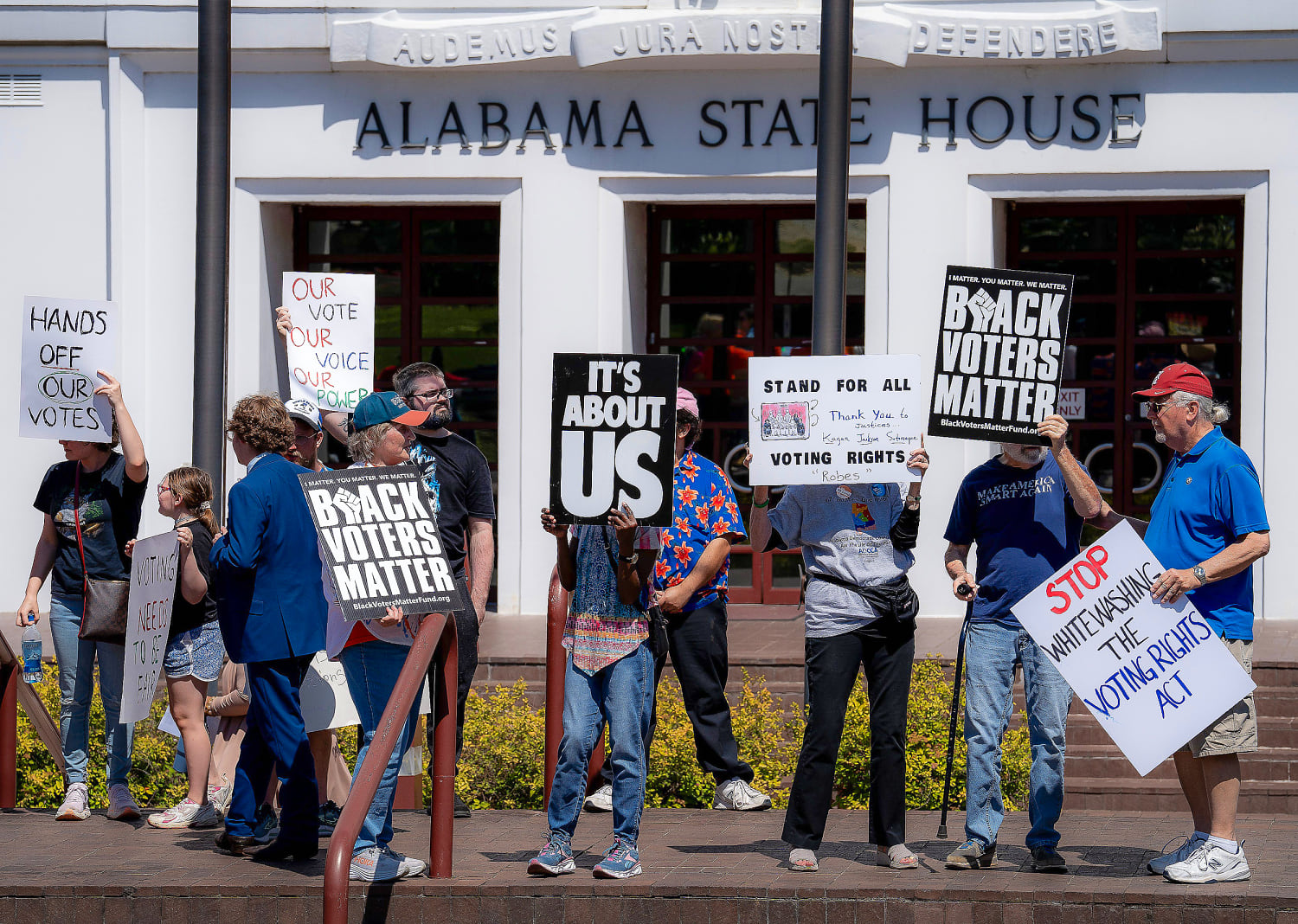
Alabama Republicans thought they found a loophole to reclaim a crucial congressional seat just in time for the 2026 midterms. A federal court just slammed that door shut, at least for now.
In a searing, unanimous ruling, a three-judge panel blocked Alabama from using a GOP-drawn congressional map that explicitly aimed to dismantle a second majority-Black voting district. The court didn't mince words. They called the state’s plan "tainted by intentional race-based discrimination."
If you feel like you’ve read this exact headline before, you aren't crazy. Alabama has been fighting federal courts over its district lines since the 2020 census data dropped. This latest blowup is a direct consequence of a chaotic legal game of ping-pong between local federal judges and a highly unpredictable U.S. Supreme Court.
The Whack-A-Mole History of Alabama’s Maps
To understand why this Tuesday ruling matters, you have to look at the sheer audacity of how state lawmakers got here. Back in 2021, Alabama drew a map with only one majority-Black district, despite the state's population being roughly 27% Black. Voting rights groups sued, arguing the map illegally diluted Black political power.
A three-judge federal panel agreed and ordered the state to create a second district where Black voters had a fair shot at electing their preferred candidate. Instead of complying, the Republican-led legislature came back in 2023 with a map that basically flipped the bird to the court, refusing yet again to add that second district.
The court was furious. It stripped the state of its map-making power and appointed a independent special master to draw a fair map. That court-ordered map was used in 2024, resulting in the election of Democratic U.S. Representative Shomari Figures in the newly created 2nd Congressional District.
Everything seemed settled until April 2026, when the Supreme Court dropped a bomb on voting rights nationwide.
How Louisiana Changed the Rules of the Game
Everything flipped because of a separate Supreme Court case called Louisiana v. Callais. In that decision, the conservative majority on the high court gutted major aspects of how Section 2 of the Voting Rights Act is applied, making it significantly harder for minority voters to prove vote dilution.
Alabama’s Republican leadership saw an immediate opening. Within days of the Callais ruling, the state took the unprecedented step of moving its upcoming congressional primary timelines. They rushed to reinstate their failed 2023 map, betting that the Supreme Court’s new posture would shield them from legal consequences. Governor Kay Ivey even set special primaries for August 11 for the four districts that would be warped by the change.
State Attorney General Steve Marshall defended the move, calling the discriminatory 2023 map "blandly unobjectionable."
But the state’s gamble just hit a massive speed bump. The three-judge panel—comprising Circuit Judge Stanley Marcus, District Judge Anna Manasco, and District Judge Terry Moorer—revisited the 2023 map and focused on a crucial distinction: intentional discrimination.
Intent Matters and the Judges Stood Their Ground
While the Supreme Court’s Callais decision made it tougher to fight maps based on general statistical dilution, Justice Samuel Alito noted in that majority opinion that maps drawn with an explicit intent to discriminate could still be struck down. The Alabama panel took that note and ran with it.
The judges ruled that when Alabama lawmakers passed the 2023 plan, they knew exactly what they were doing. They deliberately chose to deny Black voters representation, ignoring a direct court order to fix the problem.
"When the Legislature enacted the 2023 Plan, it made a calculated, purposeful decision to refuse to provide the remedy for discriminatory vote dilution that our order required," the panel wrote in its decision. "We again cannot understand the 2023 Plan as anything other than intentionally discriminatory."
The state tried to argue that its map was driven purely by partisan politics—trying to maximize Republican seats—rather than race. The court flatly rejected that defense. They noted that the state intentionally distributed Black voters across specific districts to neutralize their voting power precisely because of their race.
What This Means for the 2026 Midterms
The immediate impact is logistical sanity for Alabama voters. Changing district boundaries while an election cycle is actively happening is a recipe for absolute disaster. Absentee voting for the primaries had already begun under the 2024 lines, and scrambling the boundaries mid-stream would require an expensive, logistically nightmarish voter reassignment effort.
For now, the court-ordered 2024 map remains in place. This means the August special primaries called by Governor Ivey are effectively canceled, and the standard election cycle will proceed under the two-district framework that favors a more balanced representation.
This is a massive short-term win for national Democrats and voting rights advocates. The GOP holds a razor-thin majority in the U.S. House of Representatives, and President Donald Trump has been actively pushing Southern states to redraw lines to secure safer Republican seats ahead of November. Keeping Alabama's second majority-Black district intact keeps Shomari Figures’ seat safe and prevents an easy pickup for the GOP.
Don't expect Alabama to pack up and go home, though. Attorney General Steve Marshall announced the state will immediately appeal this injunction to the Supreme Court. Given the high court's recent track record of chipping away at voting rights, this fight is going right back to Washington. Voters and organizers in Alabama shouldn't change their strategies just yet; they need to keep running campaigns on the ground while the lawyers duke it out at the highest level.


