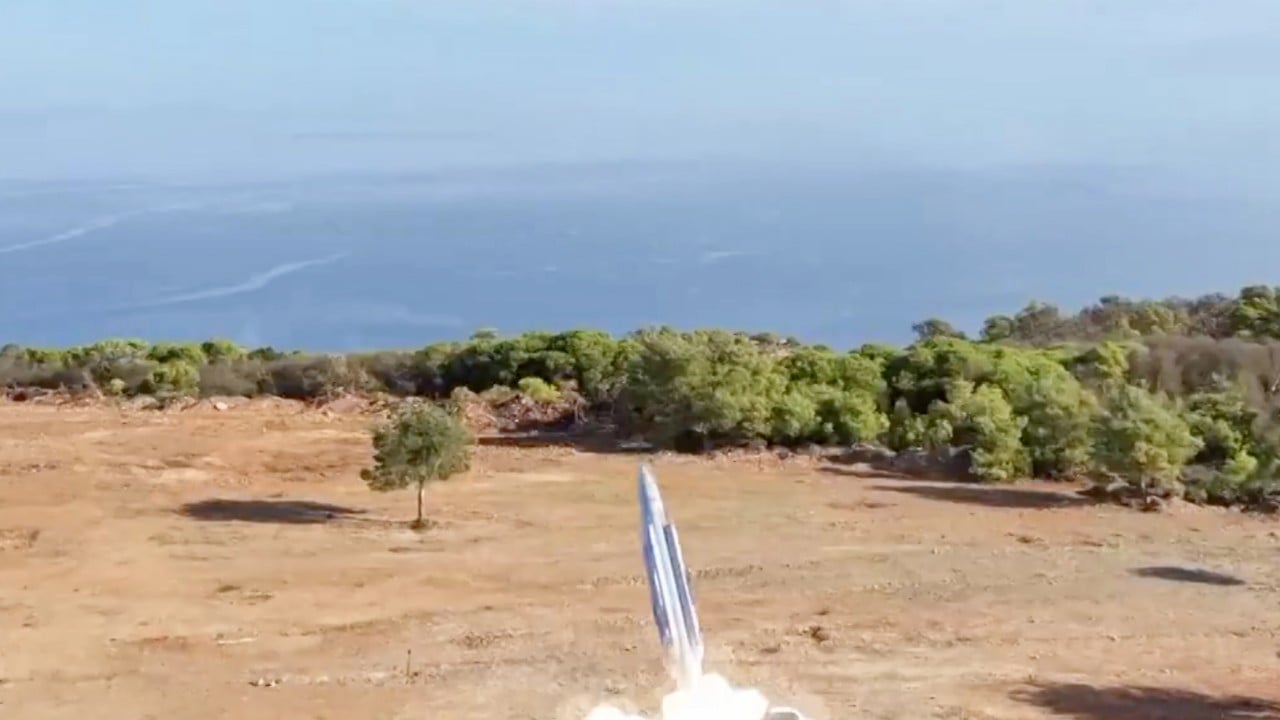
Algerian naval forces recently launched an apparent Chinese-made YJ-12B coastal defense missile during a live-fire exercise in the Mediterranean, sending a sharp, supersonic warning across one of the busiest maritime chokepoints on earth. The drill, broadcast on state television, confirmed what defense analysts have suspected for years. Algiers is no longer content with coastal patrol boats and legacy Soviet hardware. By integrating a Mach 3 sea-skimming weapon capable of striking targets hundreds of kilometers offshore, the Algerian military has fundamentally altered the naval balance in North Africa and the Western Mediterranean.
Most surface-level coverage treats this test as just another routine military exercise or a simple arms sale milestone. That misses the real story. To understand why a Ramjet-powered anti-ship missile just screamed over the Alboran Sea, you have to look at three converging pressures: a simmering cold war with neighboring Morocco, an intense European scramble for North African natural gas, and Beijing's quiet strategy to arm Western-adjacent states without triggering direct American sanctions.
Anatomy of a Carrier Killer
The weapon at the center of the footage is the YJ-12B, the land-based coastal defense variant of China's air-launched YJ-12 anti-ship cruise missile. Exported under the designation CM-302, this is not a subtle piece of hardware. It is a heavy, brutalist instrument designed for one purpose: saturating and overwhelming modern naval air defenses before a ship's crew can react.
Unlike older subsonic missiles such as the American Harpoon or the French Exocet, which cruise just below the speed of sound and give target vessels several minutes of radar warning, the YJ-12B relies on a liquid-fuel ramjet engine. Once booster rockets kick the missile up to supersonic speed, the ramjet takes over, breathing atmospheric oxygen to sustain speeds between Mach 2.5 and Mach 3 at sea-skimming altitudes. At high altitudes, it can push past Mach 4.
The math for a defending warship is unforgiving. Because of the curvature of the earth, a ship's mast-mounted radar generally cannot detect a sea-skimming target until it closes within roughly 30 to 40 kilometers. At Mach 3, a missile covers one kilometer every second. That leaves a frigate or destroyer with barely 30 seconds to detect the incoming threat, classify it, assign interceptors, and fire.
The Terminal Maneuver Problem
Speed is only half the equation. The YJ-12B carries a warhead weighing roughly 200 to 250 kilograms—heavy enough to break the back of a mid-sized frigate or mission-kill an aircraft carrier—and executes violent, high-G corkscrew maneuvers during its final approach. This erratic terminal phase is specifically engineered to defeat Close-In Weapon Systems (CIWS) like the Phalanx gatling gun or rolling airframe missiles, which rely on predicting a target's trajectory to put a wall of lead in front of it.
Consider a hypothetical scenario in the Western Mediterranean. Suppose a European naval task force is operating 150 kilometers off the Algerian coast. With older coastal batteries, those ships would sit comfortably outside the threat envelope, conducting surveillance or maritime interdiction with zero risk from shore. With the CM-302 deployed along the Algerian littoral, that entire stretch of water becomes an active engagement zone. The missile's export range is officially capped at 290 kilometers to comply with international Missile Technology Control Regime (MTCR) guidelines, though defense engineers widely acknowledge that range limits on liquid-fuel ramjets are often a matter of software programming rather than physical fuel capacity.
The Moroccan Trigger
Military hardware rarely moves in a vacuum. To understand why Algiers spent hundreds of millions of dollars on mobile coastal defense batteries, look west toward Rabat.
Algeria and Morocco have been locked in an escalating arms race since diplomatic relations collapsed completely in 2021. The dispute centers on the Western Sahara, a territory Morocco administers and claims as its sovereign southern provinces, while Algeria backs the pro-independence Polisario Front. For decades, this conflict remained frozen behind a fortified sand berm. That stability evaporated when Morocco normalized relations with Israel under the Abraham Accords in late 2020, unlocking access to advanced Israeli drones, electronic warfare suites, and air defense systems, alongside American F-16 upgrades and HIMARS rocket artillery.
Algiers watched its neighbor rapidly modernize its armed forces with Western and Israeli tech. Simultaneously, the Royal Moroccan Navy has invested heavily in modern European frigates, including the French-built FREMM class Mohammed VI and Dutch-built Sigma-class corvettes. These are capable, modern warships equipped with advanced radar and vertical launch systems.
The YJ-12B is Algeria's asymmetric answer to Morocco's surface fleet. Rather than trying to match Rabat ship-for-ship—a slow, wildly expensive proposition—Algiers bought mobile, road-bound missile batteries that can hide in the rugged coastal terrain of the Tell Atlas mountains, roll out to a firing position, launch a salvo, and vanish before counter-battery strikes arrive. In a conflict, Morocco's premier naval assets would be pinned down or forced to operate far out in the Atlantic, well away from the Strait of Gibraltar and the Algerian coastline.
Europe's Uncomfortable Energy Reality
The geopolitical ripples extend far beyond North Africa. Every time Algeria tests a high-end anti-ship missile in the Mediterranean, naval planners in Madrid, Paris, and Rome take notice.
Following the disruption of Russian pipeline gas to Europe, Algeria became one of the European Union's most vital energy lifelines. Subsea pipelines like the Medgaz (running directly from Beni Saf in Algeria to Almeria in Spain) and the TransMed (connecting Algeria to Italy via Tunisia) pump billions of cubic meters of natural gas into European power grids every year. Alongside these pipes sit massive liquefied natural gas (LNG) terminals at Arzew and Skikda.
The YJ-12B batteries sit directly over this infrastructure. While Algiers has every financial incentive to keep the gas flowing—hydrocarbons account for over 90 percent of its export revenues—the deployment gives the Algerian military immense coercive leverage. By establishing an Anti-Access/Area Denial (A2/AD) bubble over the Alboran Sea and the Balearic Basin, Algeria ensures that no foreign navy, whether Spanish, French, or American, can project power near its territorial waters without assuming massive risk.
Spain is particularly sensitive to this shift. Relations between Madrid and Algiers soured dramatically in 2022 when the Spanish government reversed decades of neutrality and endorsed Morocco's autonomy plan for the Western Sahara. Algiers responded by suspending a 20-year friendship treaty and freezing trade. While diplomatic ties have slowly begun to thaw, the sight of Chinese-made supersonic missiles roaring off the Algerian coast serves as a blunt reminder to Madrid of who controls the southern flank of the Western Mediterranean.
Beijing's Quiet Foothold on NATO's Doorstep
For decades, Russia was Algeria's undisputed arms supplier, providing upwards of 70 to 80 percent of the country's military hardware. From Su-30MKA fighter jets to Kilo-class submarines and S-400 air defense systems, the Algerian People's National Army was a showcase of Soviet and Russian doctrine.
That monopoly is cracking. Russia's invasion of Ukraine strained Moscow's defense industrial base, delaying spare parts and export deliveries as factories prioritized the front lines in Donbas. At the same time, buying major Russian weapons systems carries the constant threat of secondary American sanctions under the Countering America's Adversaries Through Sanctions Act (CAATSA).
China stepped directly into that void. Beijing offers high-end, battle-ready systems without the political lectures attached to Western arms sales and without the immediate sanctions tripwire of Russian gear. Over the past few years, Algeria has quietly become one of China's premier defense customers, acquiring:
- CH-4 and WJ-700 armed drones for persistent surveillance and strike missions along its vast desert borders.
- Type 056 corvettes and C28A stealth frigates, built in Chinese shipyards to modernize the Algerian surface fleet.
- SR-5 multiple launch rocket systems and PLZ-45 self-propelled howitzers to bolster ground firepower.
- The YJ-12B coastal defense system, which ties its naval and land-based sensors into a unified coastal strike network.
This is a major strategic win for Beijing. By putting the CM-302 into Algerian hands, China has effectively placed a capable anti-ship deterrent right on NATO's southern doorstep. Every time Algeria conducts a live-fire exercise with these missiles, Chinese military advisors and engineers gather invaluable telemetry data on how the systems perform in the dense electromagnetic environment of the Mediterranean—an area heavily monitored by NATO reconnaissance aircraft and naval vessels.
The Kill Chain Problem Nobody Mentions
If you only read defense brochures, the YJ-12B looks unstoppable. Veteran naval analysts know better. A supersonic missile is only as good as the kill chain behind it—the network of radars, satellites, drones, and data links required to find, track, and target a moving ship 250 kilometers away.
Firing a missile at a stationary target barge during a choreographed state-TV drill is one thing. Hitting an evading warship using active electronic jamming in rough seas is an entirely different operational challenge.
Because of the earth's curvature, a ground-based radar sitting on the Algerian coast cannot see a ship 200 kilometers away. To fire the YJ-12B at its maximum effective range, Algeria relies on over-the-horizon targeting. This requires airborne early warning aircraft, maritime patrol planes, unmanned aerial vehicles, or satellite reconnaissance to feed real-time coordinates back to the mobile launcher on shore. Once the missile is in the air, it flies toward those predicted coordinates before activating its own onboard active radar seeker for the final terminal dive.
This is Algeria's primary vulnerability. While the missile itself is terrifyingly fast, the sensor network required to guide it over the horizon is fragile. In a high-intensity conflict against a technologically sophisticated adversary, those surveillance drones and patrol aircraft would be the very first targets shot down or blinded by electronic warfare. Without external targeting data, the YJ-12B is restricted to the radar horizon of its ground-based sensors—cutting its effective range down to roughly 40 or 50 kilometers.
A New Reality in the Alboran Sea
Even with those targeting limitations, the strategic calculus in the Western Mediterranean has permanently changed. You do not need to sink an entire fleet to achieve deterrence; you only need to make the cost of entering an area unacceptably high.
By publicly broadcasting the YJ-12B launch, Algiers sent an unmistakable signal to Rabat, Madrid, Paris, and Washington. The era when Western navies could treat the southern Mediterranean as a permissive operating environment is over. Every naval commander transiting the Strait of Gibraltar now has to factor Mach 3 sea-skimming missiles into their threat matrix, forcing warships to burn more fuel, run active radars continuously, and keep combat air patrols aloft.
Algiers has successfully imported a piece of China's Pacific anti-access doctrine and planted it firmly on the shores of North Africa, turning a narrow stretch of blue water into a contested firing range.