The map on the wall of the old maritime office in St. John’s has faded at the edges, salt air having eaten away at the ink where the Atlantic crashes against the Newfoundland coast. For generations, people here looked across that dark, cold water toward Europe not as a distant abstraction, but as kin, market, and lifeline. They knew the rhythms of the tides and the weight of a handshake sealed over cod or iron ore.
Today, that map is trembling.
Across the globe, the gravitational pull of traditional alliances is shifting. In capitals from Ottawa to Brussels, seasoned policymakers and economists are waking up to a stark, unvarnished reality: the architecture of international order built after the Second World War is being dismantled from the inside out. When Donald Trump casts a transactional shadow over global trade, threatening tariffs that treat longtime allies like economic adversaries, the tremors reach far beyond Washington boardrooms. They hit the kitchen table in Ontario, the shipyard in Hamburg, and the parliament hill in Ottawa.
Enter Mark Carney.
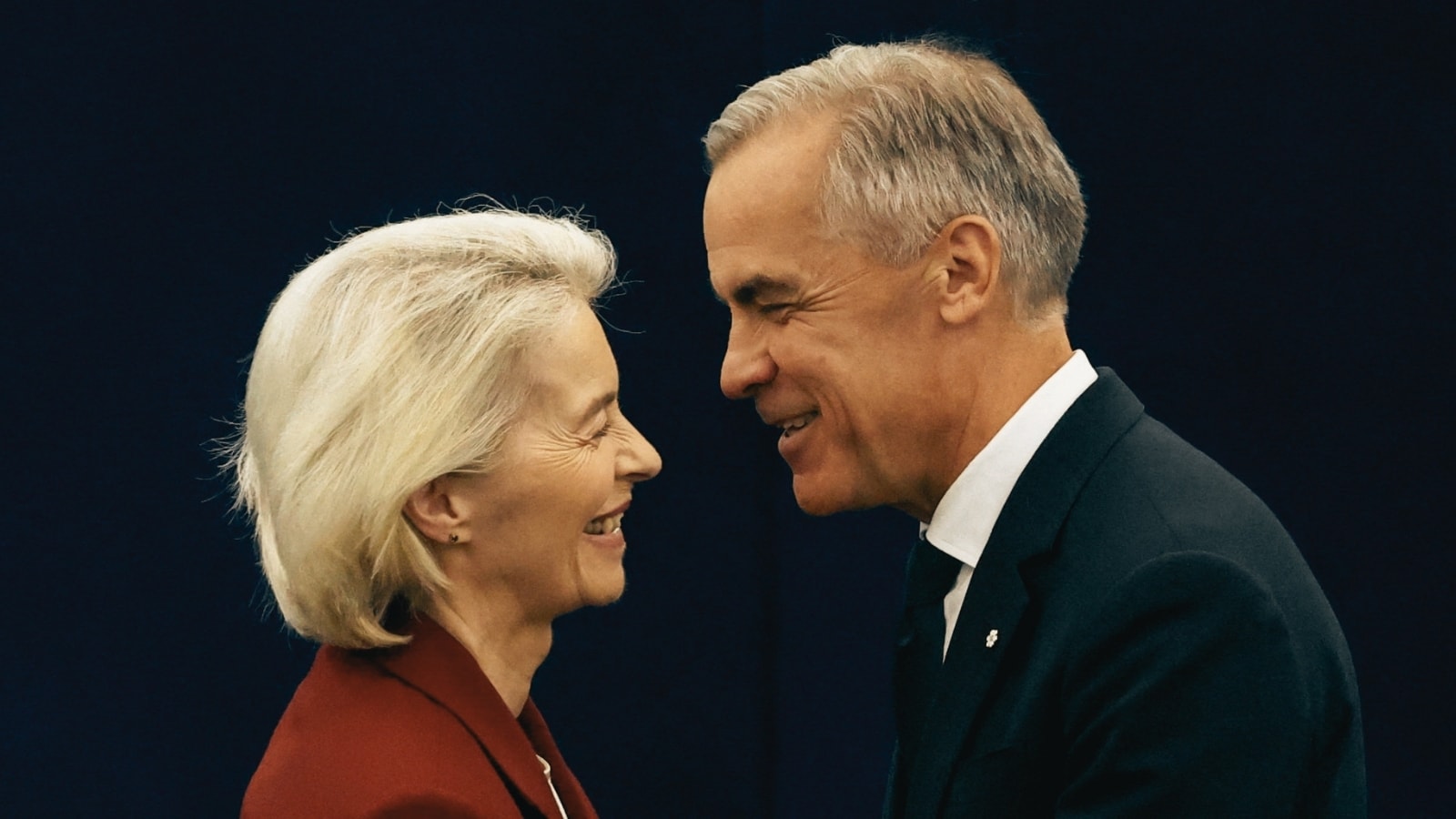
To understand why Carney’s recent call for a defensive economic and democratic pact between Canada and the European Union matters, you have to look past the dry language of trade deficits and communiqué drafts. You have to look at the vulnerability of middle powers caught between colliding superpowers. Carney, a man who has steered both the Bank of Canada and the Bank of England through economic tempests, speaks not as a starry-eyed idealist, but as a central banker who has seen the ledgers bleed.
He knows what happens when trade weapons are drawn.
Consider the hypothetical small-town manufacturer in Quebec producing specialized aerospace components. For decades, that business thrived on predictable borders, trusted supply chains, and rules-based commerce. Overnight, a stroke of a pen in a foreign capital can impose a twenty percent levy, rendering their margins negative and forcing layoffs in a community where everyone shares a hockey rink and a last name. This is the human cost of isolationism and economic nationalism. It is quiet. It is slow. And then, suddenly, it is devastating.
Carney’s counterpunch is not merely a diplomatic maneuver. It is an urgent architectural blueprint for survival.
For years, middle powers like Canada and the nations of the European Union have suffered from a collective illusion. They believed that the momentum of globalization was self-sustaining, that institutions like the World Trade Organization were permanent fixtures of civilization rather than fragile human constructs maintained by mutual consent. That illusion has shattered. When the United States—long the anchor of the liberal democratic order—turns inward, viewing alliances through the harsh lens of short-term extraction rather than long-term security, the middle powers are left exposed.
They have two choices. They can wait in the cold, hoping to appease an unpredictable hegemon through quiet diplomacy and concessions. Or they can build something new. Together.
The logic of a Canada-EU democratic alliance rests on a foundation of shared values and complementary wealth. Canada possesses the critical minerals, the clean energy potential, the vast agricultural output, and the strategic Arctic coastline that Europe increasingly needs as it decouples from authoritarian suppliers. Europe possesses a market of four hundred and fifty million affluent consumers, advanced industrial depth, and regulatory sovereignty that matches Canada’s commitment to labor rights, environmental protection, and democratic norms.
Yet, forging this bond requires political courage that is currently in short supply.
Look at Ottawa. For generations, Canadian foreign policy suffered from a comfortable provincialism. We assumed our geography—bounded by three oceans and a friendly giant to the south—guaranteed our safety. That geographic cushion is dissolving. Climate change is opening the Arctic, turning our northern frontier into a contested geopolitical chessboard where Russia and China eye shipping lanes with predatory interest. Meanwhile, economic coercion from Washington threatens to hollow out Canadian industry unless alternative markets are secured with absolute urgency.
Carney understands this better than most. He has spent his career in rooms where the air is thin and the stakes are measured in trillions of dollars. When he stands before audiences and argues that middle powers must band together to defend their democracies and economic sovereignty, he is issuing a fire alarm.
He is saying that sovereignty is not a birthright; it is a muscle. If you do not use it, you lose it.
To visualize this alliance, imagine two seasoned sailors lashed together during a nor'easter. Neither is an ocean liner; neither can command the entire sea alone. But bound by a thick line of shared interests, shared law, and shared democratic tradition, they can ride out the waves that would otherwise swamp them individually.
The European Union has spent the last decade learning harsh lessons about dependency. First came the realization that cheap Russian gas was a geopolitical noose. Then came the realization that relying solely on Asian supply chains for critical technology and pharmaceuticals left the continent dangerously exposed to supply shocks and political blackmail. Brussels is in the middle of a historic awakening. They are looking outward, scanning the horizon for reliable partners who share their DNA.
Canada fits that description with startling precision.
Critics will point to the logistical hurdles. They will talk about transatlantic shipping costs, divergent regulatory frameworks, and the sheer inertia of bureaucratic systems. They will argue that proximity dictates trade, and that Canada’s economic destiny is inextricably bound to the United States regardless of who sits in the Oval Office.
They are partially right. Geography is stubborn. You cannot pick Canada up and tow it across the Atlantic.
But economic gravity is not destiny. Markets adapt when survival demands it. When trade barriers go up in one direction, innovators and policymakers must build corridors in the other. The pivot toward Europe is not about turning our backs on our southern neighbor; it is about insurance. It is about ensuring that Canada is never again reduced to a supplicant, begging for exemptions from presidential whims.
There is also a deeper, more intangible element at stake here: the soul of democracy itself.
We tend to speak of democracy as an immovable monument. We forget that it is an ongoing conversation, a fragile trust passed from one generation to the next. When democratic institutions are attacked from without by cyber warfare, disinformation campaigns, and economic coercion, and from within by populism and polarization, the rot spreads quickly.
Authoritarian regimes are watching the fractures in the Western alliance with undisguised glee. They are betting that democracies are too short-sighted, too divided, and too soft to endure a prolonged period of strategic competition. They believe that money talks louder than ballots, and that fear is more potent than freedom.
A strong, institutionalized alliance between Canada and the European Union would shatter that narrative. It would prove that open societies can organize, cooperate, and project strength without sacrificing their core humanitarian values. It would demonstrate that the rule of law can prevail over the rule of the strongman.
We stand at a hinge of history.
The choices made in committee rooms in Brussels and Ottawa over the next few years will echo for decades. Will we retreat into defensive shells, nursing our grievances as the global order fractures into hostile economic blocs? Or will we have the imagination and the audacity to forge new bonds, rewriting the rules of international commerce and security for a complex century?
Mark Carney has pointed the way. His voice carries weight because he speaks not of utopian dreams, but of hard arithmetic and geopolitical survival.
The wind off the Atlantic is bitter tonight. It carries the chill of uncertainty, rattling the windows of coastlines that have known both prosperity and war. But out on the water, lights are burning. Ships are moving. The old ties can be renewed, strengthened, and forged into something unbreakable.
The map is changing. We must draw the lines ourselves.