Cold rain hits aluminum differently than it hits stone.
On a stone cottage in the Scottish Highlands, a November storm sounds muffled, heavy, ancient—like a wool blanket pulled over your head. Inside an insulated aluminum pod perched on a rocky outcrop in Drimnin, that same rain becomes a percussive, metallic symphony, sharp and immediate, reminding you with every drop that only a thin skin of aircraft-grade alloy separates you from the Atlantic gale.
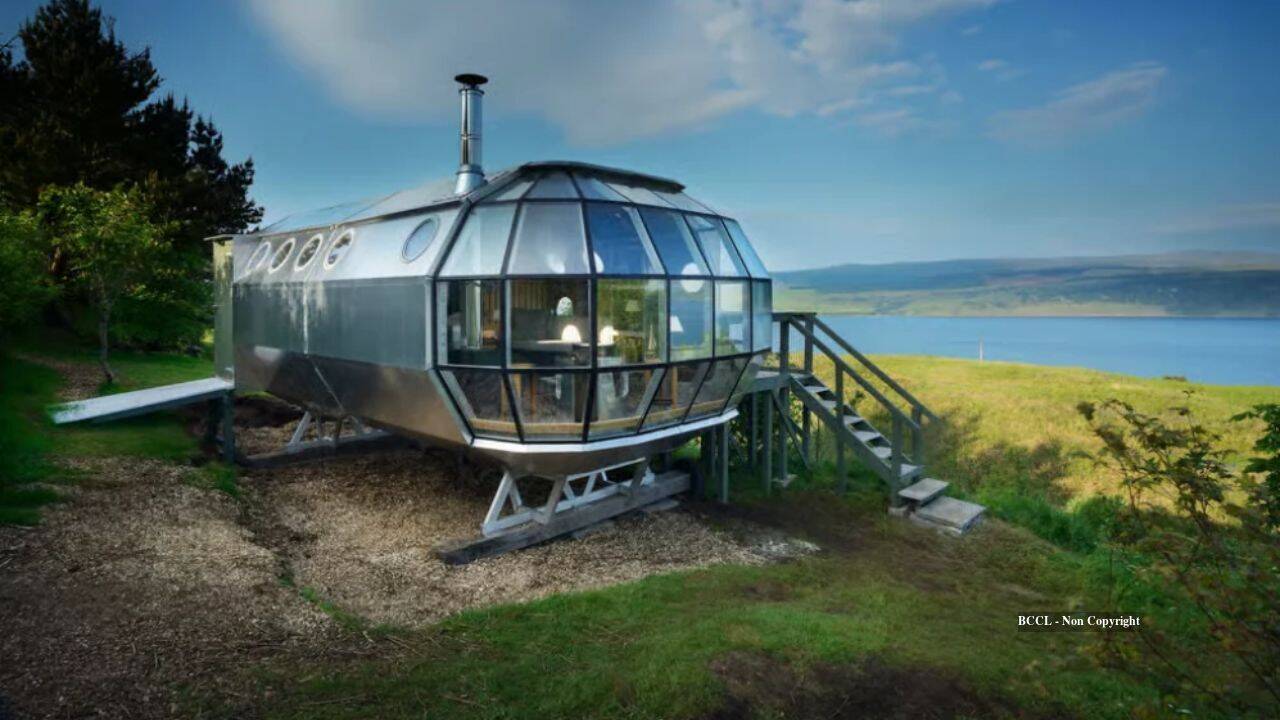
I sat inside AirShip 002 during a late-autumn squall a few years ago, watching the Sound of Mull churn into whitecaps through a curved glass window that looked like the cockpit of a grounded zeppelin. Outside, the wind howled across the Morvern peninsula at forty knots. Inside, a wood-burning stove radiated dry, steady heat while a kettle clicked off on the counter. You do not merely stay in a structure like that. You inhabit a piece of industrial sculpture that happens to have a bed and a flush toilet.
Now, that exact experience—along with the land beneath it and the ledger behind it—is for sale.
The listing price sits at offers over £750,000. On paper, it reads like a routine commercial property notice: a turnkey holiday rental business in Argyll, complete with an iconic architectural pod, adjacent outbuildings, and planning potential on a four-acre coastal plot. Read between the lines of the brochure, though, and you find something far more volatile. You find the precise price tag of modern escapism, and a quiet warning about what happens when an internet-famous fantasy collides with the brutal arithmetic of rural hospitality.
The Architecture of Escape
To understand why anyone would pay three-quarters of a million pounds for a shiny metal tube seven hours north of Edinburgh, you have to understand the man who bent the aluminum.
Roderick James did not set out to build a social media phenomenon. Long before algorithms rewarded symmetrical cabin photos with millions of likes, James was an architect obsessed with small footprints, sustainable timber, and structures that touched the earth lightly enough to be unbolted and hauled away. When he designed the AirShip concept—modular, prefabricated, clad in corrugated aluminum with dragonfly-inspired windows at each end—he was solving a practical problem. Building conventional brick-and-mortar homes in the remote Scottish Highlands is a logistical nightmare. Concrete trucks get stuck on single-track roads; builders charge premiums to travel; winter weather stalls foundations for months.
A pod built off-site and craned onto concrete pads bypassed the chaos.
When AirShip 002 landed on its granite perch overlooking the Sound of Mull, it looked like a benevolent alien craft that had decided to retire near Tobermory. The interior was warm plywood, curved ribs, and clever storage, contrasting sharply with the industrial exterior. It had a compact kitchen, a shower room, a bedroom tucked into the rear curve, and that famous front window framing the Isle of Mull across the water.
Then came the platforms.
Around the late 2010s, the short-term rental market underwent a violent mutation. Travelers stopped searching for "two-bedroom cottage near Oban" and started scrolling through curated feeds of "unique stays." Airbnb introduced categories specifically built for architectural oddities. Suddenly, location was no longer just about proximity to a pub or a hiking trail; the building itself became the destination.
AirShip 002 became a juggernaut. Influencers booked it months in advance. Design magazines ran spreads on its curved aluminum hull. Guests paid upwards of £200 to £300 a night—sometimes more in peak summer—for the privilege of drinking morning coffee while staring through a giant glass oval at passing ferries and circling white-tailed eagles.
It was a license to print money. Until the math changed.
The Spreadsheet Behind the Sunset
Let us invent a buyer to test the numbers. Call her Claire.
Claire is forty-two, works in London finance, and has spent the last five winters staring at spreadsheets while dreaming of trading her commuter rail pass for waterproof boots and a coastal view. She sees the listing for AirShip 002. Over £750,000. She thinks of her equity in a Zone 3 flat, runs a quick mental calculation, and feels her pulse quicken.
If the pod rents for an average of £250 a night, and Highland tourism is booming, she figures she only needs 200 booked nights a year to gross £50,000. Subtract a little for electricity and cleaning, and she has a self-funding Highland sanctuary that pays her to live in one of the wildest corners of Britain.
Claire’s mistake is the exact mistake that has bankrupted hundreds of lifestyle buyers from Cornwall to Caithness over the past five years. She is confusing gross revenue with survivable cash flow.
Walk through the real ledger of a remote Highland holiday let, and the romance evaporates fast. First, there is the acquisition cost. At offers over £750,000—and competitive bidding in the Highlands often pushes prime coastal plots ten to fifteen percent above the guide price—a buyer is looking at roughly £800,000 before legal fees and Scottish Land and Buildings Transaction Tax. If Claire finances half of that with a commercial holiday-let mortgage at current interest rates, her annual debt service alone will chew through £25,000 to £30,000 before a single guest checks in.
Then come the invisible friction costs of Drimnin.
Drimnin sits at the end of a long, winding, single-track road on the Morvern peninsula. Getting there involves either a lengthy detour around Loch Linnhe or a ferry crossing from Lochaline to Fishnish, or Corran across the narrows. That isolation is precisely what guests pay for. It is also what makes operations punishing.
When a dishwasher breaks in Manchester, a technician arrives that afternoon for ninety pounds. When a pump fails in Drimnin, you are paying mileage rates for a tradesperson to drive two hours each way from Fort William, assuming they have a gap in their schedule before next Tuesday. Changeovers—the frantic four-hour window between one guest leaving at ten in the morning and the next arriving at two—cannot be casually outsourced to a cheap urban cleaning agency. In a community where the permanent population can fit inside a single village hall, reliable housekeeping labor is scarce, fiercely valued, and expensive.
Add commercial waste collection, high-speed satellite internet (because even off-grid dreamers demand smooth video calls), insurance for a non-standard aluminum structure exposed to coastal gales, and the relentless wear and tear of salt air on every hinge, seal, and appliance. By the time you account for platform commissions—Airbnb and similar booking engines quietly slice off three to fifteen percent—a £60,000 gross revenue year can easily shrink to £18,000 in actual net profit.
Divide £18,000 by an £800,000 capital outlay. You are looking at a yield of just over two percent. You could earn more sitting in a standard high-street savings account without ever scrubbing a wood-burner or answering a midnight text about how to reset the router.
Why the Owners Are Selling Now
Nobody builds an icon just to walk away from it lightly. When a flagship property like AirShip 002 hits the open market, it rarely happens because the owners got bored of the view. It usually signals a shift in the tectonic plates beneath the industry.
Look at the broader Scottish short-term rental sector, and the timing makes sharp, cold sense.
Over the past three years, the Scottish Government rolled out one of the strictest short-term let licensing regimes in the United Kingdom. Operators were suddenly required to obtain formal licenses from local councils, prove compliance with rigorous fire safety, electrical, and water quality standards, and navigate planning control areas. For a single-unit operator, the administrative burden and upfront compliance fees became an exhausting annual hurdle.
At the same time, the novelty market grew crowded.
When AirShip 002 first launched, it had the stage almost entirely to itself. Today, scroll through any booking platform for the Scottish Highlands and you will find dozens of mirrored cubes, geodesic domes, converted horseboxes, luxury shepherd’s huts, and architectural cabins. Guests have grown more discerning, and their wallets have grown tighter under the pressure of inflation and higher travel costs. Filling November, January, and February—the brutal shoulder months when daylight vanishes by half-past three in the afternoon—now requires aggressive discounting or relentless social media marketing.
Operating a single iconic unit is no longer a passive income stream. It is a full-time hospitality brand disguised as a shed.
And there is another, quieter factor: physical aging. Aluminum resists rot, which makes it brilliant for coastal climates, but no building is immortal. Timber decking weathered by ten Atlantic winters needs replacing. Seals around bespoke curved glazing eventually perish under ultraviolet light and driving sleet. A savvy founder knows the exact inflection point where a trophy asset transitions from "fresh and effortless" to "due for a major capital overhaul." Selling at the peak of brand recognition allows the original creators to cash out their sweat equity while handing the next cycle of maintenance—and expansion—to someone with fresh capital.
The Four-Acre Wildcard
If the math on a single pod looks tight at £750,000, why is the asking price sitting there?
Look down at the dirt.
The true value in this listing is not the curved aluminum hull. You can commission a new pod from a fabricator for a fraction of the asking price. What you cannot manufacture is four acres of private, coastal Highland ground with established access, utilities, and an existing commercial track record.
In rural Scotland, getting planning permission to drop a brand-new commercial structure onto an untouched piece of coastline is notoriously difficult. Local authorities guard scenic areas fiercely, and rightly so. When an estate already holds established tourism use, infrastructure, and neighboring outbuildings—such as the traditional stone structures often bundled into Highland croft or coastal plots—the buyer is not just purchasing yesterday’s cash flow. They are purchasing optionality.
Imagine a buyer who isn't Claire the burnt-out solo dreamer, but a small boutique hospitality group.
To an operator who already manages three properties in Argyll, AirShip 002 is an anchor brand. They already have the laundry vans, the maintenance technician on retainer, and the centralized booking system. For them, acquiring a world-famous asset gives them a halo property that drives traffic to their entire portfolio. Even better, if the four-acre footprint allows for the careful addition of a second architectural unit—say, a complementary timber cabin tucked out of sight behind a rocky ridge—the economics transform overnight.
Two units on the same plot double the gross revenue without doubling the overhead. The same cleaner drives down the single-track road. The same gardener strims the heather. The same Starlink dish beams internet across the site. Suddenly, a sluggish two-percent yield climbs toward six or seven percent, backed by appreciating coastal real estate that cannot be replicated.
That is the hidden tension inside the £750,000 price tag. Priced as a single-cabin lifestyle retreat, it is a steep indulgence. Priced as a land-and-brand platform for a multi-unit boutique operator, it is a strategic foothold.
What No Brochure Ever Mentions
I still think about that night in Drimnin when the storm rolled in from the Atlantic.
Around ten o'clock, the wind hit a pitch that made the aluminum hull hum like a tuning fork. I turned off every light inside the cabin just to see what the darkness felt like. Through that massive curved window, the Sound of Mull was pitch black, save for the rhythmic, distant sweep of a navigation light across the water. No streetlamps. No traffic. No hum of a refrigerator from the flat next door. Just raw geography, indifferent and vast, pressing right up against a sheet of double-glazed glass.
That feeling is what made AirShip 002 famous, and it is the exact thing that cannot be captured on a balance sheet.
Anyone considering writing a check for three-quarters of a million pounds needs to separate the magic of being a guest from the reality of being the host. As a guest, the isolation is medicine; you stay for three nights, burn through a basket of kiln-dried logs, take forty photographs of the sunset, and drive back to your heated city apartment. As the owner, the isolation is your daily opponent. You are the one watching the weather forecast with a knot in your stomach when a winter gale threatens to knock out the regional power grid on the exact afternoon a couple from Zurich is scheduled to arrive for their honeymoon.
You are the one managing expectations when a city dweller realizes the nearest supermarket is an hour away, or when a sheep decides to sleep directly in front of the entrance ramp.
The market for extraordinary places is not going away. If anything, as our daily lives grow more digital, sterile, and predictable, human beings will pay ever higher premiums to spend forty-eight hours inside something strange, tactile, and exposed to the elements. AirShip 002 proved that a tiny footprint, executed with genuine architectural conviction, could outperform sprawling traditional hotels in both occupancy and cultural reach.
Yet the listing sits there as a quiet test of who the next era of Highland tourism belongs to. Will it go to an individual chasing the intoxicating myth of quitting the rat race to run a design icon by the sea, only to discover they have simply traded one demanding boss for a relentless calendar of check-ins and plumbing repairs? Or will it be absorbed by a disciplined operator who sees past the curved aluminum to the dirt beneath it, ready to turn a viral solitary pod into a resilient commercial enterprise?
Out on the edge of the Morvern peninsula, the wind does not care who holds the title deed. It keeps blowing across the Sound of Mull, testing every rivet, every seal, and every assumption made by the people bold enough to build on the rocks.