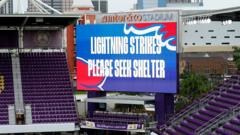
You sit down with a cold drink, flip on the TV, and expect to see the final tweaks to Thomas Tuchel's England lineup. Instead, you get a giant flashing neon sign screaming at fans to find immediate shelter.
That was the reality in Orlando when England's final pre-World Cup friendly against Costa Rica got pushed back. Torrential Florida rain submerged parts of the Inter&Co Stadium pitch, but the real culprit was lightning. A one-hour delay might seem like a minor blip in a warm-up game, but it's actually a massive warning shot.
The 2026 World Cup is here, and FIFA has a colossal atmospheric problem.
If you think this storm delay was just a random fluke, you don't know American summer weather. This wasn't an isolated incident. It's a structural hazard that's going to mess with the schedule, ruin television broadcast windows, and drive managers absolutely insane over the next month.
The Eight Mile Rule That Changes Everything
American sporting events don't handle lightning the way European leagues do. In the UK, a heavy downpour means a greasy pitch and sliding tackles. In the US, a single flash of lightning triggers a strict safety protocol.
The standard rule across American outdoor venues is simple. If lightning strikes within an eight-mile radius of the stadium, the game stops instantly. Players leave the pitch. Fans evacuate the stands.
Here is the kicker. The clock resets with every single strike. If a bolt hits the ground seven miles away, a mandatory 30-minute countdown begins. If another strike happens 25 minutes into that countdown, the clock goes right back to zero.
We saw the extreme version of this during last year's Club World Cup in the US. Six different matches faced brutal suspensions because of electrical storms. Take Chelsea's clash with Benfica in Charlotte. It kicked off late afternoon and didn't wrap up until nearly five hours later after a massive two-hour weather stoppage. Former Blues boss Enzo Maresca openly questioned whether the US was even the right place for summer tournaments.
When you have billions of dollars in television rights on the line, five-hour matches don't work. Broadcasters have tight programming windows. Fans in different time zones can't stay up until 3 AM to watch a group stage game finish. Yet, safety dictates that FIFA cannot ignore these local laws.
Why the Gulf Coast and Southeast are a Nightmare for FIFA
The match in Orlando wasn't played in the middle of a rare hurricane. It was hit by a standard summer afternoon thunderstorm.
If you live in Florida, Georgia, or Texas, you know the drill. The heat builds up all morning, the humidity peaks, and by 4 PM, the sky falls apart. The Inter&Co Stadium ground staff did a phenomenal job drying out pools of standing water with industrial dryers, but you can't dry away lightning.
Look at the host city map for this World Cup. You have outdoor venues right in the prime danger zones for severe summer weather:
- Miami (Hard Rock Stadium): Absolute prime territory for daily tropical downpours.
- Atlanta (Mercedes-Benz Stadium): Features a retractable roof, which mitigates the risk, but surrounding infrastructure faces chaos.
- Houston (NRG Stadium): Another roofed venue, but the city itself regularly floods during sudden summer deluges.
- Dallas (AT&T Stadium): Completely enclosed, which saves the matches, but severe summer storms routinely disrupt travel and fan zones.
Tuchel tried to spin the Costa Rica delay as a positive. He told reporters it gave his squad a little taste of what can happen in tournament life. It kept them on their toes. But let's be real. No manager wants their pre-match nutrition, warm-up routine, and tactical briefings shattered an hour before kick-off when they are trying to prep for a massive opener against Croatia.
The Brutal Double Whammy of Extreme Heat
It's not just the water and electricity falling from the sky. It's the blistering heat left behind when the sun comes back out.
Before the storm rolled through Orlando, temperatures hovered around 30 degrees Celsius. Because of the suffocating Florida humidity, the real-feel index sat closer to 34 degrees. Players are essentially running around inside a sauna.
FIFA has already baked mandatory water breaks into the match regulations for high-temperature games. While players like Harry Kane have dismissed the heat as something they can handle with extra hydration, the physiological toll is immense. High humidity prevents sweat from evaporating efficiently. Your body can't cool itself down.
When you mix extreme heat exhaustion with sudden, unpredictable one-hour cooling periods spent sitting in a dressing room, you get a recipe for muscle pulls, hamstring tears, and sloppy football.
How to Prepare for the Chaos
If you're a fan traveling to games or just trying to watch from home, you need to change how you approach this tournament. The smooth, predictable schedules of European tournaments are gone.
First, ignore the scheduled wrap-up times. If a match is set to air at 8 PM, don't assume you can plan something else for 10 PM. Keep your schedule flexible, especially for games hosted in the southern states.
Second, if you're attending a match live in an open-air stadium like Miami or Kansas City, pack a poncho and download a reliable local radar app. Don't wait for the stadium screens to tell you a storm is coming. Watch the cell movement yourself.
Lastly, accept that the tournament leaderboard might look weird. Teams that manage the chaos of delays, disrupted warm-ups, and sudden restarts will advance. Teams that lose their focus during a two-hour locker room wait will go home early.
The storm in Orlando wasn't a freak event. It was an accurate preview of the messy, unpredictable atmospheric reality facing this entire tournament.