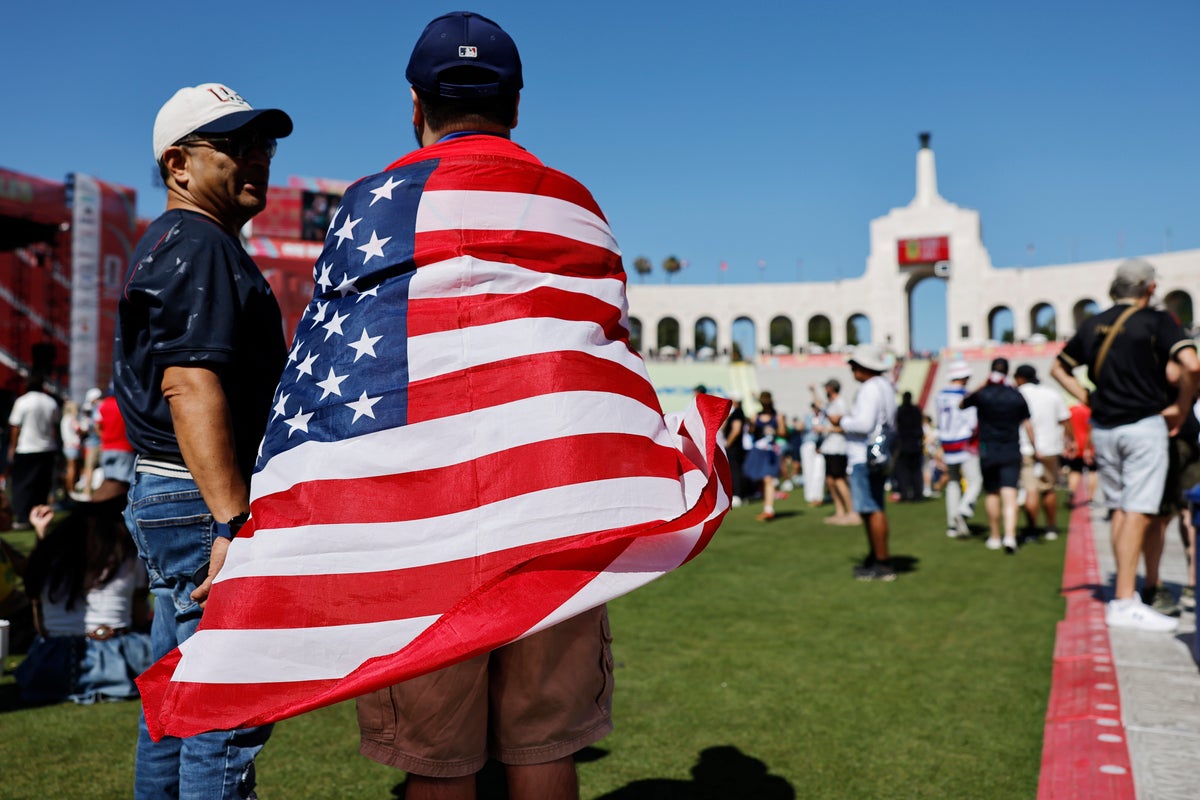
America is turning 250 this summer, but nobody feels like throwing a party. Instead of national pride, a heavy blanket of gloom has settled over the country.
The data confirms what you probably feel when talking to your neighbors or scrolling through your feed. A massive Pew Research Center study reveals that 59% of Americans believe the nation's best years are locked in the past. Only 40% think the best days are ahead. We aren't just hitting a rough patch. Millions of people genuinely believe the American experiment has passed its expiration date.
This isn't standard partisan whining. It is a deep, structural rot in the national psyche. When you look closer at the numbers, you see a country wrestling with broken promises, economic exhaustion, and a complete lack of faith in the future.
The Death of the American Dream
For generations, the baseline deal in America was simple. You work hard, you play by the rules, and your life gets better. Your kids do even better than you did.
That deal is dead.
An Associated Press-NORC Center for Public Affairs Research poll highlights a brutal reality. A full 51% of American adults say the American Dream once held true but doesn't anymore. Another 15% say it was always a lie. Think about that. Nearly two-thirds of the country believes the core engine of American society is completely broken.
It makes sense when you look at the daily math of survival. Wages don't match the cost of a mortgage. Young adults are priced out of the cities where the jobs are. They carry mountains of student debt. They look at the economy and don't see opportunity. They see a rigged game.
Pew's data shows that lower- and middle-income Americans are the most pessimistic. Sixty-one percent of people in these income brackets say our best days are behind us. Wealthier Americans are split down the middle. If you're rich, America still works. If you're struggling, the future looks terrifying.
A Republic of Total Disappointment
We like to think our history is a straight line of progress. The data says otherwise. People are looking back at the founders and realizing how far we've fallen.
An Elon University Poll dropped a fascinating data point. A massive 69% of Americans believe the signers of the Declaration of Independence would look at modern American democracy and feel more disappointment than pride. We've built a system that feels completely disconnected from its original ideals.
The same poll found that 73% of adults rate the overall health of American democracy as "fair" or "poor." People don't trust the courts. They don't trust Congress. They certainly don't trust the media.
When a society loses faith in its institutions, it loses its glue.
The pessimism cuts across racial lines too. The Pew poll found that 66% of Black adults and 64% of Hispanic adults believe the country’s best years are gone. White adults aren't much higher at 57%. No matter who you are, the current state of affairs feels unsustainable.
The Partisan Funhouse Mirror
Our view of reality depends entirely on who sits in the White House. We don't have a shared national experience anymore. We have two different realities.
Right now, in Donald Trump's second term, Republicans feel a lot better about the immediate trajectory than Democrats. In early 2026, 54% of Republicans reported being satisfied with the country's direction. Only 8% of Democrats said the same.
Back in 2022, under Joe Biden, the script was flipped. Democrats were more satisfied, and Republican satisfaction cratered to 10%.
This constant whiplash destroys any chance of long-term planning. We don't solve big problems anymore. We just spend four years trying to undo whatever the last guy did. The polling reflects this fatigue. Democrats are overwhelmingly dissatisfied with how democracy functions right now, with 86% expressing anger over the current system.
The Under 30 Disconnect
The most dangerous data point for America's future is the massive generation gap. The kids are not alright, and they don't believe in American exceptionalism.
According to the AP-NORC poll, 44% of Americans under the age of 30 believe there are other countries that are simply better than the United States. Compare that to older Americans. Only 22% of people aged 60 and older feel that way.
Older generations grew up during the Cold War or the post-WWII boom. They remember an America that felt unified, wealthy, and dominant.
Younger Americans have a different core memory. They grew up with the 2008 financial crash, endless political gridlock, active shooter drills in school, and runaway inflation. Only about half of younger Americans even consider a democratically elected government to be central to the nation's identity. They don't have nostalgia for the past because they didn't live it, and they don't have hope for the future because the present is too exhausting.
Is There a Hidden Silver Lining
It is easy to look at these numbers and assume we are headed for a collapse. But public opinion is a fluid thing. It turns out Americans are complicated.
Despite the deep worry about our institutions, 68% of people still say they are proud to be American. We hate the current state of our politics, but we still like the idea of America.
There is also a weird, quiet uptick in optimism regarding the long-term outlook. Pew asked people to look forward to the year 2050. In 2023, only 32% of people thought the economy would be stronger by mid-century. In the latest 2026 polling, that number jumped to 43%.
Similarly, more people are starting to hope that our brutal political divisions will calm down over the next few decades.
We are in a sour mood right now, but we haven't totally given up. The upcoming 250th anniversary celebrations shouldn't focus on military parades or superficial fireworks. The polling shows that 68% of Americans want the semiquincentennial to focus on deep reflection regarding our history and values. We want to look in the mirror, not watch a light show.
If you want to move past the doom and gloom, stop waiting for Washington to fix itself. The data shows that 71% of Americans believe small, local anniversary events feel more authentic than massive national celebrations.
Fixing the country starts by focusing on your immediate community. Join a local board. Support a neighborhood business. Talk to the person next door who votes differently than you do. The national narrative is broken, but the local one is still yours to write.