Ohio politics just took a sharp, unexpected turn. When networks projected Dr. Amy Acton as the winner in the Ohio governor's race, the reaction inside her campaign ballroom wasn't just standard election-night cheering. It felt like a massive release of tension that had been building since the dark days of 2020.
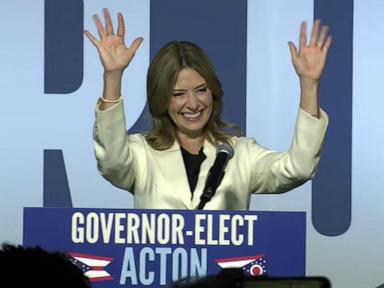
If you've watched Ohio elections over the past decade, you know the script. Democrats struggle outside the major urban hubs, Republicans dominate the statewide map, and every cycle ends with pundits declaring the Buckeye State permanently crimson. Yet here we are, watching a former state health director—someone who had never run for public office before—step up to the podium as the projected next governor of Ohio.
The Speech That Defined the Night
Acton didn't come out swinging with typical partisan red meat. Honestly, she never does. Taking the stage in front of a packed crowd of supporters, her tone was measured, empathetic, and heavily focused on uniting a state that has spent the last several years deeply fractured over public health, economic shifts, and cultural battles.
She leaned hard into her personal story. Growing up in Youngstown, experiencing homelessness as a child, and working her way through medical school before leading the Ohio Department of Health under Republican Governor Mike DeWine—that biography was the backbone of her remarks. She reminded the crowd that leadership isn't about scoring points on cable news. It's about showing up when things get ugly.
"We didn't build this campaign on anger," she told the room, pausing as the applause drowned out the microphones. "We built it on the simple idea that Ohioans deserve leaders who listen to facts, care about their neighbors, and actually solve problems."
It was a direct, unmistakable contrast to the aggressive political style that has dominated Midwest campaigns recently. And clearly, enough voters bought into it.
How a Public Health Official Pulled This Off
To understand why Acton’s victory speech resonated so deeply, you have to remember who she was to Ohioans six years ago. During the spring of 2020, Amy Acton was the calm, soft-spoken physician standing next to Governor DeWine every afternoon at 2:00 PM. For a few months, she was arguably the most trusted person in the state.
Then came the backlash. Armed protesters showed up outside her suburban Columbus home. Lawmakers stripped away her department's authority. By June 2020, she resigned, stepping away from the spotlight while partisan commentators painted her as the face of government overreach.
Most political consultants would have told you her career in Ohio public life was dead on arrival. You don't survive that kind of polarization in a state Donald Trump won twice by eight points.
Except those consultants missed something crucial. While vocal critics dominated the headlines, millions of suburban parents, healthcare workers, and moderate independents remembered her differently. They remembered someone who told them the truth when nobody knew what was coming next. They saw a doctor who walked away from power rather than compromise her medical ethics.
When she launched her gubernatorial bid, she didn't run away from her 2020 record. She owned it. That authenticity broke through the usual campaign noise in ways a career politician simply couldn't replicate.
The Numbers Behind the Shift in Ohio
You can't win statewide in Ohio just by running up the score in Cuyahoga, Franklin, and Hamilton counties. Every Democratic strategist knows that math doesn't work anymore. To pull off a projected win, Acton’s coalition had to crack open areas that have drifted steadily right since 2012.
Let's look at what changed on the map:
- Suburban realignment accelerated. Counties like Delaware, Warren, and Medina—traditionally reliable Republican strongholds—saw massive turnout among college-educated voters and women who prioritized healthcare access and public education funding.
- The Youngstown factor. Having a candidate from the Mahoning Valley mattered. While she didn't flip every rural township in northeast Ohio, she stopped the bleeding among working-class voters who felt left behind by Columbus policymakers.
- Healthcare became the kitchen-table issue. Rising hospital costs, rural clinic closures, and ongoing debates over reproductive rights gave a physician an unmatched platform to talk about practical solutions rather than ideological talking points.
During her address, Acton specifically thanked the volunteers who knocked on doors in small towns and rural counties where Democrats usually don't even bother setting up field offices. That ground game paid off.
What Critics Are Saying About the Result
Not everyone in Columbus is celebrating, obviously. Republican leaders were quick to push back against the narrative that Acton’s projected win represents a permanent political shift in Ohio.
Conservative commentators and GOP strategists point to candidate quality, internal party divisions during the primary, and national headwinds as the real culprits behind their loss. From their perspective, voters didn't suddenly embrace progressive policies—they simply reacted to specific flaws in the Republican ticket and lingering frustration over statehouse scandals that have plagued Columbus for years.
There's merit to that argument. Ohio still has a Republican supermajority in the General Assembly. The state legislature isn't going to suddenly rubber-stamp a progressive agenda just because a Democrat sits in the governor's mansion. In fact, Acton faces an immediate, uphill battle the second she takes the oath of office.
The Reality of Governing a Divided Statehouse
Winning the election is one thing. Governing Ohio with a hostile legislature is an entirely different beast.
If you've followed state politics here, you know the Ohio General Assembly holds massive institutional power. They have overridden gubernatorial vetoes before, and they won't hesitate to do it again. Acton hinted at this reality during the final stretch of her speech, acknowledging that the real work starts the morning after the confetti gets swept up.
She will need to use the bully pulpit effectively. As governor, she controls executive agencies, the state budget proposal process, and the veto pen. Even if lawmakers can override her vetoes, forcing them to take tough, public votes on popular healthcare, education, and infrastructure initiatives changes the political dynamic in Columbus.
Her background working alongside Mike DeWine gives her an unusual advantage here. She knows how the state bureaucracy actually functions from the inside. She knows where the bottlenecks are in Medicaid administration, mental health funding, and local health departments. Unlike an outsider who spends the first year just figuring out where the restrooms are in the Vern Riffe Center, Acton already knows the machinery of Ohio government.
Three Things to Watch Before Inauguration Day
If you want to understand how an Acton administration will actually operate, don't just replay the victory speech. Pay close attention to what happens over the next few weeks as the transition team takes shape:
- Cabinet appointments. Watch who she taps to run the Ohio Department of Health, the Department of Medicaid, and the Department of Development. If she brings in seasoned, bipartisan administrators rather than partisan activists, it signals she's serious about working across the aisle to get bills passed.
- Early budget priorities. Ohio's operating budget process is where the real policy fights happen. Look for how she frames investments in public schools, childcare, and rural hospitals to appeal to moderate Republicans in the state Senate.
- Relationship with legislative leadership. The tone set in her first closed-door meetings with the House Speaker and Senate President will tell you whether Columbus is headed for two years of total gridlock or pragmatic compromise.
Check the official Ohio Secretary of State election results portal over the coming days as county boards finalize provisional and absentee ballots, and follow local coverage from outlets like the Columbus Dispatch and Cleveland.com to track her transition team announcements. The campaign rhetoric is over; now comes the hard part of actually running Ohio.