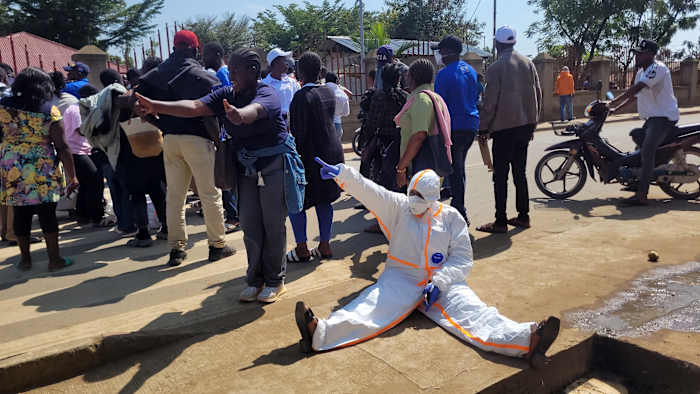
Epidemiological containment in fragile states operates on a strict mathematical threshold: the rate of intervention deployment must permanently outpace the basic reproduction number of the pathogen. When this velocity equation fails, localized transmission transitions into systemic crisis. The ongoing resurgence of the Ebola virus disease in the Democratic Republic of the Congo demonstrates a systemic breakdown of public health response architecture. Conventional reporting attributes this failure to vague geopolitical friction or inherent regional instability. A rigorous operational deconstruction reveals structural vulnerabilities across diagnostic lag, supply chain elasticity, and community trust parameters.
The Diagnostic Velocity Deficit
The foundational mechanism governing epidemic expansion is detection latency. Time elapsed from symptom onset to laboratory confirmation dictates the window during which an infected individual functions as an uncontained transmission node. In the current outbreak, early transmission dynamics were accelerated by a mismatch in diagnostic protocols. Initial case presentations were misattributed to alternative pathologies, including peritonitis, while localized clinics utilized assays calibrated for mismatched viral species.
This diagnostic delay creates an exponential compounding effect on contact tracing registers. When biological verification stalls, epidemiological mapping relies on retrospective case reconstruction. By the time central laboratories in Kinshasa processed mishandled or misdirected samples, the transmission chains had already branched beyond the reach of active surveillance.
[Symptom Onset] -> [Diagnostic Mismatch] -> [Delayed Isolation] -> [Exponential Node Expansion]
The friction points within this sequence are measurable:
- Sample Transport Time: Physical isolation zones lacking cold-chain transport networks increase turnaround times beyond the biological window of effective contact quarantine.
- Species Specificity Error: Deploying reagents unsuited for specific viral strains yields false negatives, directly expanding the community reservoir of infection.
- Information Silos: Decentralized reporting units failing to aggregate daily anomaly counts into predictive regional models.
The Cost Function of Infrastructure Deficits
Epidemic containment capacity is bounded by the physical and logistical throughput of the host nation's health system. The Democratic Republic of the Congo manages recurring resurgences against a backdrop of chronic underinvestment in primary healthcare infrastructure. When an acute epidemic spikes, response teams must divert resources from baseline medical operations, inducing secondary systemic failure across maternal care, malnutrition management, and endemic disease control.
Supply chain elasticity dictates whether an intervention scales or collapses. Personal protective equipment shortages force healthcare workers to ration barriers, directly increasing occupational infection rates. Each infected clinician removes a high-value node from the treatment matrix while simultaneously converting a clinical facility into a nosocomial amplification point.
Logistical friction compounds these vulnerabilities. Transporting mobile isolation units and specialized therapeutics across terrain defined by poor road networks and active conflict zones introduces severe time penalties. Humanitarian access is frequently disrupted, transforming routine supply distribution into high-risk security operations that require bespoke military or NGO escorts.
Behavioral Resistance and the Trust Equilibrium
Epidemiological models frequently treat human compliance as a constant. In practice, public adherence to containment protocols is a variable dependent entirely on institutional trust. When state apparatuses and international bodies deploy top-down mandates without accounting for historical socio-political context, communities construct alternative explanatory frameworks for the epidemic.
Traditional funeral practices serve as a primary vector for viral propagation during rural resurgences. Mandating safe and dignified burials without providing culturally resonant alternatives triggers direct behavioral resistance.
[Top-Down Enforcement] -> [Erosion of Local Trust] -> [Secretive Burials/Evasion] -> [Surveillance Blind Spots]
This dynamic introduces systematic surveillance blind spots. If populations perceive isolation centers as terminal holding facilities rather than therapeutic environments, symptomatic individuals actively evade detection. Contact tracing efficiency drops to near zero when households conceal sick relatives, rendering official epidemiological curves inaccurate reflections of true disease prevalence.
Strategic Operational Realignment
Mitigating recurrent epidemic acceleration requires moving past reactive crisis management and transitioning toward structural resilience engineering. Public health frameworks must integrate decentralized diagnostic platforms capable of point-of-care genetic sequencing directly at the health-zone level, eliminating transport delays to central laboratories.
Supply chains must transition from emergency airlifts to prepositioned regional caches managed via localized logistics hubs, ensuring personal protective units and cold-chain therapeutics remain buffered against border closures or transport blockades. Crucially, community engagement architecture must be decoupled from enforcement agencies, positioning local leaders and community health workers as primary architects of surveillance design rather than passive recipients of centralized directives.