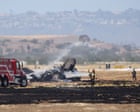
A pilot successfully ejected from a United States Marine Corps F-35B Lightning II during a training operation near Marine Corps Air Station Miramar. While the pilot sustained non-life-threatening injuries and recovery protocols functioned within acceptable parameters, treating this event as an isolated flight line mishap misreads the structural realities of fifth-generation tactical aviation. The F-35B variant, defined by its Short Takeoff and Vertical Landing capabilities, represents one of the most complex integration matrices of software, propulsion vectors, and structural airframes in modern military history.
Analyzing an ejection event requires dissecting the cascading sequence where mechanical integrity, thermal management, and human-machine interface thresholds intersect. When a mishap forces a pilot out of the cockpit, the failure is rarely a singular point of structural fracture. Instead, it is the terminal output of a multi-variable system breakdown where feedback loops outpace response times, forcing the pilot to rely on automated egress systems designed to operate at the absolute limits of human physiological tolerance.
The Propulsion Architecture of Vertical Landing Operations
To understand the operational risks inherent to the F-35B airframe, one must evaluate the thermodynamic and mechanical complexity of the propulsion system. Unlike the conventional takeoff and landing F-35A or the carrier-variant F-35C, the B-variant incorporates a Rolls-Royce LiftSystem. This architecture combines a turbofan engine, a driveshaft-driven lift fan positioned forward of the cockpit, a pivoting three-bearing swivel module at the rear exhaust, and two roll-post ducts under the outer wings.
During hover and low-speed transition phases, this system shifts the center of gravity and thrust vectors dynamically. The lift fan alone produces nearly twenty thousand pounds of vertical thrust through counter-rotating fans driven directly by the main engine turbine via a bevel gearbox and clutch system. This mechanical linkage introduces high-stress torque transfer points operating under extreme thermal loads.
When a propulsion anomaly occurs during slow flight or vertical descent, the window for pilot recognition and corrective action narrows significantly. Traditional fixed-wing aircraft rely on forward airspeed to maintain aerodynamic control surfaces. The F-35B in vertical mode relies primarily on reaction control valves and vectoring thrust. If the engine experiences a transient loss of power or a clutch engagement failure, the loss of lift is instantaneous. The aircraft transitions from a controlled flying machine to a ballistic mass within fractions of a second, leaving the flight control computer and the pilot with minimal recovery time.
Human Factors and Physiological Stressors in High-Performance Ejection
The Martin-Baker US16E ejection seat utilized across the F-35 fleet is an engineered marvel designed to safely extract a pilot from a disabled aircraft across a wide envelope, ranging from zero altitude and zero airspeed on the runway to high-speed, high-altitude flight. However, the biomechanical forces exerted on the human body during seat actuation remain severe.
Upon pulling the ejection handle, a sequence of events unfolds in milliseconds. Canopy jettison explosives clear the path overhead. Rocket motors ignite, propelling the seat upward along guide rails while a drogue parachute stabilizes the trajectory. Simultaneously, leg restraints snap tight to prevent flail injuries, and the harness retractor locks the pilot's torso against the seatback.
The acceleration force, commonly measured in Gs, spikes violently during the rocket motor burn. For the pilot, this translates into sudden spinal compression. Even when ejections are categorized as successful, micro-fractures in vertebrae and soft tissue trauma are common occupational hazards of modern ejection systems. Furthermore, the F-35 helmet-mounted display system, while offering unmatched situational awareness, adds mass to the pilot's head. During high-speed windblast or rapid seat deployment, this added mass increases the risk of neck strain and cervical injury, forcing engineers to continuously refine the aerodynamic stabilization fins and dual-parachute sequencing of the egress system.
The Maintenance and Diagnostics Bottleneck
Behind every flight line incident lies the invisible infrastructure of maintenance logistics, supply chain constraints, and diagnostic data processing. The F-35 program relies heavily on the Operational Data Integrated Network, a cloud-based logistics and maintenance management system designed to track parts health, predict component failures, and schedule depot-level maintenance.
Complex software-driven platforms generate millions of data points per flight hour. Ground crews must parse telemetry data to identify anomalies before they manifest as critical failures. However, the diagnostic feedback loop is not infallible. Intermittent electrical faults, software synchronization glitches between the mission systems computer and the engine control unit, or wear on specialized mechanical linkages like the LiftSystem drive shaft can evade detection during routine inspections.
When an investigation board examines a mishap, the primary focus centers on the integration between hardware wear and software interpretation. If a sensor reports a false reading or fails to register an impending pressure drop in a hydraulic line, the flight control software may execute automated safeguards that alter flight parameters unexpectedly. Maintenance protocols must constantly adapt to account for these systemic interdependencies, shifting from reactive part replacement to predictive metallurgical and electronic integrity testing.
Strategic Fleet Implications and Risk Mitigation
The loss of an F-35B airframe triggers a ripple effect across global defense readiness, procurement economics, and pilot training pipelines. The financial cost of a single fifth-generation platform requires strict preservation of assets, but the human capital cost of a trained tactical aviator far outweighs the hardware replacement value. Training an operational F-35 pilot represents years of institutional investment and millions of dollars in simulator hours, flight instruction, and tactical integration exercises.
Military aviation authorities approach mishaps through the lens of systematic risk reduction rather than searching for a single scapegoat. Grounding fleets temporarily or restricting specific flight envelopes, such as hover operations or high-angle-of-attack maneuvers, allows engineering teams to inspect fleet-wide components for systemic material fatigue or manufacturing defects.
The long-term viability of vertical landing strike fighters depends on continuous iteration of both software safety margins and mechanical redundancy. As flight control algorithms become more sophisticated, they must balance autonomous stabilization with unambiguous pilot override authority. When split-second decisions dictate survival, the interface between human cognition and machine response must remain transparent, predictable, and resilient against unexpected environmental and mechanical stressors.
Implement a comprehensive diagnostic overhaul of the LiftSystem clutch actuation mechanisms across all active-duty F-35B squadrons, mandating ultrasonic non-destructive testing at half the current hourly threshold while simultaneously updating flight control software to widen the automated recovery envelope during low-speed thrust vector transitions.