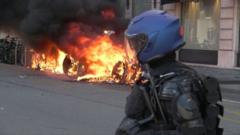
The convergence of international diplomatic summits and mass civil unrest is not a series of spontaneous outbursts; it is a predictable, structural friction point governed by identifiable socio-economic and logistical variables. When a G7 summit occurs, it acts as a high-value target for asymmetrical political expression. The recent clashes between law enforcement and protesters in Geneva demonstrate a recurring operational pattern that can be broken down into distinct strategic vectors: urban density exploitation, asymmetric tactical friction, and the economic strain of localized security containment.
Understanding this dynamic requires moving past surface-level media narratives of "chaos" to analyze the underlying mechanics of modern civil disruption in high-security environments.
The Tri-Border Strategic Vulnerability
Geneva occupies a unique geographic and political position that complicates standard crowd-management and counter-disruption doctrines. The city’s proximity to the French border creates a porous operational environment. Unlike isolated or highly securitized custom zones, urban summits in the European borderless zone face a specific logistical challenge: the rapid, unchecked cross-border movement of affinity groups.
Three distinct variables dictate the scale of mobilization in this specific geography:
- The Border Proximity Multiplier: Activists can establish logistical bases in neighboring jurisdictions (such as France), minimizing exposure to Swiss domestic surveillance and pre-summit preventative detentions, then cross into the target zone hours before an action.
- Jurisdictional Friction: Swiss cantonal police forces must coordinate across internal federal boundaries and external international lines. This structural separation introduces latency in intelligence sharing and tactical synchronization.
- The Symbolic Vector: Geneva houses the United Nations European headquarters, the World Trade Organization, and the World Economic Forum's nearby headquarters. It is a dense cluster of institutional symbols, meaning any disruption achieves a disproportionate amplification effect in international media.
This combination shifts the cost-benefit analysis for decentralized activist networks. The physical barrier to entry is low, while the concentration of high-visibility targets maximizes the return on tactical disruption.
The Tactical Cost Function of Urban Containment
The physical confrontation between protesters and police forces in an urban core operates under a strict resource-allocation model. Law enforcement aims to maintain spatial containment, protecting critical infrastructure and diplomatic assets. Disruption networks aim to force resource dispersion, compelling police to dilute their perimeter strength.
During the Geneva escalation, this manifested through a clear sequence of tactical moves and counter-moves.
Activist Mobility Vector ---> Target Dispersion ---> Perimeter Dilution
                                                            |
Police Kinetic Response <--- Tactical Bottleneck <--- Spatial Containment
The disruption strategy relies on small, highly mobile affinity groups operating independently of the main, peaceful march. By initiating property damage or breaching secondary perimeters at disparate geographic points, these groups exploit the latency in police reaction times.
The police response function is inherently constrained by urban architecture. Narrow streets, historic centers, and public squares limit the efficacy of mechanized crowd-control units. This forces reliance on kinetic containment measures: tear gas, water cannons, and physical barriers.
The use of these measures introduces a secondary vulnerability: tactical escalation feedback loops. The deployment of chemical irritants or kinetic projectiles often transforms neutral or passive observers into active participants against law enforcement, expanding the crowd mass and altering the risk profile of the zone.
The Economic and Logistical Externalities
The total cost of hosting a G7 summit extends far beyond the direct budgetary allocations for hospitality and diplomatic venues. The primary economic drain is the security footprint, which scales non-linearly based on the threat level of civil unrest.
Direct Cantonal and Federal Expenditure
The mobilization of thousands of police officers, military personnel, and private security contractors requires significant capital injection. This includes overtime pay, logistical staging, specialized gear replenishment, and the construction of physical cordons (such as steel fencing and concrete blast barriers).
Private Sector Capital Destruction
When protests transition into property destruction, the immediate cost is borne by local commercial enterprises. Luxury retail, banking institutions, and hospitality venues in Geneva’s central business district face immediate revenue loss due to forced closures, alongside direct capital costs from shattered storefronts and property vandalism.
The Opportunity Cost of Urban Paralysis
The imposition of a "Red Zone" (high-security exclusion sector) paralyzes public transit networks, halts commercial deliveries, and prevents the local workforce from accessing employment hubs. This structural friction slows down the local GDP velocity for the duration of the summit and the subsequent cleanup period.
The Asymmetric Media Incentive Structure
Modern civil disruption cannot be understood without examining the information architecture surrounding it. Both state security apparatuses and radical activist groups operate with a keen understanding of media amplification metrics.
For decentralized protest networks, success is rarely defined by holding physical territory; it is defined by capturing narrative real estate. A single image of a burning barricade with a G7 backdrop achieves the strategic objective of puncturing the image of total state control and institutional consensus. The mainstream media’s structural bias toward high-stimulus, kinetic visual content ensures that violent clashes receive orders of magnitude more coverage than peaceful parallel forums or the policy debates within the summit walls.
Conversely, law enforcement operates under a restrictive transparency mandate. Excess force captured on digital media instantly shifts the political pressure from the protesters to the state authorities, potentially delegitimizing the summit itself. This asymmetry gives small, disciplined groups of disruptive actors a tactical leverage point: they can escalate violence up to the threshold of a kinetic response, knowing that the state's retaliation will be heavily scrutinized and politically costly.
Operational Recommendations for Future Summit Hosting
To mitigate the predictable disruption patterns observed in Geneva, future summit planning must shift from a reactive containment model to a proactive, friction-inducing strategy.
Cities with dense urban centers and complex border realities should not be selected for high-profile diplomatic summits unless the state is willing to enforce a complete, multi-day administrative closure of the urban core. The optimal operational play involves moving the physical summit venue to isolated, easily defensible geographies—such as remote coastal enclaves or mountain resorts—where the geography itself acts as a natural filter for mass mobilization.
If an urban venue is non-negotiable, the security doctrine must prioritize early, cross-border intelligence integration to disrupt the supply lines and assembly points of radical networks before they enter the urban transit matrix. Waiting for crowds to assemble in a dense city center ensures that law enforcement is always operating on the defensive, reacting to the tactical choices of an agile, decentralized adversary.