The sound wasn't loud. It wasn't the sickening crack of a bone or the wet snap of a ligament that echoes through a silent arena. It was something quieter, more insidious—a sharp, electric twitch deep in the back of the thigh. In the high-speed ballet of professional basketball, that tiny sensation is the sound of a season grinding to a halt.
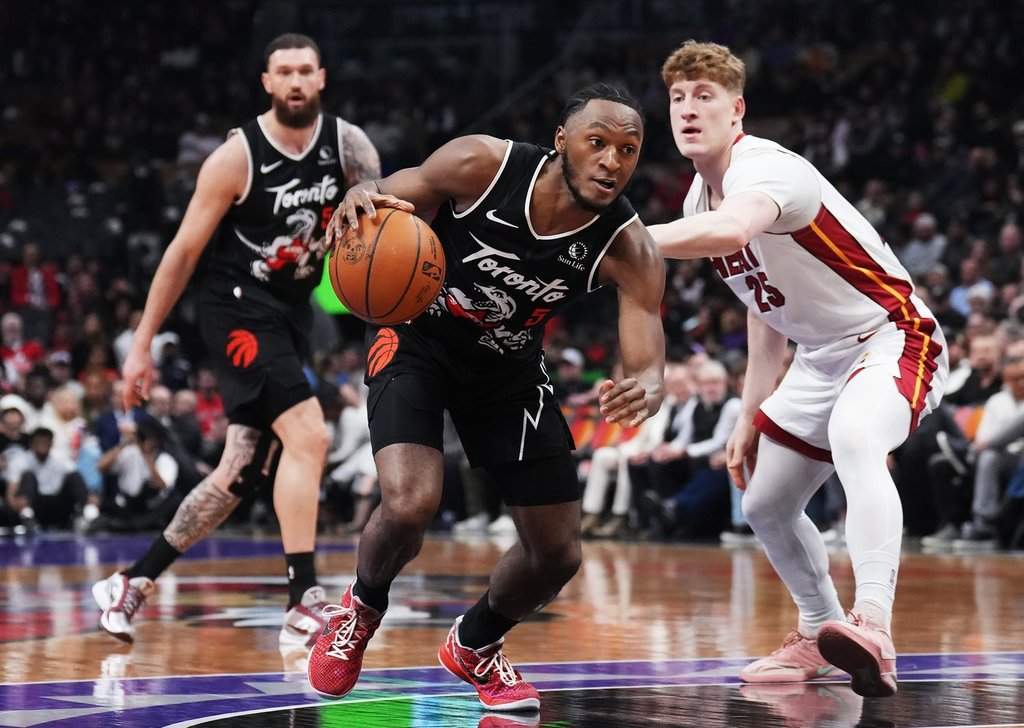
Immanuel Quickley is a man built on the audacity of the first step. For the Toronto Raptors, he is the engine, the twitchy, high-energy spark plug tasked with turning a chaotic fast break into a mathematical certainty. But right now, that engine is idling. The medical report calls it a hamstring strain. The reality is much more frustrating. It is a theft of identity.
The Invisible Anchor
Imagine standing on a sheet of black ice while trying to sprint at twenty miles per hour. That is the psychological weight of a soft-tissue injury. For an elite athlete, the body is a finely tuned instrument of instinct. You don’t think about planting your foot; you just do it. You don’t calculate the torque on your hips during a crossover; you just feel the space open up.
When a hamstring goes, that bridge between thought and action collapses.
The injury happened during a routine push-off. Now, the status is "day-to-day." In the clinical language of the NBA, those three words are meant to be comforting. They suggest a minor setback. They imply that the door is still ajar. But for the player trapped in the training room, day-to-day is a psychological purgatory. It means waking up every morning, swinging your legs off the bed, and waiting for the first few steps to tell you who you are today. Are you a world-class athlete, or are you a patient?
The Geometry of the Strain
To understand why a hamstring strain is so devastating, we have to look at the physics of the human sprint. The hamstrings are the brakes and the accelerators. They are a trio of muscles—the biceps femoris, semitendinosus, and semimembranosus—that work in a violent, beautiful harmony to pull the leg back and propel the body forward.
During a maximal sprint, these muscles undergo what trainers call eccentric loading. They are stretching and contracting simultaneously under immense force. If the timing is off by a millisecond, or if the muscle fibers are fatigued just a fraction beyond their limit, the tissue frays.
For a player like Quickley, who relies on "the shift"—the ability to change speeds and leave a defender frozen in a different zip code—even a Grade 1 strain is a structural failure. It isn’t about whether he can walk or even run. It’s about whether he can explode. Without that explosion, he is just another guy on the court. He becomes a liability in a game where the difference between a blocked shot and a game-winning layup is measured in centimeters.
The Training Room Silence
There is a specific kind of loneliness that exists in a professional training room while the rest of the team is out on the floor. You hear the rhythmic thud of the balls through the walls. You hear the whistles. You hear the laughter and the trash talk.
Inside, there is only the hum of the ultrasound machine and the cold, damp pressure of an ice wrap.
The process of returning from a hamstring strain is a tedious climb. It begins with "isometric" exercises—holding a position without moving, testing the muscle’s ability to simply exist under tension. If it holds, you move to slow, controlled movements. Eventually, you get to the "return to play" progression.
The Raptors' medical staff isn't just looking at whether Quickley can run a straight line. They are watching his "load symmetry." They use wearable technology to measure exactly how much force he is putting through his left leg versus his right. If he favors the healthy side by even five percent, he stays on the bike. The body is a master of compensation. If the hamstring is weak, the lower back or the calf will try to do its job. That is how a "day-to-day" hamstring becomes a month-long back issue.
The Stakes of the Wait
Toronto is in a precarious spot. They are a team trying to find a new soul after years of transition. Quickley was supposed to be the architect of that new identity. When he is on the floor, the floor shrinks for the defense and expands for his teammates. His gravity pulls defenders away from the rim. His pace forces the opposition into mistakes.
When he sits, the game slows down. It gets heavier.
The pressure on a young star to return is immense. It comes from the fans who bought tickets to see a show. It comes from the front office looking at the standings. It comes from the player’s own competitive ego. There is a voice in every athlete’s head that says, "I can play through this."
But the history of the league is littered with the ghosts of players who came back at 85 percent only to feel that same electric twitch three minutes into their first game back. A re-aggravation doesn't just double the recovery time; it creates scar tissue that can haunt a career for years.
The Science of Rest
We live in an era of "load management," a term that fans often use as a slur. It implies softness. It suggests a lack of grit. But the science tells a different story. The modern NBA game is faster and more physically taxing than it has ever been. The distance covered and the intensity of the "closeouts" on shooters have skyrocketed.
Rest isn't a luxury. It is a biological requirement.
For Immanuel Quickley, being day-to-day means he is currently a scientist of his own body. He is learning the subtle language of his muscles. He is learning that sometimes, the most aggressive thing you can do for your career is to sit still.
The team will call it a "precautionary measure." The analysts will talk about "roster depth" and "next man up." But for the kid from Maryland who has spent his entire life being the fastest person in the room, this is a lesson in patience. It is the realization that his greatest weapon—his speed—is also his greatest vulnerability.
He will be back. The twitch will fade. The ice wraps will be packed away. But for now, the Toronto Raptors are a car with a missing gear. They are waiting for the engine to heal, one quiet morning at a time.
The lights of the Scotiabank Arena will stay bright. The roar of the crowd will continue. But until that hamstring can handle the violence of a crossover, the most important work Immanuel Quickley does won't be under the spotlights. It will be in the silence of the weight room, testing a muscle that currently holds the keys to the city.
He stands up from the treatment table. He takes a breath. He walks toward the door.
One step. Two steps. No pain.
But he isn't ready. Not yet.