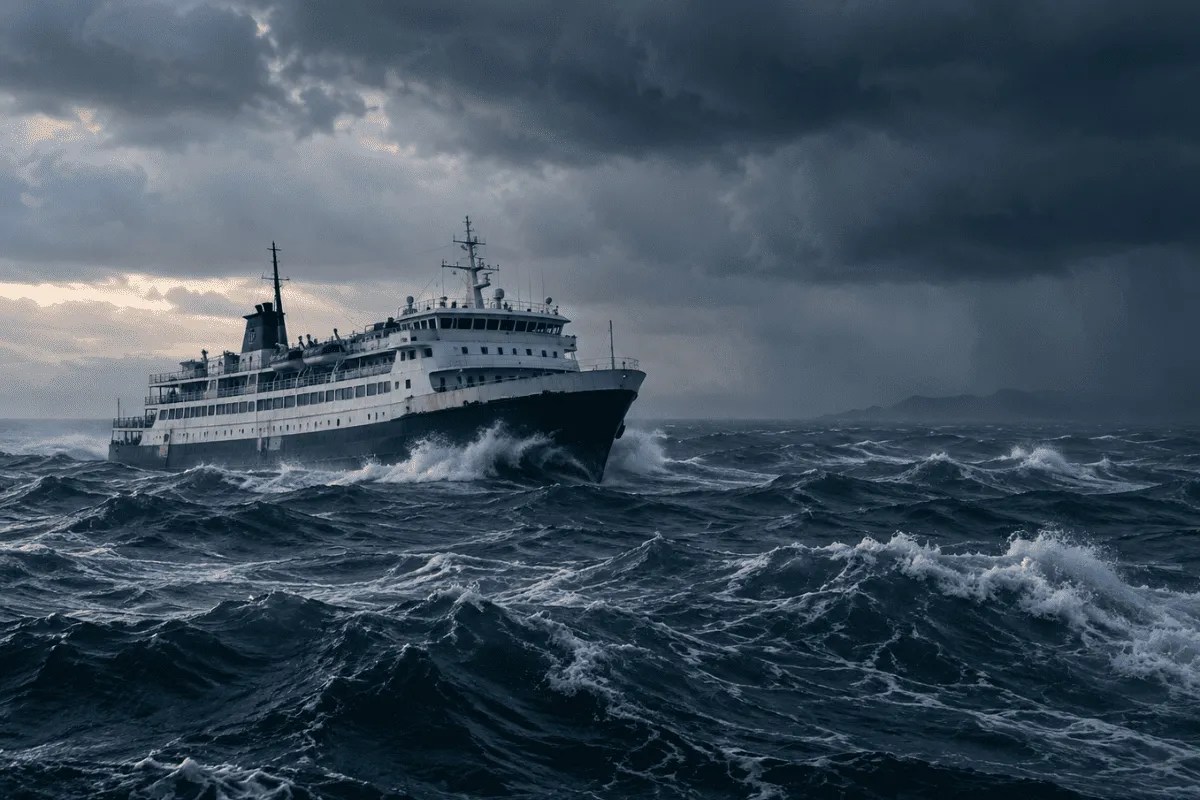
Maritime logistics within archipelago-based geographies rely on high-frequency, high-capacity passenger and roll-on/roll-off ferries to maintain economic continuity across fragmented landmasses. When a catastrophic loss of communication and vessel stability occurs—such as the disappearance of the passenger and cargo vessel Virgo Transport 8 in the Java Sea carrying over 240 individuals—the event exposes systemic vulnerabilities in operational safety thresholds, meteorological risk management, and regulatory oversight enforcement. Analyzing incidents of this magnitude requires moving past descriptive reporting to evaluate the underlying mechanics of vessel failure, environmental stress variables, and search-and-rescue (SAR) response dynamics.
The Environmental Stress Matrix
The Java Sea functions as a dynamic hydrological corridor characterized by volatile microclimates, seasonal squalls, and severe wave height variations. Operating a mixed passenger and cargo vessel through these waters during adverse weather introduces multiple compounding stress vectors: In similar news, read about: Stop Obsessing Over AI Safety Plans Because They Are Just PR Stunts for the Timid.
- Dynamic Hydrostatic Pressure: High-velocity winds generate steep, short-period waves that increase the frequency of wave slam and green water loading on the main deck.
- Free Surface Effect: If vehicle decks or cargo holds lack secure lashings, shifting payloads alter the vessel center of gravity, exponentially reducing metacenter height and righting moments.
- Communication Degradation: Extreme precipitation and electrical interference degrade VHF and satellite telemetry, delaying distress signal propagation and isolating the vessel from real-time routing optimization updates.
When wave heights exceed vessel design limits—such as swells reaching 2.5 meters or higher combined with localized wind squalls—the margin for error narrows rapidly. Without proactive course alterations or shelter-seeking protocols, structural stress on hulls and stabilization systems reaches critical failure thresholds.
Structural Metrics of Fleet Risk and Regulatory Compliance
Archipelagic transit safety is governed by the friction between economic accessibility and regulatory enforcement. Ferries like the Virgo Transport 8 serve as economic lifelines because they offer low-cost transit relative to aviation. However, this economic imperative frequently creates systemic vulnerabilities: USA Today has analyzed this fascinating topic in extensive detail.
The compliance gap in developing maritime sectors stems from decentralized port authority inspections and variable adherence to International Safety Management (ISM) codes. Economic pressures on operators encourage high passenger volume loading and dense cargo configurations. When combined with lax enforcement of manifest verification, vessels frequently operate near or above maximum deadweight tonnage capacities.
Furthermore, life-saving appliance (LSA) readiness—including inflatable life rafts, hydrostatic release units, and personal flotation devices—relies entirely on rigorous maintenance schedules. In environments with high operational turnover, inspection intervals are often compressed, increasing the probability of equipment failure during an emergency evacuation.
The Search and Rescue Optimization Function
When a vessel loses communication and drops off radar telemetry, the primary variable governing survivability is the reaction time and spatial accuracy of the initial search grid calculation. Search and Rescue agencies operate under strict drift-modeling equations that factor in:
- Last Known Position (LKP): The final recorded coordinates transmitted via Automatic Identification System (AIS) or manual radio contact.
- Leeway and Current Vectors: Surface current velocity and windage acting upon hulls, life rafts, and persons in the water.
- Thermal and Exhaustion Limits: Human survival duration exposed to open sea states, hypothermia, and dehydration.
Deploying state assets like the KN SAR Laksamana requires balancing asset range against weather constraints. Surface vessels face severe operational limits when wave action impedes boarding or rescue deployment, often necessitating aerial support to spot survivors before sea drift widens the debris field beyond salvageable parameters.
Operational Reconstruction Priorities
To prevent recurrence and optimize future disaster response protocols, maritime authorities must transition from reactive incident management to predictive risk engineering. Fleet operators operating within volatile equatorial seas must mandate real-time weather routing systems that automatically restrict departures when localized wind and wave thresholds exceed safety parameters. Port authorities must institute automated digital manifest systems to ensure accurate headcounts and weight distributions prior to casting off. Regulatory bodies must decouple economic subsidy dependencies from safety enforcement, ensuring that aging tonnage undergoes mandatory structural audits regardless of route demand.