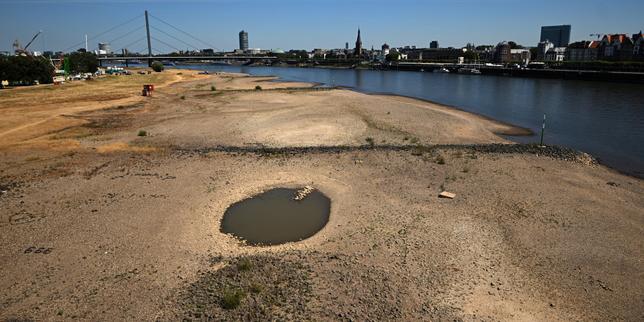
Low water levels on the Rhine River function as an immediate structural stress test for industrial manufacturing and energy production across Central Europe. When the hydrological baseline drops below critical navigation thresholds at key chokepoints like Kaub, the cost function of the entire European logistics network shifts upward. This disruption is not merely a seasonal shipping inconvenience; it represents a systemic supply chain bottleneck that restricts raw material inputs, strands finished goods, and directly suppresses regional gross domestic product through compounding capacity constraints.
The Logistics Cost Function
The primary economic transmission mechanism of a Rhine drought operates through modal shift economics. Inland waterway transport relies on high-volume, low-cost draft capacity. A standard large barge can carry the equivalent of more than one hundred freight trucks or multiple freight train loads. When hydrographs fall, barge operators must reduce cargo payloads by up to fifty percent or more to clear shallow riverbed sections.
This capacity reduction triggers an immediate market response:
- Spot freight rates surge as available barge tonnage declines relative to contracted demand.
- Shippers scramble to secure alternative transport modes, overwhelming regional rail capacity and heavy-goods trucking networks.
- The marginal cost of moving a metric ton of industrial input—such as coal, crude oil, or chemical feedstock—escalates rapidly.
Logistics managers face a constrained optimization problem where every alternative transport mode introduces acute operational friction. Rail corridors along the Rhine valley operate near maximum capacity during normal conditions, leaving little surge capacity to absorb diverted barge freight. Trucking options face acute driver shortages, regulatory weight limits, and higher per-unit carbon emissions profiles, eroding corporate sustainability metrics alongside operating margins.
Industrial Vulnerability Vectors
Heavy manufacturing clusters situated along the Rhine corridor depend on continuous feedstock delivery. Chemical complexes, steel mills, and power generation facilities cannot absorb sudden interruptions in raw material supply without curtailing output.
Refineries and chemical producers require massive volumes of water for cooling and processing, alongside inbound shipments of hydrocarbons and basic chemicals. Low water temperatures and reduced flow volumes complicate environmental discharge compliance, forcing plants to throttle production even before transport logistics become entirely impossible. Coal-fired and nuclear power plants face identical thermodynamic constraints; inadequate cooling water volume forces generation capacity reductions at precisely the moments when regional energy grids experience heightened stress.
Inventory buffers offer only temporary insulation. Standard lean manufacturing practices minimize on-site raw material storage to reduce working capital requirements. Consequently, a prolonged low-water event exceeding two weeks drains local buffer stocks, translating shipping restrictions directly into manufacturing downtime. Downstream industries, including automotive assembly and machinery production, experience secondary supply chain shocks as component shortages ripple through tier-one and tier-two suppliers.
Macroeconomic Transmission and GDP Suppression
At the macroeconomic level, regional productivity losses aggregate into measurable contractions in national output. The German economy, structurally dependent on industrial export manufacturing and integrated supply chains anchored by inland waterways, absorbs these shocks directly.
The economic damage manifests through three distinct channels:
- Direct output losses from facility shutdowns and reduced operating rates in energy and chemical sectors.
- Escalated input costs that compress corporate operating margins or force pass-through pricing, eroding consumer purchasing power.
- Capital misallocation as firms invest heavily in redundant logistics infrastructure, localized storage facilities, and fleet adaptations rather than productivity-enhancing innovations.
Econometric models frequently underestimate these impacts because they treat logistics as a linear input rather than a network-dependent variable. When a critical chokepoint fails, the penalty extends beyond the delayed cargo; it invalidates the scheduling synchronization required for complex manufacturing ecosystems.
Strategic Mitigation Architecture
Mitigating structural exposure to Rhine hydrology requires a fundamental redesign of industrial operating models. Enterprises operating within the affected corridor must transition from reactive crisis management to structural asset protection.
Supply chain architects must decouple raw material intake from single-mode dependency. This involves establishing multi-modal terminal contracts well in advance of hydrological stress periods, maintaining strategic safety stocks of critical inputs outside immediate flood or drought zones, and redesigning chemical formulations where feasible to accept alternative feedstocks that can be sourced via rail or pipeline.
Infrastructure operators and policymakers must accelerate riverbed deepening projects, deploy advanced predictive hydrological monitoring networks, and expand rail freight infrastructure parallel to the Rhine corridor to provide a genuine, high-capacity alternative during extreme weather events.
Capitalize on structural volatility by reallocating logistics budgets toward multi-modal redundancy contracts, securing long-term rail capacity allocations before spot market spikes occur, and re-engineering inventory holding costs to absorb a minimum of six weeks of complete waterway disruption without production curtailment.