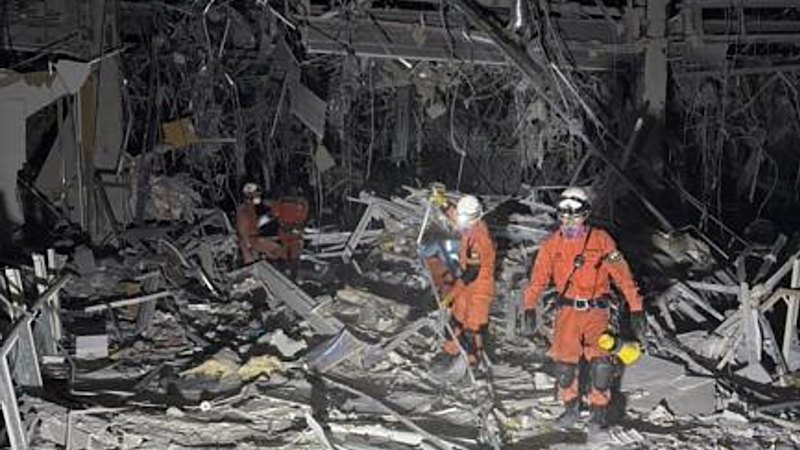
Disaster response systems do not fail because of a lack of operational courage; they fail because of structural friction between rapid asset deployment and rigid logistical pipelines. When a high magnitude seismic event occurs, public safety infrastructure immediately enters a high stakes operational bottleneck. Analyzing the cascading effects of structural failures following events like the Kumamoto magnitude 7.1 earthquake reveals that the primary limiting factor in saving lives is not initial rescue intent, but the efficiency of spatial coordination under infrastructural degradation.
Traditional disaster reporting focuses on the emotional narrative of waiting survivors and rising mortality metrics. A rigorous analytical breakdown requires shifting the lens toward the underlying mechanics: asset allocation velocity, secondary hazard propagation, and vulnerability matrices within industrial and commercial nodes.
The Three Vectors of Structural Failure
The collapse of urban and industrial environments during a major seismic event follows predictable mechanical pathways. Understanding these pathways allows analysts to model risk distribution rather than treating casualties as random statistical anomalies.
- Kinetic Architectural Collapse: Primary structural failure occurs when peak ground acceleration exceeds the load bearing capacity of built environments. This encompasses residential housing stock, multi story commercial centers, and industrial facilities. The primary variable here is the age of the building stock relative to updated seismic codes.
- Secondary Industrial Cascades: Seismic energy rarely acts in isolation. The physical displacement of heavy machinery, cranes, and structural chimneys initiates secondary kinetic and chemical hazards. For instance, factory structural failures and localized gas explosions in commercial complexes compound the initial casualty count independently of the primary tremor.
- Logistical Severance: Linear infrastructure—including road networks, rail arteries, and electrical grids—suffers immediate fragmentation. This isolates impact zones, rendering standard emergency response transit times obsolete and creating geographic pockets where rescue assets cannot arrive within the critical survival window.
The Cost Function of Search and Rescue Delays
Time is the definitive independent variable in post earthquake survival dynamics. The probability of extricating live victims decreases exponentially past the seventy-two-hour threshold, often referred to in emergency management as the golden window.
When transportation routes are compromised by landslides, bridge structural compromises, or debris fields, the cost function of deployment spikes dramatically. Heavy machinery cannot access dense urban ruins or isolated industrial sites without cleared pathways. Consequently, emergency response must rely on manual labor, canine units, and specialized regional or international teams. This creates a resource allocation dilemma: directing limited initial personnel toward large public sites with high concentration densities versus smaller, scattered residential pockets where individuals remain trapped beneath collapsed domestic structures.
Vulnerability Disparities Within the Demographic Matrix
Disaster vulnerability is structurally uneven. Analyzing victim profiles across modern seismic events highlights a distinct exposure gradient driven by occupational status and demographic concentration.
Migrant workers and technical interns frequently occupy high risk industrial sectors, manufacturing plants, and logistics hubs. Their exposure is compounded by informational asymmetries. Language barriers, differential access to municipal emergency broadcast alerts, and rigid institutional hierarchies within subcontracted labor models can delay targeted evacuation or protective positioning. When industrial infrastructure fails—such as a crane collapse at a manufacturing plant or structural failures at processing facilities—non-native laborers often face disproportionate risk due to their physical proximity to heavy operational machinery.
Simultaneously, aging regional demographics alter shelter management requirements. An older population increases the demand for specialized medical intervention, continuous electrical power for life support and temperature regulation, and structural continuity in healthcare access. When power grids and water supply networks fail simultaneously, the secondary mortality risk shifts from trauma injuries to dehydration, hypothermia, or heat stress within evacuation centers.
Resource Allocation Protocols Under Infrastructure Strain
To resolve the operational paralysis that occurs when thousands of homes lose electricity and running water, municipal authorities must execute rapid triage of civil infrastructure.
[Seismic Event]
       │
       ▼
[Infrastructural Fragmentation] ──► (Roads Severed / Power Grid Failure)
       │
       ▼
[Logistical Bottleneck] ────────► (Delayed Heavy Asset Deployment)
       │
       ▼
[Secondary Hazard Amplification] ──► (Industrial Explosions / Structural Collapses)
       │
       ▼
[Resource Triage Matrix] ───────► (Concentration vs. Dispersion Dilemma)
The mathematical and logistical challenge lies in balancing immediate search and rescue operations with utility restoration. Deploying Self-Defense Forces and specialized engineering units requires establishing localized forward operating bases that bypass blocked ground arteries through air or maritime transit when land routes are impassable.
Strategic Play for Resiliency Optimization
Mitigating future structural and human tolls requires shifting capital expenditure from reactive emergency spending to predictive hardening. Regional authorities must mandate structural retrofitting for commercial complexes built before modern seismic enforcement milestones, specifically targeting secondary hazard vectors like industrial gas lines and unanchored overhead machinery. Furthermore, disaster communication architectures must integrate multilingual, automated protocols directly tied to mobile devices to eliminate informational latency for non-native residents and temporary workers before a seismic event occurs.


