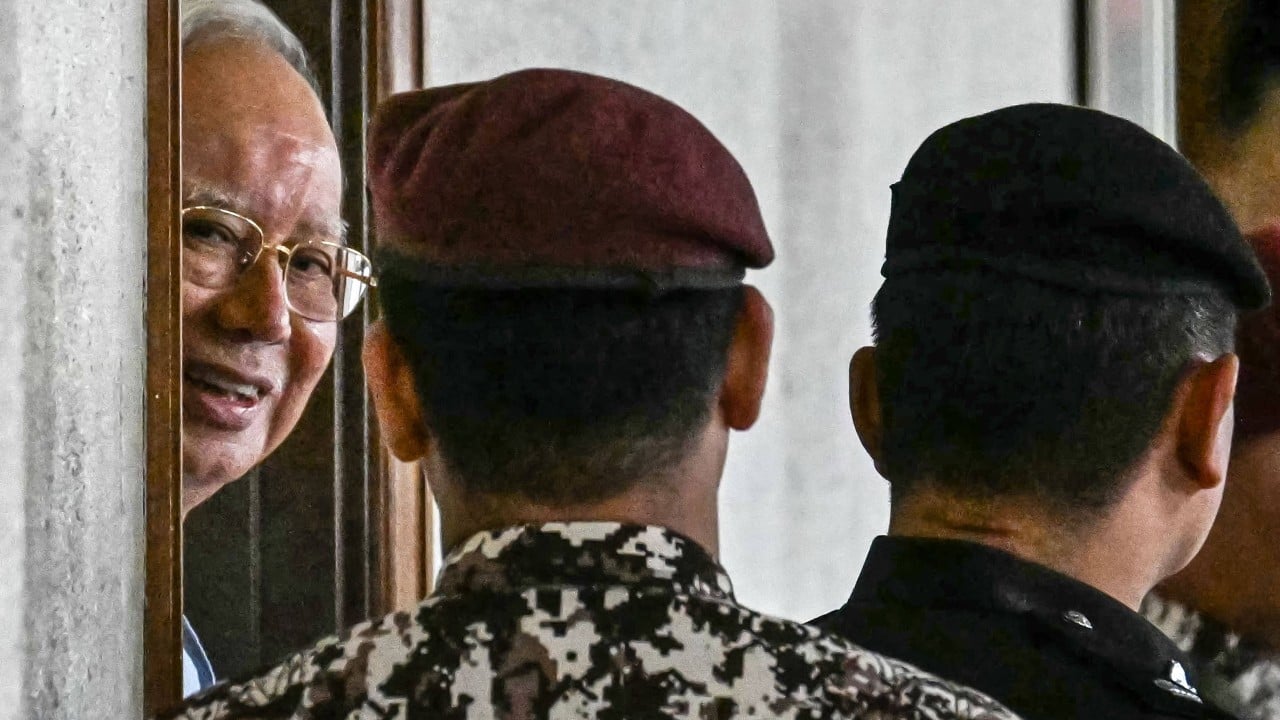
On November 10, 2026, former Malaysian Prime Minister Najib Razak exited Kajang Prison in a police-escorted convoy and entered his private residence at No. 11, Jalan Langgak Duta, Kuala Lumpur. Conventional political coverage reduces this transfer to a superficial binary: either a convicted head of government has secured a luxury escape, or strict custodial conditions have stripped away domestic comforts. Both interpretations miss the structural reality. The transfer is not an ordinary release; it is an administrative conversion of private real estate into a statutory penal facility governed by constitutional clemency, conditional liquidity transfers, and overlapping judicial liabilities.
To understand the mechanics of Najib Razak’s home detention, analysts must separate the optical narrative from the legal, financial, and political instruments operating beneath it.
The Statutory Mechanism of Private Carceral Conversion
Malaysia lacks a dedicated statutory framework for general house arrest. Unlike jurisdictions that utilize electronic ankle monitoring under routine community corrections statutes, Malaysian penal execution relies on the Prison Act 1995. Under Sections 2 and 3 of this legislation, an inmate cannot legally serve a custodial sentence outside a designated facility.
Executing a royal clemency order for home confinement therefore requires an administrative workaround: the state must legally reclassify the detainee’s private compound as a prison.
- Constitutional Trigger: On September 18, 2026, the Yang di-Pertuan Agong, Sultan Ibrahim, exercising prerogative powers via the Federal Territories Pardons Board, granted a conditional pardon modifying the execution of Najib’s remaining SRC International sentence. Rather than shortening the six-year reduced term—which runs until August 23, 2028—the order altered the venue of confinement.
- Administrative Gazetting and Friction: On November 6, 2026, Home Minister Saifuddin Nasution Ismail moved to designate the Taman Duta bungalow as a gazetted prison. However, immediate execution stalled when the Attorney General’s Chambers (AGC) identified procedural ambiguities in the initial discharge instrument, forcing a four-day retention at Kajang Prison until the Kuala Lumpur High Court issued a rectifying order on November 10.
- Custodial Symmetry: Once classified as a prison annex, the property ceases to function as an autonomous household. Under the Prisons Department’s operational jurisdiction, domestic life is subordinated to institutional rules. Movement is restricted to the perimeter, external communications and visitors are subject to state vetting, and any breach of the conditional terms triggers immediate revocation of the pardon and physical return to Kajang Prison.
The operational takeaway is direct: the physical architecture of a mansion remains intact, but its legal sovereignty transfers to the Ministry of Home Affairs. A detainee surrounded by familiar walls remains subject to state surveillance, visitor logs, and strict movement ceilings.
The Liquidity Bottleneck and Conditional Clemency
Public commentary frequently overlooks the financial engineering required to activate the September 18 royal decree. The pardon was strictly conditional, gated by a mandatory RM50 million (approximately US$12.3 million) fine settlement. This figure itself reflects a 76 percent reduction from the original RM210 million penalty imposed by the High Court in July 2020.
Despite the reduction, clearing the RM50 million threshold exposed a severe liquidity constraint:
- Asset Encumbrance: Following his 2018 charges, state enforcement agencies executed sweeping asset freezes and civil forfeiture actions against Najib’s personal accounts and properties—including recovery actions totaling roughly RM900 million to RM1.1 billion in linked assets. His defense counsel explicitly noted that satisfying a liquid cash penalty was obstructed because his personal capital remained locked under court-ordered freezing mandates.
- Public Crowdfunding Failure: A grassroots fundraising drive launched by supporters to crowdsource the penalty stalled at approximately RM9.25 million—less than 19 percent of the required sum—demonstrating the limits of retail political donations when confronted with eight-figure legal liabilities.
- Institutional Bailout: On November 6, 2026, the United Malays National Organisation (UMNO) intervened directly, settling the RM50 million fine on Najib’s behalf.
This transaction alters the principal-agent dynamic between Najib and his political party. By clearing the financial barrier to his transfer, UMNO converted a legal liability into political leverage. Najib’s transition from a cell block to his Taman Duta residence was financed by institutional party capital, binding his post-prison political utility directly to UMNO’s leadership survival.
The Three-Tiered Constraint Matrix
Superficial reporting frames house arrest as a binary trade-off between luxury and deprivation. In reality, Najib’s daily existence at Jalan Langgak Duta is governed by three distinct constraint vectors that separate physical comfort from operational freedom.
1. Spatial and Logistical Restrictions
While living alongside immediate family members within a private compound eliminates the sensory deprivation of Kajang Prison, the property operates under a perimeter lockdown. Unlike standard residential living, entry and exit are controlled by uniformed correctional officers. The Home Ministry explicitly rejected requests to designate a secondary residence for his detention, anchoring him to a single audited location. Domestic staff, medical personnel, and legal counsel must pass institutional clearance protocols, transforming a private estate into a monitored enclave.
2. Political Neutralization
For a career politician whose primary asset is mass mobilization and grassroots patronage, isolation from uncontrolled public contact is a severe operational handicap. In Kajang Prison, Najib’s sporadic court appearances functioned as high-visibility media events where supporters could rally and narratives could be projected. Inside a gazetted private residence, media access is severed. Unauthorized political strategy sessions, unvetted visitors, or public broadcasts violate the conditions of custodial detention. Home confinement effectively neutralizes his capacity for retail politics while removing the martyrdom optics generated by incarceration in a conventional penal facility.
3. The Overhanging 1MDB Liability
The most critical variable omitted in lifestyle-focused coverage is that the November 10 transfer applies exclusively to the SRC International conviction. It does not extinguish Najib’s broader legal exposure. In a separate, far larger prosecution involving 1Malaysia Development Berhad (1MDB) funds, the High Court handed down an additional 15-year prison sentence and a RM11.4 billion fine, ordered to run consecutively after the completion of his SRC sentence.
While Najib is appealing the 1MDB verdict, the structural timeline is unforgiving. Under the current legal order, his conditional house arrest expires on August 23, 2028. Unless his appellate team overturns the 1MDB conviction or secures a separate executive intervention before that date, the Attorney General’s Chambers has already specified that Najib faces transfer back to Kajang Prison on August 24, 2028, to commence the 15-year term. His domestic residence is therefore a temporary waystation bounded by a hard statutory deadline.
Coalition Friction and Institutional Cost
The execution of this home detention order has triggered measurable destabilization across Malaysia’s governing coalition, Pakatan Harapan (PH) and Barisan Nasional (BN), exposing the political cost function borne by Prime Minister Anwar Ibrahim’s administration.
- Intra-Coalition Fracture: The Democratic Action Party (DAP), a core pillar of Anwar’s unity government whose urban voter base was mobilized on anti-corruption platforms, faced immediate constituent backlash over perceived two-tier justice. The fallout escalated to the cabinet level when Transport Minister Anthony Loke tendered his resignation following the court’s enforcement of the house arrest order, forcing Prime Minister Anwar into crisis management to prevent a full legislative collapse.
- Constitutional Insulation vs. Political Accountability: Legally, the Pardons Board’s advice and the King’s prerogative decisions are insulated from judicial review. The AGC has maintained that the monarch’s conditional pardon cannot be challenged in court. Politically, however, voters do not separate royal prerogative from executive administration. Because the Home Ministry gazetted the residence and government representatives sit on the Pardons Board, the Anwar administration absorbs the electoral penalty for an outcome it claims it could not block.
- Judicial Precedent Risk: Beyond immediate partisan damage, civil society and the Malaysian Bar have initiated judicial review challenges targeting the legality of converting a private home under the Prison Act 1995. Creating a bespoke detention pathway for a former prime minister establishes an administrative precedent that future high-net-worth defendants will inevitably cite to demand equal treatment under Article 8 of the Federal Constitution.
Strategic Trajectory Through August 2028
The operational reality of Najib Razak’s return to Jalan Langgak Duta is defined by asymmetrical incentives. The state has traded physical incarceration for political containment, while UMNO has traded RM50 million in party liquidity for the symbolic restoration of its former leader.
Between November 2026 and the August 23, 2028 expiration of the SRC sentence, three concrete developments will dictate the outcome of this arrangement:
- Appellate Attrition on 1MDB: Najib’s legal team will concentrate all resources on staying or overturning the 15-year sentence and RM11.4 billion fine in the 1MDB appeal before August 2028. Without a reversal, home detention merely delays a return to Kajang Prison.
- Pre-Election Coalition Realignment: Prime Minister Anwar Ibrahim faces a narrowing window ahead of Malaysia’s 16th General Election. To stem defections among reformist voters alienated by the house arrest optics, Pakatan Harapan must distance itself from UMNO’s clemency lobbying without triggering a Barisan Nasional walkout that collapses its parliamentary majority.
- Institutional Codification: To neutralize ongoing Malaysian Bar litigation and public accusations of elite exceptionalism, the Home Ministry will likely be forced to introduce formal statutory amendments governing home detention—defining clear eligibility metrics, electronic monitoring standards, and cost-recovery mechanisms so that private incarceration ceases to operate as an ad hoc executive privilege.