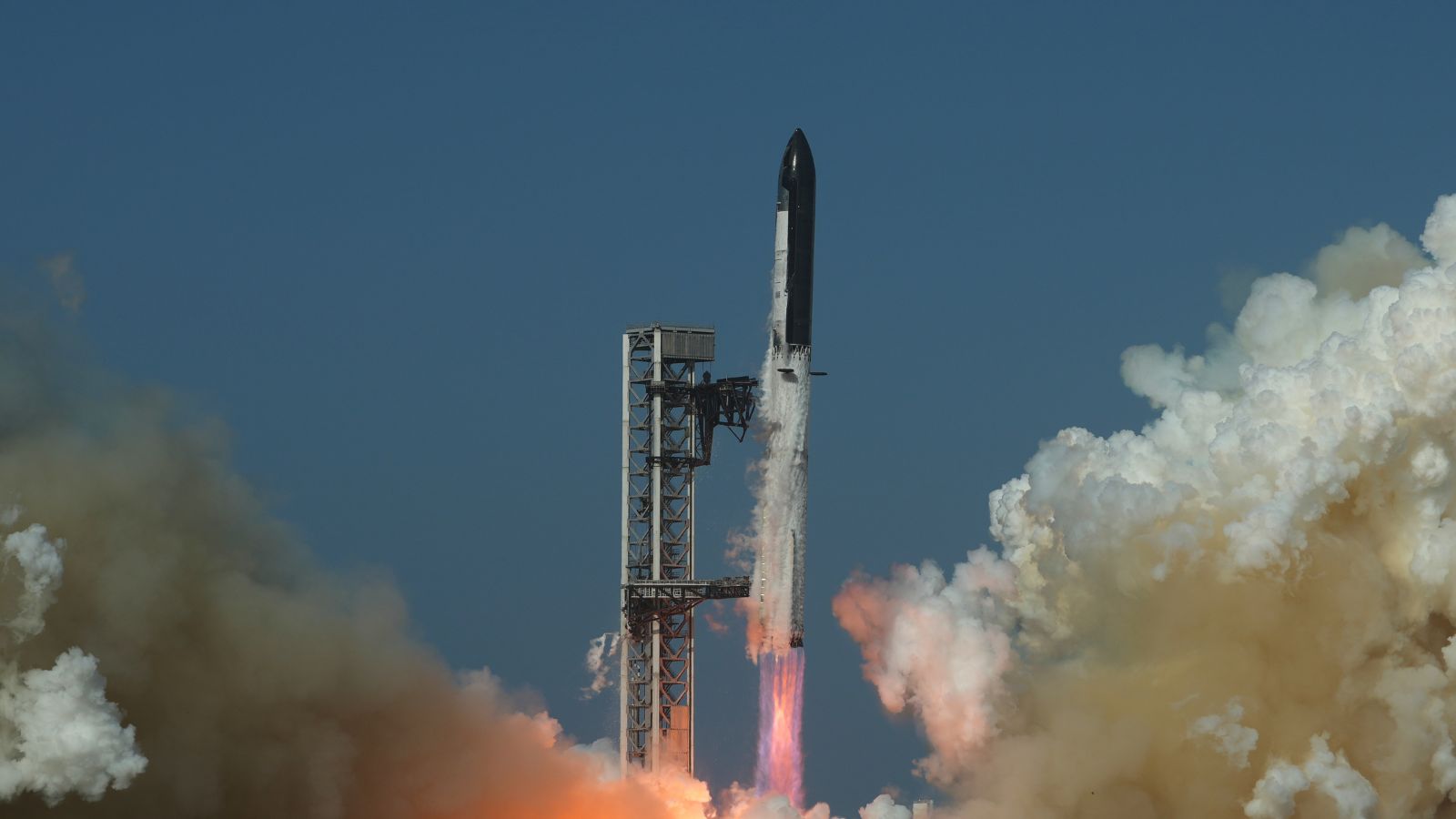
The economics of orbital delivery are bound entirely by mass fraction efficiency and cadence. When SpaceX executed the thirteenth integrated test flight of its Starship architecture from Starbase, the public narrative focused on the visual spectacle of an Indian Ocean splashdown. A structural audit of the mission reveals a different reality. Flight thirteen was an empirical stress test of payload deployment mechanics and in-space thermal dissipation under high-mass constraints, providing the telemetry necessary to shift the system from developmental status to operational utility.
The Payload Economics of Version Three Hardware
The primary operational constraint of mega-constellation maintenance is not raw launch capacity, but volumetric and mass density per fairing enclosure. Prior iterations relied on Falcon 9 infrastructure, capping deployment batches at roughly twenty-three standard units per flight. Flight thirteen introduced the first operational deployment of twenty next-generation Starlink Version 3 satellites utilizing the full-scale Starship upper stage.
[Falcon 9 Architecture] -> 23 Units/Flight -> High Cost-Per-Gigabit-Delivered
[Starship V3 Architecture] -> Target 60 Units/Flight -> Unit Economics Inflection
This deployment mechanism tests a critical economic threshold. To achieve the targeted cost reduction per gigabit delivered, Starship must consistently clear a threshold of sixty Version 3 satellites per launch. Deploying twenty units serves as an intermediate systems check, confirming that the internal mechanical dispenser ring, pneumatic separation pushers, and avionics sequencing can eject mass without imparting destabilizing rotational vectors onto the main vehicle body.
The physical dimensions of Version 3 hardware require structural redesigns of the deployment slot. Because these units feature expanded phased-array antennas and high-gain inter-satellite laser links, clearance tolerances inside the payload bay are narrow. The successful ejection sequence validates that acoustic vibration profiles during maximum dynamic pressure do not warp the internal deployment rails.
The Thermal and Propellant Mechanics of In-Space Relights
Orbital insertion and precise deorbit trajectories demand active thermal management and long-duration coast capabilities from cryogenic propulsion systems. During flight thirteen, the vehicle executed a fourteen-second in-space relight of a single Raptor 3 engine. This operational milestone addresses the primary technical bottleneck facing heavy-lift architectures: propellent boil-off and turbopump thermal conditioning in zero-gravity environments.
A multi-ignition sequence requires liquid oxygen and liquid methane to remain in precise thermodynamic states despite solar radiation loading during coast phases. The fourteen-second burn duration exceeds previous flight envelopes, confirming two distinct engineering variables:
- Autogenous Pressurization Stability: The system maintained tank pressure without external helium injection during extended engine operation.
- Turbopump Thermal Soak Control: Rapid chill-down protocols functioned within tolerance, preventing hard-start pressure spikes when ignition commands were executed.
Without a validated in-space relight capability, orbital circularization and precision deorbit burns remain theoretically impossible. Flight thirteen converts this requirement from a theoretical design parameter into an empirically verified baseline.
Booster Recovery Failures and Structural Trade-Offs
While the upper stage achieved its designated splashdown zone west of Australia, the Super Heavy first-stage booster encountered structural and operational anomalies during its descent sequence over the Gulf of Mexico. Telemetry indicated that only a fraction of the planned thirty-three Raptor 3 engines successfully re-ignited for the terminal landing burn, resulting in an excessive touchdown velocity and a hard impact.
This failure mode illuminates the core tension of rapid iterative prototyping. The Super Heavy V3 design utilizes simplified plumbing and advanced additive-manufactured components designed to reduce manufacturing costs by an order of magnitude. However, these same design choices increase vulnerability to transient turbopump spin instabilities during high-stress maneuvers like the boostback and hot-staging flip.
The mechanical sequence of a booster return involves three distinct propulsion phases:
- Boostback Burn: Reversing the momentum vector of a forty-story vehicle descending at hypersonic velocities.
- Hot-Staging Separation: Clearing the exhaust plume of the upper stage while managing residual propellant slosh.
- Landing Burn: Transitioning from supersonic retro-propulsion to a stationary hover above the mechanical catch arms.
When ignition reliability dips during step three, the kinetic energy calculation shifts instantly from a controlled catch scenario to structural failure. The data harvested from this booster loss allows engineering teams to refine the oxidizer-to-fuel mixture ratios during engine chill-down sequences, directly addressing the turbopump spin anomalies identified during pre-launch scrubs.
The Re-Entry Thermal Protection System Audit
The structural survival of the upper stage through peak heating and maximum dynamic pressure provides essential feedback on second-generation thermal protection tiles. Unlike early flight models that relied on uniform ceramic blanket applications, the V3 architecture tests differential thickness layouts aligned with computational fluid dynamics predictions.
As the vehicle plunged back through the atmosphere toward the Indian Ocean, plasma ionization disrupted standard communication pathways, forcing reliance on direct-to-constellation telemetry relay. The subsequent survival of the airframe through the transonic and subsonic flight regimes until water contact demonstrates that the structural skeleton can withstand uneven thermal expansion caused by asymmetric shockwaves.
The decision to execute a water landing rather than a tower catch for the upper stage during these developmental flights is a deliberate risk-mitigation strategy. Capturing thermal and acoustic stress telemetry from an intentional sea impact yields raw metallurgical data that non-destructive testing cannot replicate. Engineers can inspect recovered fragments to measure micro-fracturing in the stainless steel alloy skin, mapping the exact limits of material fatigue under thermal shock.
Strategic Execution Priority
To transition from developmental flight testing to commercial maturity, engineering resources must decouple upper-stage thermal validation from first-stage booster recovery consistency. The immediate operational priority requires stabilizing the Raptor 3 ignition reliability threshold during the booster landing burn, ensuring that the hardware can consistently return to the launch mount without relying on water-impact telemetry. Once first-stage recovery achieves statistical repeatability, the program can scale payload density to the target sixty-satellite threshold per launch, permanently altering the capital expenditure per gigabit for global broadband infrastructure.


.jpg)