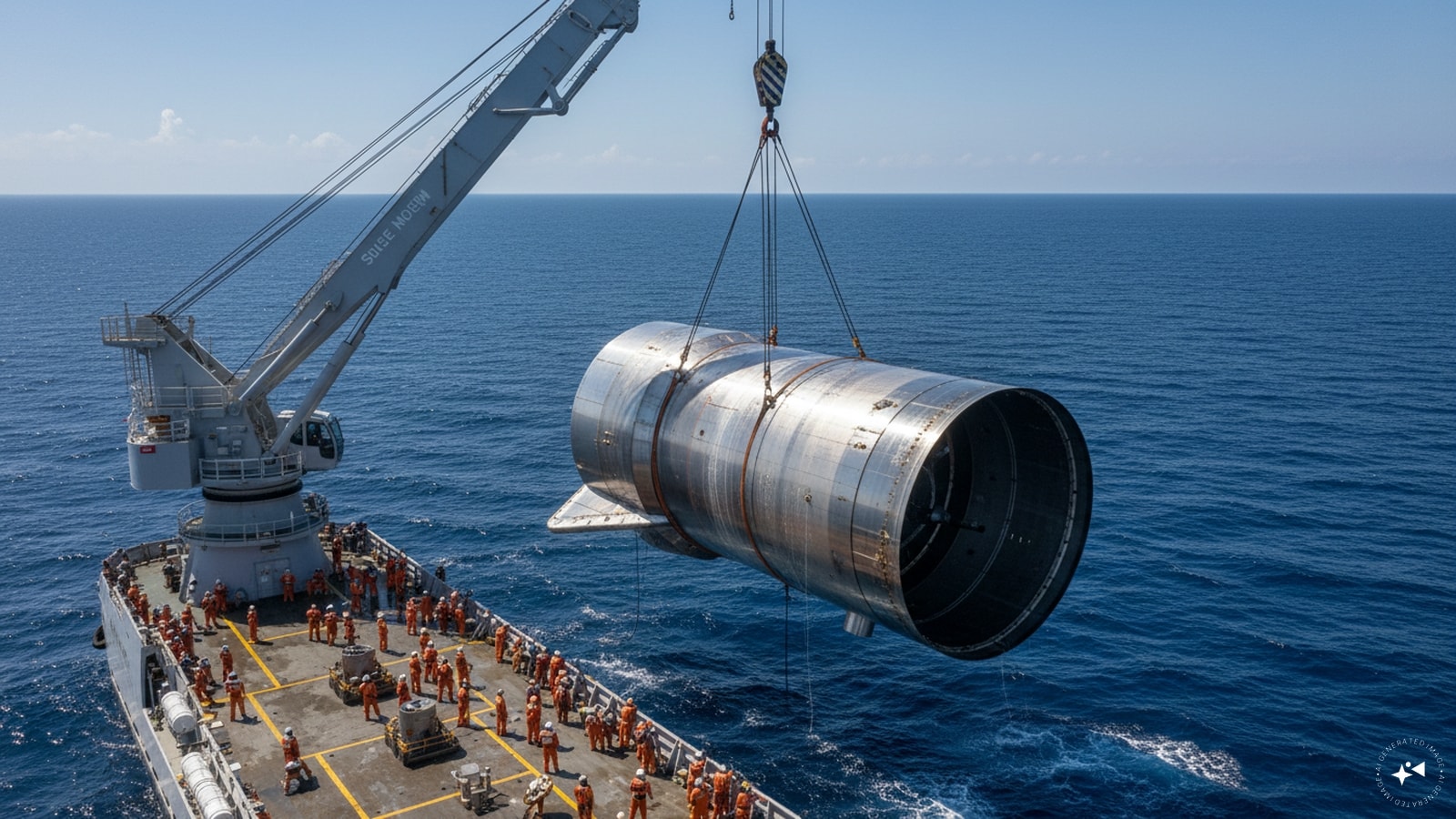
The strategic vulnerability of Western maritime security resides not on the ocean surface, but on the seabed and within the deep water column. The announcement by the United States, the United Kingdom, and Australia regarding the immediate acceleration of their first AUKUS Pillar Two signature project—the deployment of standardized, multi-mission Unmanned Undersea Vehicle (UUV) payloads by 2027—marks a critical transition from conceptual defense integration to operational deployment. This collaborative initiative addresses a severe operational deficit: the Western alliance's current inability to monitor, defend, and counter asymmetric threats across vast oceanic expanses, particularly the critical subsea infrastructure and contested littoral zones of the Indo-Pacific and the High North.
By evaluating the tactical and economic mechanics of this deployment, it becomes evident that the project is not merely an procurement exercise for robotic hulls. Instead, it is a structural re-engineering of undersea warfare designed to break the traditional, cost-prohibitive acquisition cycles of nuclear-powered attack submarines (SSNs) through modular autonomy and distributed sensor networks.
The Asymmetric Cost-Exchange Ratio of Undersea Warfare
To understand why the AUKUS partners are prioritizing UUV payloads, one must analyze the stark economic and operational asymmetries governing modern undersea combat. The traditional method of projecting power and gathering intelligence below the surface relies on manned SSNs. While these platforms possess unmatched survivability and endurance, their deployment is constrained by a highly restrictive cost function.
$$C_{\text{submarine}} = f(S_{\text{hull}}, P_{\text{nuclear}}, M_{\text{crew}}, L_{\text{cycle}})$$
Where the total cost ($C$) is driven by extreme structural survivability requirements ($S$), complex nuclear propulsion engineering ($P$), compounding crew training and sustainment costs ($M$), and multi-decade lifecycle maintenance frameworks ($L$).
Manned submarines are finite, exquisite assets. Committing a multi-billion-dollar Virginia-class or Astute-class SSN to passive monitoring of subsea fiber-optic cables or mine countermeasure operations in shallow, contested littorals represents a severe misallocation of strategic capital. It exposes a scarce platform to high-risk environments where physical or electronic neutralization yields a catastrophic loss of capability and life.
Conversely, the deployment of modular UUV networks fundamentally alters the cost-exchange ratio in favor of the defender. The operational calculus shifts toward an attritable, mass-oriented model.
- Platform Capital Expenditure: A standard large or extra-large UUV costs a fraction of a manned submarine, permitting deployment scales that can saturate a geographic theater.
- Mission Elasticity: By decoupling the payload from the propulsion system, the same UUV chassis can be reconfigured within hours to pivot from a long-range acoustic intelligence mission to an active electronic warfare or mine-clearing operation.
- Risk Tolerance: Autonomous systems remove human risk from the equation, enabling aggressive operational deployment inside anti-access/area-denial (A2/AD) envelopes where manned vessels cannot safely operate.
The Three Pillars of the AUKUS UUV Payload Framework
The trilateral agreement allocates an initial £150 million ($201 million) from the United Kingdom to jumpstart the industrial base, signaling a pivot away from platform-centric development toward payload-centric interoperability. This mechanism relies on three core operational pillars.
Unified Command and Control Architecture
The primary bottleneck in multi-national autonomous operations is software fragmentation. Historically, the US, UK, and Australian navies have operated siloed autonomous software suites, creating severe inefficiencies when attempting to share tactical data in real-time. The AUKUS signature project mandates a single, unified command-and-control (C2) software baseline.
This architecture allows an operator based in Western Australia to assume operational control of a UUV deployed by a British Royal Navy vessel in the North Sea, a capability successfully validated during recent trilateral exercises. By standardizing the C2 layer, the alliance eliminates software translation latencies and creates an interchangeable tactical ecosystem.
Modular Interoperable Payloads
Rather than co-developing a single, rigid UUV platform, the alliance is designing a suite of highly adaptable, modular payloads that adhere to a strict open-architecture physical and digital interface standard. These payloads are classified into four distinct operational profiles:
- Acoustic and Environmental Intelligence: Advanced passive sonar arrays and bathymetric sensors capable of mapping seabed typography and tracking the acoustic signatures of adversary submarines.
- Subsea Infrastructure Protection: Specialized sensor packages designed to detect, track, and deter tampering with undersea internet cables, energy pipelines, and benthic monitoring systems by hostile state actors.
- Contested Littoral Manoeuvre: Miniaturized, high-yield mine countermeasure (MCM) systems capable of autonomous detection and neutralization in shallow water environments.
- Asymmetric Strike and Deception: Kinetic and non-kinetic payloads, including localized electronic warfare jamming pods and variable-yield acoustic decoys to confuse adversary surface and subsurface sonar networks.
The Simulated Reference Environment
To accelerate the 2027 deployment timeline, the alliance is establishing a shared, synthetic test and reference environment. This cloud-linked simulation framework allows defense scientists and industry participants to model the behavior of autonomous systems under complex, real-world hydroacoustic conditions. By running millions of simulated mission permutations, the alliance can validate autonomous software logic, edge-computing algorithms, and payload behaviors without the friction and expense of continuous physical sea trials.
Structural Bottlenecks and Operational Risks
Despite the strategic utility of the AUKUS UUV framework, several severe technical and logistical bottlenecks limit its immediate efficacy. A analytical assessment reveals that autonomous undersea operations face far harsher physical constraints than aerial or surface drones.
The Hydroacoustic Communication Deficit
Radio frequency signals do not propagate through seawater. Consequently, UUVs are isolated from standard satellite communication networks and GPS data while submerged. They must rely on acoustic telemetry for communication and inertial navigation systems (INS) paired with Doppler Velocity Logs (DVL) for positioning.
Acoustic communication features low bandwidth, high latency, and is highly susceptible to environmental interference such as thermal layers, salinity variations, and ambient maritime noise. This creates a severe operational trade-off: a UUV must either remain entirely silent and autonomous—limiting real-time command intervention—or emit acoustic data bursts to report findings, which immediately compromises its location to enemy anti-submarine warfare units.
Energy Density and Propulsion Boundaries
Manned SSNs possess virtually infinite endurance due to nuclear propulsion. UUVs, conversely, are bound by the strict limitations of chemical energy storage, primarily lithium-ion or silver-zinc battery chemistries. This creates an engineering bottleneck between range, payload power draw, and speed.
An extra-large UUV drawing continuous power for advanced active sonar arrays and high-bandwidth edge processing will experience a rapid contraction of its operational radius. Until fuel cell technologies or low-power localized nuclear batteries mature, UUV deployments will remain tethered to nearby host platforms or localized coastal launch facilities.
The Industrial Supply Chain Bottleneck
Transitioning from successful prototyping—such as the trials conducted during the recent AUKUS Maritime Big Play exercises using Australia’s Speartooth UUV testbed—to industrial mass production by 2027 introduces immense supply chain friction. The precision components required for undersea warfare, including specialized transducer ceramics for sonar arrays, high-grade carbon fiber for pressure hulls, and radiation-hardened semiconductors for onboard AI processing, are subject to severe manufacturing backlogs.
The Western defense industrial base is currently optimized for low-volume, high-cost production. Scaling up to meet the demand for hundreds of expendable or attritable UUV payloads requires a radical overhaul of sub-tier supplier networks across all three nations.
The Strategic Realignment of Maritime Power
The integration of UUV payload delivery by 2027 serves as a vital bridge for the AUKUS alliance. Under Pillar One of the pact, Australia is scheduled to receive its first bought Virginia-class SSNs from the United States in the early 2030s, followed by the co-developed SSN-AUKUS platforms in the 2040s. This leaves a critical, decade-long capability gap during which the balance of naval power in the Indo-Pacific could fundamentally shift.
Pillar Two's UUV project mitigates this temporal vulnerability. By fielding a distributed fleet of autonomous underwater systems within the next twelve to twenty-four months, the alliance establishes an immediate, cost-effective layer of deterrence. This deployment signals to regional competitors that the alliance can project sensor density and defensive counter-strike options deep within contested waters long before the first physical AUKUS hull slides into the ocean.
The final strategic play for the AUKUS partners is clear: defense ministries must aggressively bypass legacy military procurement regulations, institutionalize the open-architecture payload standards across their domestic defense primes, and treat subsea autonomy not as a future technological vision, but as an immediate, mass-manufactured necessity for contemporary deterrence.