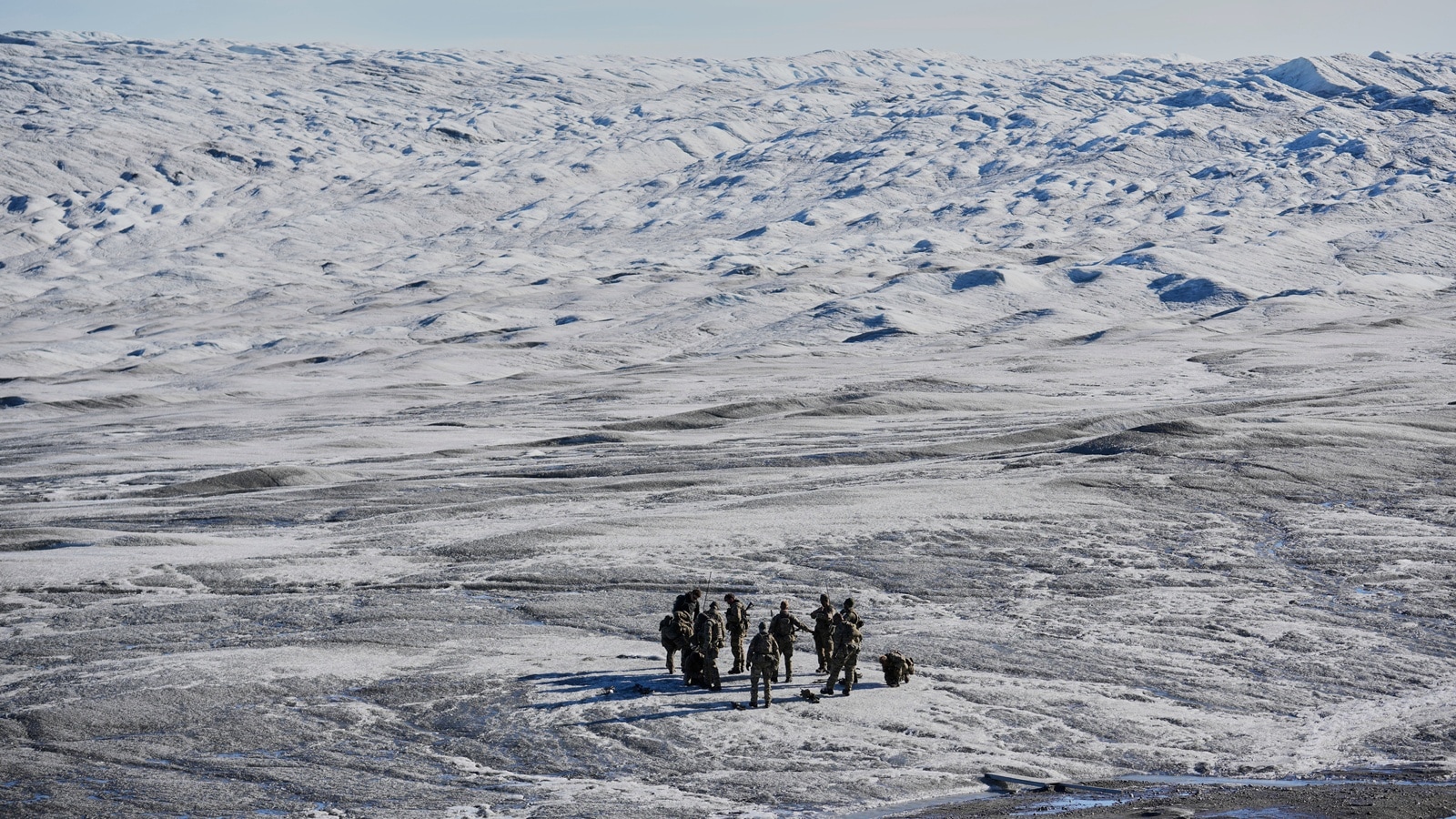
The United States’ pursuit of expanded military footprints in Greenland represents a fundamental shift from temporary rotational presence to permanent, sovereign infrastructure. This strategy hinges on the realization that the Arctic is no longer a peripheral buffer zone but a primary theater for high-latitude logistics and early-warning persistence. High-level talks regarding "sovereign territory" status for new bases signal a desire to bypass the bureaucratic friction of host-nation agreements in favor of the legal certainty required for multi-billion dollar, multi-decade capital investments.
The Strategic Calculus of Arctic Permanence
The current push for new installations is driven by three primary structural deficits in the existing Arctic defense architecture.
- The Range Gap: Existing facilities, primarily Pituffik Space Base (formerly Thule), were designed for Cold War-era ballistic missile detection. They lack the modular capacity to support modern hypersonic interceptors or long-range strike platforms that require specialized fueling and maintenance infrastructure.
- Climate-Induced Access: As sea ice diminishes, the "Northern Sea Route" and the "Northwest Passage" transition from theoretical lanes to contested commercial arteries. Control over Greenland’s coastline provides a geographic choke point to monitor and, if necessary, interdict non-NATO transit.
- The Legal Bottleneck: Standard Status of Forces Agreements (SOFA) often limit the types of sensitive equipment—such as advanced signals intelligence (SIGINT) arrays—that can be deployed. Establishing areas as sovereign US territory, modeled after the "Guantanamo" or "Unincorporated Territory" frameworks, removes the requirement for host-nation oversight on classified hardware.
The Cost Function of Sovereign Infrastructure
Building in the Arctic involves a nonlinear cost curve where logistical difficulty scales exponentially with latitude. The US military’s interest in sovereign territory is, at its core, a risk mitigation strategy for these high-capital expenditures.
The Permafrost Variable
Traditional construction fails in Greenland because of thermal transfer. Heat from a building melts the permafrost, leading to structural collapse. New bases would require "Passive Thermosyphon" technology—sealed tubes filled with pressurized CO2 that extract heat from the ground to keep the soil frozen. The investment in this technology is only viable if the US has guaranteed long-term tenure, as the amortization of these costs exceeds the typical 10-year horizon of standard international leases.
Power Density Requirements
Modern radar arrays, specifically those designed to track hypersonic glide vehicles (HGVs), require massive, consistent power loads. Standard diesel generators are insufficient for the next generation of Long Range Discrimination Radar (LRDR). Sovereign status allows for the deployment of Small Modular Reactors (SMRs) or micro-reactors without the political friction associated with nuclear energy in European-aligned territories like Denmark.
Logic of the Dual-Use Threshold
The talks are not merely about silos and runways. The proposed expansion follows a "Dual-Use Logic" where military infrastructure serves as the backbone for resource extraction.
- Rare Earth Dominance: Greenland holds significant deposits of neodymium, praseodymium, and terbium. These are critical for the permanent magnets used in F-35 motors and missile guidance systems.
- The Escrow Effect: By establishing a permanent military presence, the US effectively "de-risks" the region for private American mining firms. No company will invest $5 billion in a Greenlandic mine if the security of the shipping lanes is in question. The base acts as a physical escrow, guaranteeing the safety of the supply chain.
Geographic Displacement and Power Projection
The specific geography of Greenland creates a "Force Multiplier Effect." An aircraft or missile battery stationed on Greenland's northern coast sits at the apex of the Great Circle routes between the Northern Hemisphere’s major powers.
$$T = \frac{D}{V}$$
In this simplified relation where $T$ is time to intercept, $D$ is distance, and $V$ is velocity, Greenland minimizes $D$ more effectively than any other landmass in the Western Hemisphere. For a hypersonic threat traveling at Mach 5+, every 500 miles of proximity gained by a Greenlandic base translates to minutes of critical decision-making time for command and control (C2) systems.
The Bottleneck of Danish Sovereignty
The primary friction point in these talks is the Kingdom of Denmark’s "Constitutional Unity." While Greenland has self-rule (Act on Greenland Self-Government, 2009), foreign policy and defense remain under Copenhagen’s purview.
The US strategy involves a tiered approach to sovereignty:
- Level 1: Exclusive use of specified zones with zero local law enforcement access.
- Level 2: Total jurisdictional control, where US federal law applies to all personnel and contractors.
- Level 3: Permanent land transfer or 99-year irrevocable leases.
Denmark views Level 3 as a violation of territorial integrity, whereas the US views anything less than Level 2 as a security vulnerability. This creates a stalemate where the "talks" are likely focused on creating a new legal hybrid: "Strategic Administrative Zones."
Signals Intelligence and the Subsea Interface
A critical, often overlooked component of the new base talks is the landing of subsea fiber-optic cables. Greenland sits atop the literal "cables of the world" connecting North America to Europe. Sovereign bases would allow the US to install "Passive Intercept Nodes" directly into the terrestrial termination points of these cables.
By controlling the land where the cables emerge from the ocean, the US gains a structural advantage in data interception that cannot be achieved through satellite surveillance. This is not about "spying" in the traditional sense, but about monitoring the flow of global financial and military data that moves through the Atlantic's "Digital Undersea Highway."
Systematic Risks and Mitigation Failures
The strategy of seeking sovereign territory is not without systemic risks.
- Diplomatic Overreach: Forcing the issue of "sovereignty" can alienate the Greenlandic population (Kalaallit), potentially leading to a pro-independence movement that seeks to expel the US entirely in favor of a neutralist stance.
- The Russian Counter-Pivot: Any increase in US permanent footprint triggers a symmetrical response in the Russian Arctic, specifically in the Franz Josef Land and Novaya Zemlya archipelagos. This leads to a "Security Dilemma" where each move intended to increase safety actually decreases the overall regional stability.
- Ecological Fragility: The Arctic ecosystem does not "heal." A single fuel spill on sovereign US land in Greenland remains a permanent environmental debt. If the US holds the sovereignty, it also holds 100% of the cleanup liability, which, in the Arctic, can exceed the cost of the base itself.
The Strategic Recommendation
The United States must move away from the binary choice of "Lease vs. Buy." The optimal path is the "Project-Specific Sovereignty" model. Under this framework, the US should not seek ownership of the land, but rather "Operational Primacy" over the technological systems and the immediate physical security perimeter.
This involves:
- Establishing a joint-venture Arctic Research & Defense Command where Denmark retains the flag, but the US retains all encryption, power generation, and tactical control.
- Prioritizing the deployment of mobile, modular assets over massive concrete "targets." The future of Arctic defense is not a single large base, but a network of "Distributed Nodes" that can be activated or deactivated based on the threat environment.
- Integrating Greenlandic economic interests directly into the base logistics. By making the local economy dependent on the base’s power grid and desalinization plants, the US creates a "social license to operate" that is more durable than any legal treaty.
The goal is a "Ghost Presence"—an infrastructure so integrated into the landscape and the local economy that it becomes inseparable from Greenland’s own survival, thereby achieving the benefits of sovereignty without the political cost of annexation.