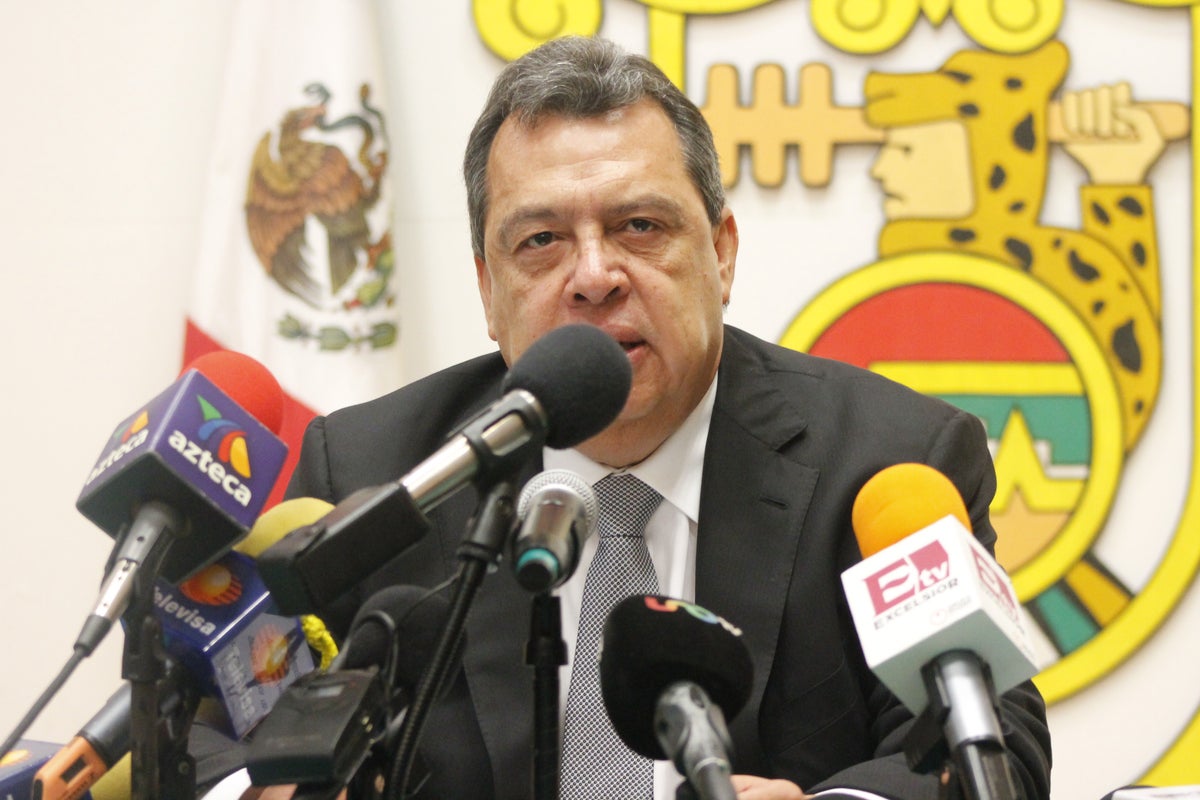
Every time handcuffs click around the wrists of a former Mexican official tied to the Ayotzinapa tragedy, the international press corps treats it as a structural victory. Headlines flash across global terminals. Pundits celebrate accountability. Watchdog organizations praise the slow, grinding wheels of justice finally catching up to the powerful.
It is theater. In similar news, read about: Why Everything You Know About the US Brazil Diplomatic War is Wrong.
The recent arrest of yet another former governor over the alleged cover-up of the 43 missing students from the Ayotzinapa Rural Teachers' College is being heralded as a turning point. It is not. It is a convenient political ritual designed to satisfy the appetite for symbolism while leaving the underlying machinery of impunity completely untouched.
We have watched this script play out for over a decade. A high-profile target is paraded before the cameras. The state declares a milestone in transparency. Yet the systemic rot that allowed students to vanish in Iguala on that night in September 2014 remains as entrenched as ever. Targeting individuals without dismantling the institutional incentives that protect corruption is like bailing out the ocean with a teacup while leaving the hull completely shattered. The Washington Post has analyzed this important topic in extensive detail.
The Lazy Consensus of Individual Culprits
The dominant narrative pushed by mainstream outlets relies on a comforting illusion: that corruption is simply a bad apple problem. According to this lazy consensus, Mexican state institutions are basically sound, but occasionally infiltrated by uniquely malicious actors. If you remove the bad actors, the system purifies itself.
History proves the exact opposite.
I have spent years watching political analysts misdiagnose structural crises as moral failures of single leaders. When Tomás Zerón, the former head of Mexico's Criminal Investigation Agency, fled the country amid allegations of fabricating evidence and torturing witnesses in the Ayotzinapa case, the focus fixed entirely on his personal malfeasance. When former Attorney General Jesús Murillo Karam was arrested, the media framed it as the ultimate reckoning.
These arrests mistake symptoms for the disease.
The 43 students did not vanish because a governor or an investigator woke up one morning and decided to act like a villain in a melodrama. They vanished because local police, organized crime syndicates, and military garrisons operate in an overlapping ecosystem of operational interdependence. When the local state apparatus is fused at the hip with cartels, arresting the governor at the top of the pyramid does not alter the economic and territorial realities on the ground. The cartel still owns the transit routes. The municipal police still take the envelopes of cash. The next guy in the chair inherits the exact same corrupted incentives.
The Architecture of Impunity
To understand why arresting former governors changes nothing, we have to look past the political theatre and examine the mechanics of power in regional Mexican politics.
Imagine a scenario where every single politician ever accused of a cover-up in the Ayotzinapa case is convicted and locked away for life. Does that stop a local cartel from controlling municipal police forces? Does it rewrite the archaic procurement laws that starve local law enforcement of honest operating budgets, forcing them to rely on illicit funding streams? Does it reform a military justice system that historically resists civilian oversight?
No. Because the political survival of any official in a high-risk region depends on accommodation, not confrontation.
When federal power confronts local criminal governance, it rarely seeks to eradicate it; it seeks to negotiate terms. The official narrative surrounding Ayotzinapa—the infamous "historical truth" concocted under the previous administration—was not just a sloppy cover-up by panicked bureaucrats. It was a calculated defense mechanism of the state. The goal was to protect the institutional reputation of the military and the ruling apparatus from a truth too destabilizing to handle: that the lines separating the state from organized crime had completely dissolved.
When you arrest a former governor for covering up a crime, you are prosecuting someone for protecting a system that the federal government itself relies on to maintain a fragile, managed stability.
The Wrong Questions Driving the Coverage
If you follow international coverage of Mexico's security crisis, the questions being asked are fundamentally broken.
- When will all the masterminds behind Ayotzinapa be brought to justice?
- Can the current administration restore trust in the judicial system through high-profile prosecutions?
- Does this arrest prove that impunity is finally ending in Mexico?
These questions assume that "justice" in this context is a finite resource that can be accumulated through convictions, and that "trust" can be restored via public relations spectacles.
The real questions are entirely different:
- How do you dismantle a local political economy where public office is financed by criminal syndicates?
- What happens to regional security when you remove a corrupt governor without replacing the underlying financial dependencies of the police force?
- Why does the state continue to prioritize institutional self-preservation over structural transparency?
Asking these questions forces us to confront an uncomfortable truth. The state does not want total transparency because total transparency requires admitting that the modern Mexican state was built on compromises with criminal power structures that date back decades.
The Cost of Performative Accountability
Performative justice has a tangible body count. Every time a high-profile arrest dominates the news cycle, it creates a temporary political sedative. The public feels a momentary rush of vindication. The pressure on lawmakers to enact painful, structural reforms evaporates because "something is being done."
Meanwhile, the structural vulnerabilities remain untouched. Prosecutors still rely on coerced confessions because forensic capabilities at the state level are atrocious. Independent investigative bodies are routinely starved of resources or undermined politically when their findings cut too close to the bone. Families of the victims are forced into a permanent loop of grief and political gaslighting, where every new administration promises a fresh start while recycling the same old tactics of deflection and selective prosecution.
We do not need more perp walks. We need an admission that the entire model of policing and regional governance in high-risk zones is structurally bankrupt.
Until policymakers stop treating corruption as a personal moral failing and start treating it as an inevitable output of misaligned institutional incentives, every arrest is just another episode in an ongoing political soap opera.
Stop celebrating the handcuffs. Start demanding the blueprints.