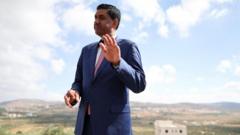
The sun over the southern West Bank doesn't just shine; it bakes. It reflects off the chalky white stone of Khirbet Zanuta, a ghost village where life used to exist. On a scorching Wednesday in July, the silence here was absolute, heavy with the weight of forced displacement. A school stood hollowed out, its walls reduced to rubble. Homes lay abandoned, evacuated under the pressure of escalating violence.
For Ro Khanna, a progressive Democratic congressman from California, this was meant to be a fact-finding mission. He wanted an unfiltered look at the human toll of the occupation. He was walking through the debris, absorbing the quiet devastation, when the silence shattered.
A van carrying Khanna and his American delegation was suddenly cut off. A group of masked men emerged. They were not wearing uniforms. They carried no official badges. Yet they wielded the ultimate authority of the terrain: American-made M4 rifles.
The Shock of Unchecked Power
The men who surrounded the vehicle were young Israeli settlers, barely out of their teens. In their eyes, Khanna later noted, lived a fierce, unyielding arrogance. They laughed as they blocked the path, trapping a sitting United States representative, his aides, and a traveling photojournalist in the dust.
Powerlessness is an unfamiliar sensation for a Washington lawmaker. Usually, a congressional pin opens doors. It commands respect. It acts as an invisible shield against the chaotic realities of international conflict. But in the jagged hills of the West Bank, that shield evaporated.
For ninety agonizing minutes, the delegation sat trapped. Cameron Kasky, an aide traveling with Khanna, watched the scene unfold with a growing sense of urgency. Phone calls were placed. Text messages were fired off to the United States Embassy in Jerusalem. The requests were simple: We are American citizens, we are officials, and we are being held at gunpoint.
Then, the military arrived.
The appearance of the Israel Defense Forces should have signaled relief. Instead, it brought a deeper, more chilling revelation. When the young soldiers rolled up to the scene, they did not admonish the armed civilians blocking the road. They did not order the rifles lowered. Instead, they exchanged friendly words with the settlers. They sided with them. The soldiers reinforced the blockade, extending the detention of the American delegation.
Consider the irony that hung over that dirt road. Khanna, a federal lawmaker who votes on US foreign policy, found himself staring down the barrels of M4 automatic rifles—weapons manufactured in America, supplied via agreements brokered in Washington, and carried by men backed by a military that receives billions in American taxpayer dollars. The machinery of his own government was being used to hold him hostage.
The Illusion of Safety
"I felt powerless in that situation," Khanna later admitted, reflecting on the encounter. "Which is not an easy thing, as I have a lot of privilege in life."
His vulnerability is a window into a much darker reality. If an American congressman traveling with a national press presence and a direct line to the US Embassy can be detained on a whim by twenty-year-olds with machine guns, what happens when the cameras turn away?
The true focus of this encounter isn't actually Ro Khanna. It is the invisible populace that walks these roads every day without a smartphone, without a security detail, and without a platform. The event exposed a systemic blueprint of occupation: a toxic culture of total impunity, where civilian settlers and state military forces operate in a seamless loop, leaving local Palestinians entirely unprotected.
The Israeli military later issued a statement offering a sanitized version of events. They claimed troops were dispatched to disperse civilians blocking foreign nationals and that soldiers did not participate in the blockade. But the testimony from the ground paints a vastly different picture—one of mutual understanding between the armed settlers and the young soldiers tasked with policing them.
The Electoral Aftershocks
This ninety-minute standoff in a ruined Bedouin village is already rippling outward, threatening to reshape the upper echelons of American politics. Khanna is not just an outspoken progressive; he is a man openly weighing a presidential run in 2028.
The conflict in the Middle East has fractured the Democratic Party. For years, the party establishment treated unconditional support for Israel as a baseline policy, an immovable piece of the geopolitical puzzle. But younger voters, progressives, and Arab-American communities have fundamentally rejected that status quo. The legislative battle lines are drawn, and the generational divide is widening into a canyon.
Khanna’s willingness to bypass the standard, carefully curated diplomatic tours to look directly at the ruins of Khirbet Zanuta was already a bold political statement. His subsequent detention has transformed a policy disagreement into a visceral, deeply personal crusade.
The experience has not deterred him. If anything, it has hardened his resolve. He spoke out sharply against what he termed a "blank check" policy, linking the party's previous electoral losses in key swing states like Michigan and Wisconsin directly to an administration that he argues has turned a blind eye to human rights abuses.
The dust has settled in Khirbet Zanuta, and the congressman’s convoy eventually moved on after Israeli police finally intervened to clear the road. But the political landscape back in Washington has been permanently altered. The memory of young men laughing behind American rifles remains etched into the narrative of a lawmaker who went searching for the truth of the occupation—and found himself staring directly into its eyes.