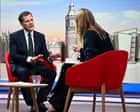
There is a specific kind of theater played out under the harsh lights of television studios, and it relies entirely on a straight face.
Imagine walking into a room smelling faintly of dry paper and cold ambition. Across from you sits a man whose tie is knotted with millimeter precision, his hair pushed back into a neat, immovable architecture. He looks like he has never spilled coffee on his shirt in his life. He looks like a man who spent his childhood practicing sincerity in front of a three-way mirror.
His name is Robert Jenrick, and he is here to talk about money. Not just any money, but the kind that arrives in large, polite parcels from people whose names rarely appear on high street plaques.
Politics has always had its mechanics, but there is something uniquely modern about the way large donations are escorted through the front door of public life, bowing politely to transparency laws while slipping past the scrutiny of anyone too tired to check the footnotes. When a political vehicle like Reform UK secures another multi-million-pound injection from a wealthy benefactor, the machine immediately pivots to damage control. And who better to deploy than a man who wears the polished armor of institutional respectability?
To understand why this matters, you have to strip away the jargon of election commissions, donation thresholds, and declaration timelines. You have to look at the raw mechanics of influence.
Money is not just a resource in modern politics. It is gravity. It warps the space around it, pulling media attention into its orbit, buying prime real estate in the minds of voters, and transforming fringe grievances into mainstream inevitabilities. When a check with seven zeroes clears into an account, the political weather changes. The air gets heavier. The microphones multiply.
Yet, when the cameras roll, the defense is never about the gravity. It is about the weather.
"Generosity," the polished voice will murmur, leaning slightly toward the interviewer with the practiced concern of a family doctor delivering difficult news. "Just ordinary people backing a movement they believe in."
Ordinary. That is the magic word. It is a word designed to evoke images of pensioners putting five pounds into a collection tin at a village hall bake sale. It wraps a multi-million-pound corporate or high-net-worth transaction in the homespun warmth of community spirit. It asks you to squint so hard at the ledger that a city financier looks just like your neighbor Dave who volunteers down at the youth club.
Consider how the narrative is constructed.
First, you normalize the scale. Millions are no longer astronomical sums; they are merely the cost of doing business in a crowded marketplace of outrage.
Second, you personalize the benefactor. They are rarely portrayed as strategic investors seeking a return on political capital. Instead, they are painted as brave mavericks stepping out of the shadows to save the common man from the suffocating grip of the establishment.
Third, you attack the critics. Anyone who questions the provenance of the funds or the motives of the donor is instantly labeled part of the very elite you are supposedly fighting against. It is a brilliant, self-sealing loop.
Robert Jenrick understands this loop better than most. He has spent years navigating the strange corridors where conservative orthodoxy rubs shoulders with populist grievance. He knows how to speak the language of the shires while appealing to the restless energy of the suburbs. When he steps up to defend the latest influx of cash, he isn't just defending a rival party's balance sheet; he is defending the broader ecosystem of transactional politics that keeps the whole wheel spinning.
Because let us be honest about what is happening beneath the polished veneer.
Money in politics is never a gift. It is an investment. People who write checks of that magnitude do not do so out of a sudden, overwhelming surge of philanthropic spirit. They do it because they want a seat at the table when the menu is being written. They want influence over the contours of the national debate. They want the sharp edges of their own interests smoothed down by government policy.
When that reality is dressed up in the language of democratic participation, it becomes dangerous. Not because politics shouldn't be funded—democracy is an expensive enterprise—but because it breeds a profound, gnawing cynicism among the public.
You see it on the faces of people waiting for the morning bus in towns where the factories closed thirty years ago and never came back. They watch the endless parade of well-dressed men talking about millions of pounds changing hands between people they will never meet, for reasons they can barely influence. They feel the distance between the grand theater of Westminster and the quiet struggle of paying next month's energy bill.
The tragedy is not that wealthy people want to buy influence. That has been happening since the first coins were minted. The tragedy is how easily the machinery of justification has been perfected.
You watch the interview finish. The host nods, the credits roll, and the screen cuts to a commercial for luxury cars. The studio lights cool down. The men in suits shake hands, pack up their briefcases, and step out into the London evening, where the rain is just starting to slick the pavement.
The money has cleared. The defense has been delivered. And the rest of us are left wondering when the conversation is ever going to be about us.


