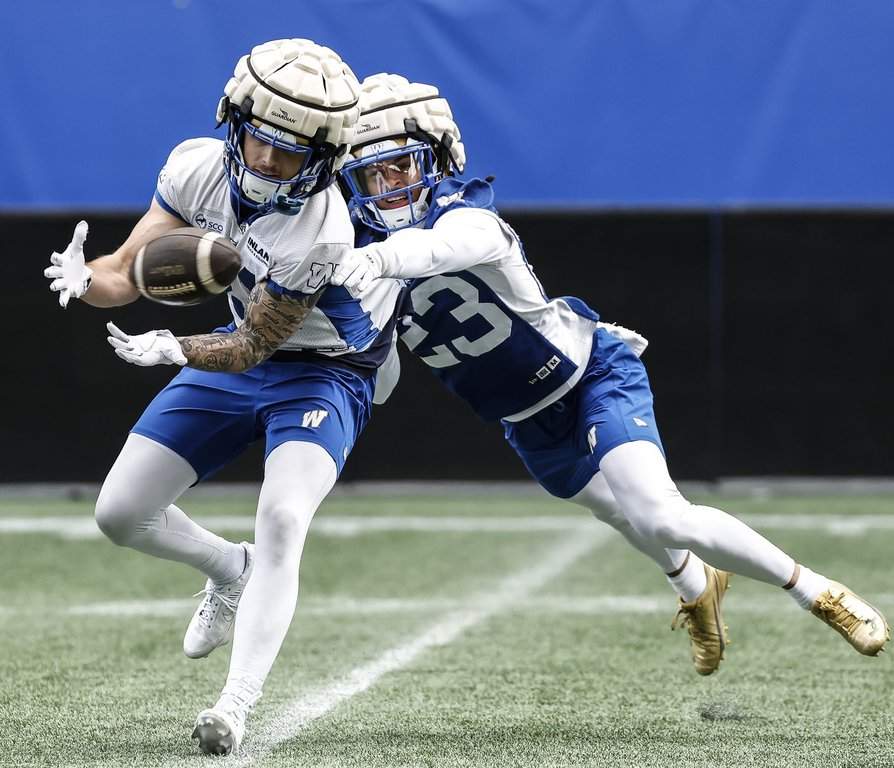
The turf at Princess Auto Stadium has a specific scent when the humidity spikes. It’s a mix of recycled rubber, industrial cleanser, and the metallic tang of sweat. For most players, it’s just the smell of the office. For DeVonte Vaval, it’s the smell of a narrow window.
In the Canadian Football League, being a "return specialist" is a gilded cage. You are the designated lightning bolt. You exist for those frantic, ten-second windows where the ball hangs in the air and twelve men with bad intentions are sprinting toward your throat. It is a job defined by highlights and high-speed collisions. But for Vaval, the electricity of the return game isn't enough. He wants the grind. He wants the dirty work of a defensive back, the snap-by-snap chess match where a single misstep means six points for the other side.
He is no longer content being the man who only appears when the clock is stopped.
The Gravity of the Second Year
There is a psychological cliff that every professional athlete faces between their first and second seasons. The rookie year is fueled by adrenaline and the sheer shock of having "made it." You play on instinct. You survive on raw speed. But the "sophomore slump" isn't just a cliché; it’s a mathematical reality. By year two, there is film on you. Coaches in Regina, Calgary, and Toronto have sat in dark rooms with lukewarm coffee, dissecting your tendencies. They know if you lean back before a sprint. They know if you’re susceptible to a double move.
Vaval entered his second camp with the Winnipeg Blue Bombers knowing that "fast" is a baseline, not a career plan. To transition from a situational weapon to a defensive anchor, a player has to undergo a fundamental shift in identity. It’s the difference between being a sprinter and being a sentinel.
Consider the mechanics of a corner. It is perhaps the most lonely position in sports. You are playing the game backward, retreating at full speed while trying to mirror the movements of a receiver who knows exactly where he’s going. If a quarterback misses a throw, it’s an incomplete pass. If a lineman misses a block, the play might still survive. But if a defensive back misses his assignment? The siren goes off. The fireworks explode. Every eye in the stadium finds you.
That is the pressure Vaval is inviting. He isn't just asking for more playing time; he is asking for the right to be the villain in someone else’s highlight reel.
The Invisible Stakes of the Depth Chart
Professional football is an ecosystem of brutal efficiency. In the CFL, the roster is a puzzle of "nationals" and "americans," a balancing act dictated by the ratio. Every spot on the active roster is a piece of prime real estate. When a player like Vaval pushes for a starting role on defense, he isn't just competing against the opposing team’s wideout. He is competing against the internal logic of the coaching staff.
Why risk your primary returner on defense? If he takes a hard hit on a second-and-ten crossing route, who catches the punt in the fourth quarter?
This is the tension that defines Vaval’s current trajectory. He has to prove that his value on the field is greater than the risk of his absence. To do that, he has to master the "dark arts" of the secondary. It’s not about the forty-yard dash anymore. It’s about the "jam" at the line of scrimmage—the ability to put a hand on a receiver’s chest and disrupt his timing by a fraction of a second. It’s about eye discipline. It’s about knowing that the quarterback’s pump-fake is a lie told with the shoulders.
During the offseason, while fans were looking at stat sheets, Vaval was likely looking at geometry. Football at the professional level is a game of angles. If a receiver has a three-step head start, the angle of pursuit determines whether the play ends in a tackle or a touchdown. Vaval’s background as a returner actually gives him a unique perspective here. He knows what a defender’s fear looks like because he has spent his life trying to provoke it. He understands the hesitation that a sudden change of direction causes. Now, he’s learning how to suppress that hesitation in himself.
The Weight of the Blue and Gold
Winnipeg is a town that demands a specific kind of player. The Blue Bombers' identity under Mike O’Shea isn't built on flash. It’s built on "physicality" and "work rate"—words that get thrown around so often they almost lose their meaning until you see a player dive into a pile of bodies for a fumble that most people would have given up on.
Vaval is trying to weave himself into that fabric. Being a star returner makes you a fan favorite, but being a starting defender makes you a teammate. There is a different level of respect earned in the film room when you can point to a disguised coverage that forced a check-down.
Imagine the heat of a July afternoon practice. The air is thick enough to chew. Vaval is lined up against a veteran receiver, someone who has been in the league since Vaval was in middle school. The receiver tries a subtle shove at the break. A rookie might complain to the ref. A second-year player looking for a starting job just shoves back harder.
That grit is the currency of the locker room. Vaval’s push for a defensive role is a signal to the veterans that he isn't just a "track guy" playing football. He’s a football player who happens to be fast.
The Silence Between the Whistles
There is a specific kind of silence that happens right before the ball is snapped. For a returner, that silence is filled with the wind and the sight of a leather ball tumbling through a grey prairie sky. It’s a solo performance.
But on defense, that silence is communal. You are connected by invisible strings to the linebacker on your left and the safety behind you. You are part of a hive mind. Vaval is learning to hear the communication, the late-shift calls, the "under, under, under" screams that happen in the split second before the chaos begins.
His growth isn't measured in return yards this season. It’s measured in the lack of completions in his "zip code." It’s measured in the way he stays "on the hip" of a vertical threat, erasing the quarterback’s first option and forcing him to hold the ball for an extra heartbeat—just long enough for the defensive line to get home.
The transition is never linear. There will be games where he gets burned. There will be afternoons where the speed of the pro game feels like it’s being played at 1.5x speed. But the drive to be more than a specialist is what separates the brief flashes in the pan from the players who define an era.
The Long Road to the Boundary
We often talk about "breakout" seasons as if they happen overnight. We see the interception or the forced fumble and think, there he is. We miss the thousands of repetitions of backpedaling. We miss the late-night sessions with a tablet, watching the same five-second clip of a slant route until the pixels blur.
Vaval is in the middle of that invisible work. He is fighting the perception that he is a "one-trick pony." In a league as competitive as the CFL, where the talent gap is razor-thin, the players who survive are the ones who can do the things that don't make the evening news.
He is still the man who can turn a broken play into a sixty-yard sprint. That hasn't left him. But now, he wants to be the man who prevents that sprint from happening to someone else. He wants the responsibility of the goal-line stand. He wants the burden of the "island."
The sun sets over the stadium, casting long, distorted shadows across the turf. The lights hum with a low, electric vibration. DeVonte Vaval stands at the corner, eyes locked on the man across from him, waiting for the snap. The ball is no longer his to catch. It’s his to take.
He isn't just returning kicks anymore. He is returning to the roots of the game, where the only thing that matters is the man in front of you and the refusal to give an inch.
The stadium will eventually fill with screaming fans, and the announcers will call his name when he breaks into the open field on a punt return. They will marvel at his speed. But the real story is happening in the quiet moments, in the press-man coverage, and in the bruising contact of a run-fit. That is where a career is built. That is where a specialist becomes a cornerstone.
He is ready for the noise. But he’s working for the silence.
The turf still smells the same, but the view has changed. For Vaval, the field isn't just a place to run anymore; it’s a place to stay.