Records are for track meets and drag strips. In deep space exploration, they are often a hollow distraction from engineering reality.
The media is currently obsessed with a single metric: distance. Specifically, the fact that Artemis II is slated to carry four humans farther from Earth than any person has ever traveled, eclipsing the record set by the Apollo 13 crew in 1970. This narrative frames space flight as a series of olympic milestones—higher, faster, farther. It’s a comforting, linear way to track progress.
It’s also entirely beside the point.
Chasing the "farthest from Earth" title is a vestige of the 1960s Space Race ego. If we want to actually inhabit the solar system, we need to stop cheering for odometer readings and start looking at the grueling, unglamorous physics of the skip reentry and the life support margins that actually define the Artemis era.
The Apollo 13 Record Was an Accident of Survival
To understand why the Artemis II distance record is a superficial goal, you have to look at why the record exists in the first place. Apollo 13 didn’t set out to break a distance record. They were forced into a high-altitude "free-return trajectory" because their Service Module was a ticking time bomb.
The moon’s position in its slightly elliptical orbit at that specific moment pushed Jim Lovell, Jack Swigert, and Fred Haise approximately 400,171 kilometers away from home. It was a byproduct of a desperate scramble to use lunar gravity as a slingshot to save three lives.
When Artemis II exceeds this by a few thousand kilometers, it won’t be because we’ve unlocked some hidden tier of propulsion technology. It’s because the mission profile—a hybrid free-return trajectory—requires a specific orbital apogee to ensure the crew can return to Earth using nothing but the cold, hard math of gravity if their engines fail.
Celebrating this as a "record-breaking achievement" is like celebrating a ship for drifting further out to sea because the tide was exceptionally high. It’s a geographical quirk, not a technical triumph.
The Real War is Thermal, Not Spatial
The layman asks, "How far did they go?" The engineer asks, "How fast are they hitting the atmosphere?"
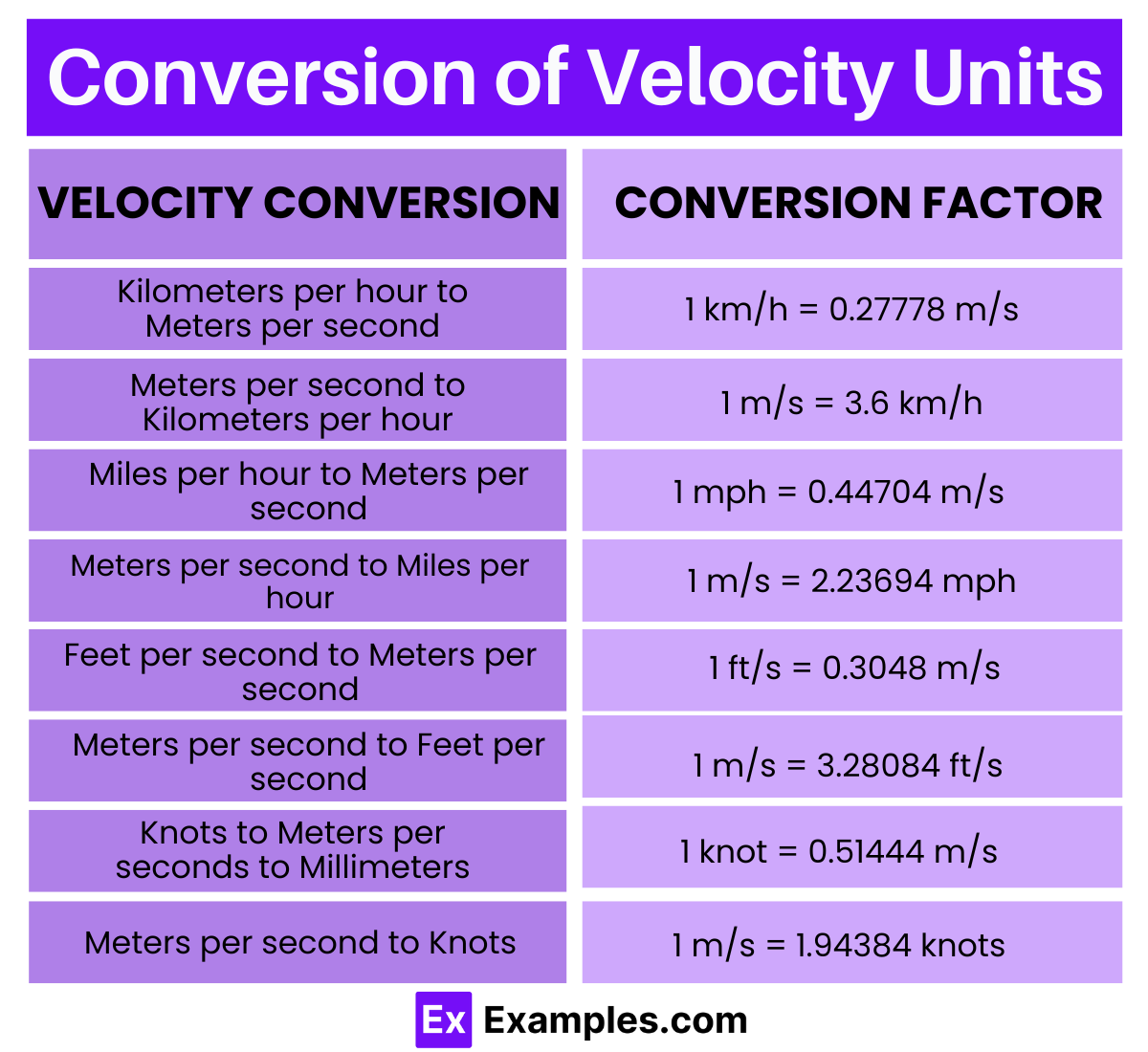
The true leap between the Apollo era and Artemis II isn't the distance from Earth; it's the energy management during the return. Apollo capsules hit the atmosphere at roughly 11 kilometers per second ($11 km/s$). They threw away kinetic energy by turning their heat shields into sacrificial charred husks.
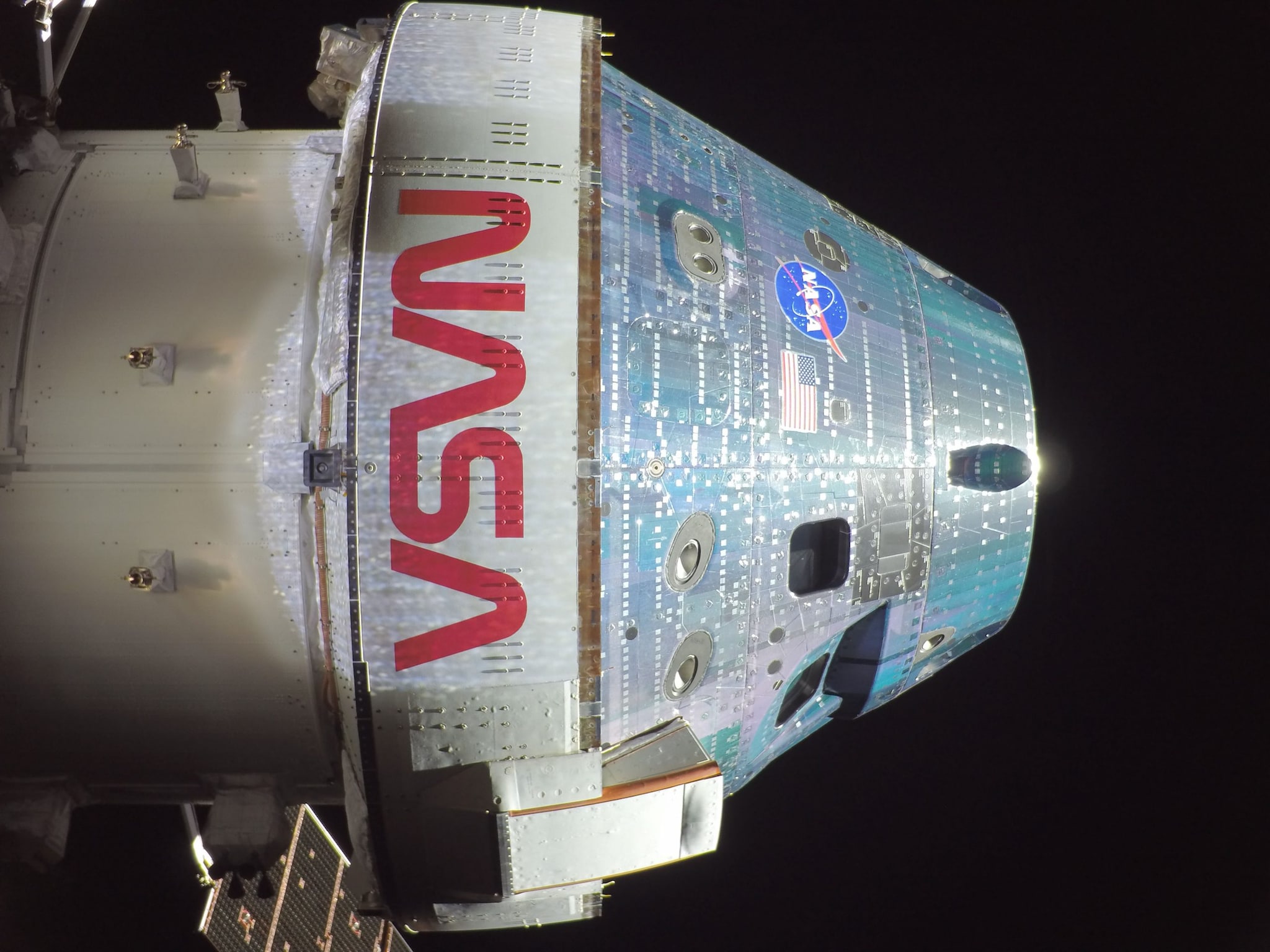
Artemis II is testing the Orion spacecraft’s ability to handle a "skip reentry." Imagine skipping a stone across a pond. Orion will dip into the upper atmosphere, use its lift-to-drag ratio to bounce back out into space briefly, and then plunge back in for the final descent.
Why do this? To reduce the G-loads on the crew and to allow for more precise landing sites. It’s a far more complex aerodynamic feat than anything the Apollo crews attempted. This is where the mission succeeds or fails. If the guidance computer misses the "skip" angle by a fraction of a degree, the crew either skips off into a permanent solar orbit or incinerates during an over-steep descent.
If you're focused on the distance record, you’re missing the fact that we are trying to master the art of controlled atmospheric skipping at $25,000 mph$. That is the delta. That is the progress. The distance is just the runway.
The Fallacy of "All You Need to Know"
Most coverage of Artemis II treats the mission like a scenic flyby. They list the crew—Reid Wiseman, Victor Glover, Christina Koch, and Jeremy Hansen—as if they are passengers on a very expensive tour bus.
They aren't. They are test pilots in a vehicle that is, in many ways, less "proven" than the Saturn V was by its second crewed flight.
Consider the heat shield. During the uncrewed Artemis I mission, the Orion heat shield experienced "ablation" issues—charred material wore away in a manner that wasn't perfectly predicted by the models. NASA has spent months dissecting why chunks of the shield didn't behave as expected.
When people ask, "When are we going back to the moon?" they are asking about a destination. The real question is: "Can we build a reusable heat shield architecture that doesn't require a total redesign after every encounter with lunar-return velocities?"
The "distance record" is a PR shield used to deflect from the granular, terrifyingly difficult work of fixing these thermal protection systems. We are betting four lives on the idea that we’ve understood the fluid dynamics of a plasma wake better than we did in 2022.
The Cost of the PR High
There is a danger in selling the public on records. When you frame success as "going further than before," you create a treadmill of diminishing returns. After Artemis II, what’s the next distance record? Artemis III will stay in a Near-Rectilinear Halo Orbit (NRHO), which might actually bring them closer to Earth at certain points than the Artemis II apogee.
By the media's own metric, Artemis III—the actual moon landing—could be seen as a "step back" in terms of distance from the home planet.
This is why the "distance" narrative is toxic. It prioritizes the "First, Best, Furthest" mentality over the "Sustainable, Scalable, Repeatable" requirement. Deep space isn't a mountain to be climbed once for a photo op. It’s an environment to be managed.
High Earth Orbit is the True Proving Ground
Before Orion heads for the moon, it will spend roughly 24 hours in a High Earth Orbit (HEO). This is the most underrated part of the mission. Most articles skip right to the lunar injection.
In HEO, the crew will perform proximity operations. They will use the spent ICPS (Interim Cryogenic Propulsion Stage) as a target, maneuvering the massive Orion capsule around it to test manual handling. This is where the "pilot" in "test pilot" actually matters.
Apollo had the advantage of being built in an era of "disposable" thinking. If a docking didn't work, you had limited options. Artemis is being built as a modular system that must interface with a Gateway station, a SpaceX Starship HLS, and future logistics modules.
The proximity ops in Earth orbit are a far better indicator of our future in space than how many miles the odometer shows behind the moon. If they can't dance with a spent rocket stage in Earth orbit, they have no business trying to dock with a landing craft 240,000 miles away.
The Fragility of the Life Support Loop
Let's talk about the Environmental Control and Life Support System (ECLSS). On the International Space Station, if a CO2 scrubber fails, you have a closet full of spares and a cargo ship coming in a few weeks. In deep space, you have what’s in the walls.
Artemis II is the first time the Orion ECLSS will be pushed by four metabolisms for ten days in a deep-space radiation environment.
The competitor articles love to mention that the crew will see the "farside" of the moon. They rarely mention that they will be doing so while monitoring whether their urine-processing and oxygen-generation systems can handle the spike in demand without the safety net of a quick trip back to low Earth orbit.
The "record" we should be tracking is the "Mean Time Between Failure" for life-critical components. But "NASA Achieves 99.9% Reliability on Oxygen Manifold" doesn't get the clicks that "Breaking Apollo's Record" does.
Stop Looking at the Odometer
We have been conditioned to view space exploration as a series of flags and footprints. We want the "biggest" rocket and the "furthest" distance because those are easy to visualize. They fit into a spreadsheet.
But space is not about distance. It is about velocity change ($\Delta v$) and thermal management.
Artemis II is a mission designed to see if we can survive the return trip from the moon, not just the journey there. The fact that the path happens to loop a few thousand kilometers further out than a crippled 1970s spacecraft is a statistical irrelevance.
If we celebrate the record, we validate the idea that space is a stunt. If we want to stay there, we have to start celebrating the skips, the scrubbers, and the heat shields.
The moon is 384,400 kilometers away. Going 400,000 or 405,000 doesn't make us more of a space-faring civilization. Mastering the skip reentry does.
Stop checking the mileage. Watch the telemetry.