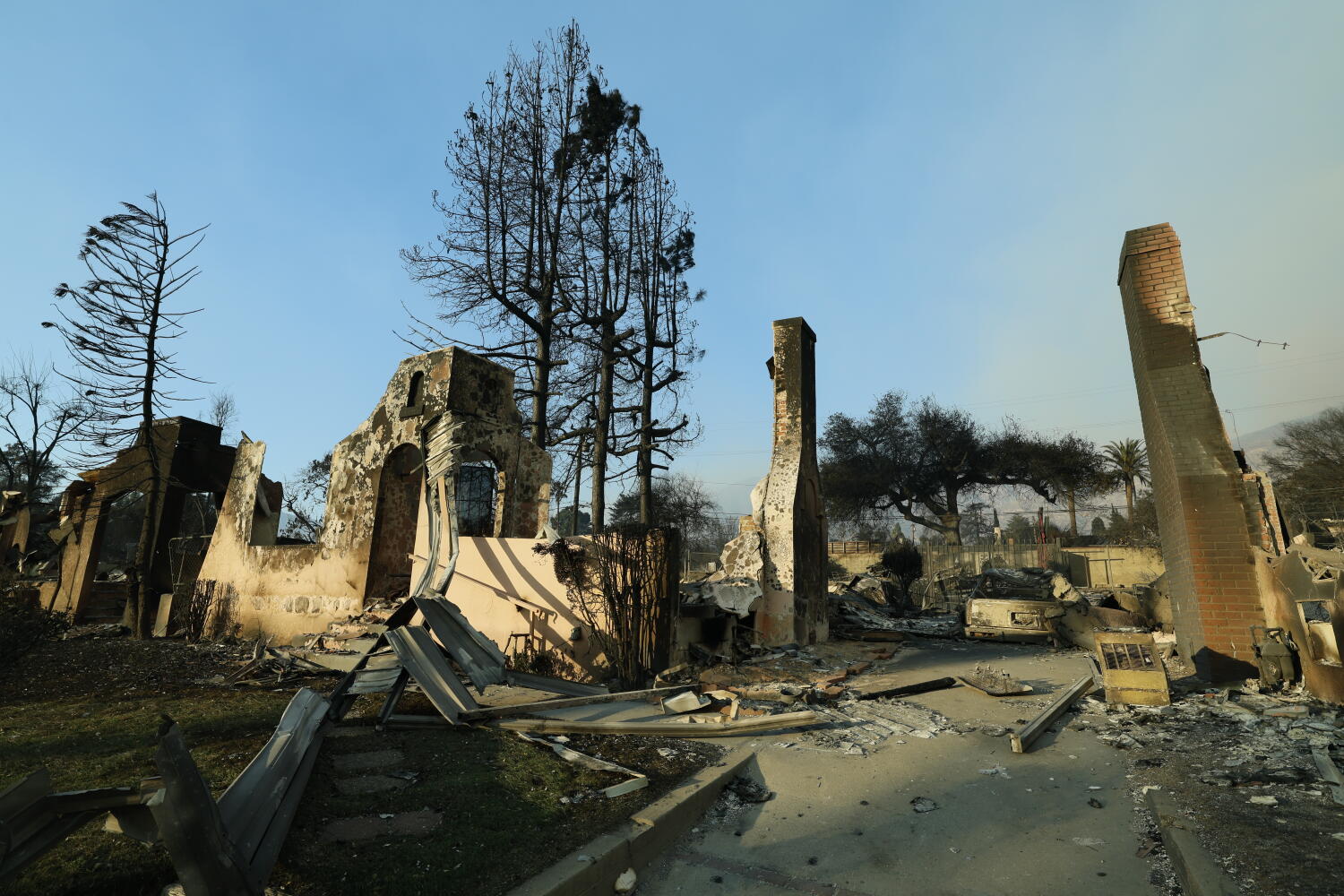
The air in the Santa Clarita Valley never quite forgets the smell of burning cedar. Long after the flames have been beaten back by weary crews in yellow coats, long after the choppers stop churning the smoke-choked sky, the scent lingers in the fabric of a sofa, in the rafters of a charred garage, in the quiet, creeping panic of a Tuesday afternoon when the wind shifts from the east.
When you stand in the footprint of a home that was yours for thirty years, the math of loss is not calculated in millions of dollars. It is calculated in missing wedding albums. In the dented coffee mug your daughter painted in the second grade. In the suffocating realization that the safety net you paid for month after month, year after year, might just be a ghost story written in 12-point font on cream-colored paper.
Los Angeles County officials looked at that exact kind of ash recently, and instead of writing another polite memo, they decided to sue.
They targeted State Farm, one of the titan insurers of the American domestic landscape. The lawsuit, filed on behalf of the county, cuts straight to a terrifying vulnerability: the gap between the promise of protection and the reality of corporate survival instincts when whole neighborhoods turn to charcoal.
The Anatomy of a Paper Promise
Insurance is an invisible architecture. We buy it the way we buy air conditioning or earthquake insurance—hoping with every fiber of our being that we will never actually need to test its structural integrity. You pay your premiums. You autopay on the first of the month. You trust that if the monster comes down the canyon, someone will be there to help you rebuild the walls.
State Farm, like many of its peers, has faced an existential squeeze in California. Megafires are no longer anomalies; they are annual seasons. The mathematical models that insurance actuaries used for a century are broken. Climate reality has outpaced corporate comfort.
So what do corporate giants do when the risk gets too high? Sometimes, they quietly retreat. They tighten the purse strings. They slow-walk claims. They introduce bureaucracy so thick and suffocating that people who have lost everything give up halfway through the paperwork.
Imagine waking up in a cramped hotel room fifty miles from your burned-down life. Your hands still smell like soot. You call your insurance adjuster to figure out where your family is going to sleep next month. Instead of a human voice offering a lifeline, you get a labyrinth of automated holds, shifting adjusters, and demands for receipts that burned up in the inferno.
That is the operational friction Los Angeles County is taking to court.
The Quiet War Over Neighborhoods
This legal action is not just about a single disputed payout. It is about a philosophy of endurance.
For decades, suburban expansion pushed deeper into the brush. We built beautiful homes where chaparral and scrub oak met dry hillsides. We loved the views. We loved the hawks circling over the canyons. But we also entered a compact with nature, and by extension, with the financial institutions that backed us.
When those hillsides ignite, the insurers face a reckoning. State Farm announced scaling back or pulling back on new policies in California, citing the sheer exposure to catastrophic wildfire loss. That is a rational business move on a spreadsheet in Bloomington, Illinois. But on the ground in Altadena, Malibu, or the foothills of the San Gabriels, it feels like an abandonment.
The lawsuit alleges a pattern of behavior that goes beyond mere caution. It points to institutional resistance against fully honoring the commitments made to policyholders. When a county government steps into the courtroom to sue an insurance provider on behalf of its residents, it signals that the social contract has ruptured.
Governments do not typically pick fights with multi-billion-dollar financial institutions unless the pain of inaction has become politically and socially radioactive. Local leaders are watching their tax bases literally turn to smoke. They are watching displaced families crowd into rental markets that are already near breaking point.
The Human Cost of Delay
Let us be entirely clear about how this plays out in real life. (And here, we step into a composite scenario based on dozens of verified accounts from recent Southern California firestorms.)
Picture a retired teacher named Arthur. His home in the foothills survived three decades of seasonal smoke alerts. Then came the windstorm of late autumn. The fire moved faster than the fire trucks. Arthur grabbed his dog, his wife's ashes, and his laptop. By midnight, his zip code was an international news chyron.
In the weeks that followed, Arthur did everything right. He filed his claims immediately. He itemized every lost room, every appliance, every framed photograph.
Then the silence began.
The first adjuster was reassigned. Then a second. The third adjuster asked for proof of items that had been reduced to microscopic carbon particles. Every week of delay added a layer of financial bleeding. The temporary housing allowance was running out. The grocery bills in a hotel with a mini-fridge were mounting. Arthur was spending twelve hours a day fighting a corporate machine while grieving a lifetime.
This is the invisible battlefield. It is fought not with guns or shouting, but with spreadsheets, depreciation schedules, and administrative exhaustion.
When Los Angeles County points its legal artillery at State Farm, it is aiming at that exact exhaustion. The county's legal team is arguing that failing to process and pay claims fairly and promptly during a state-declared disaster isn't just bad customer service. It is a systemic failure that threatens the stability of entire communities.
Why This Changes Everything
We are standing at a historic hinge point. The old model of disaster insurance—where coastal and urban policyholders quietly subsidized the high-risk fire zones—is collapsing under the weight of modern climate frequency.
Insurance companies are panicking. Homeowners are terrified. Local governments are desperate.
If State Farm is forced to answer for its handling of these claims in a public trial, it sets a massive precedent. It forces corporate boards to weigh the cost of legal accountability against the cost of walking away from disaster victims. It establishes whether a company can collect premiums during the quiet years and then deploy bureaucratic attrition when the roaring years arrive.
The lawsuit forces a blunt question into the open: What is insurance actually for? Is it a partnership for resilience, or is it a weather-dependent lottery where the house changes the rules the moment the wheel lands on red?
The smoke from the canyons clears eventually. The winter rains turn the blackened hillsides into a startling, defiant green. Poppies push through the ash. Life insists on returning to the earth, stubborn and beautiful.
Somewhere in a downtown office tower, lawyers will argue over clauses and commas. But out on the ridge, where the charred skeleton of a chimney still stands against the Pacific sunset, the people waiting for their checks are not looking at legal briefs. They are just waiting to know if the word of a corporate giant is worth any more than the smoke drifting out to sea.