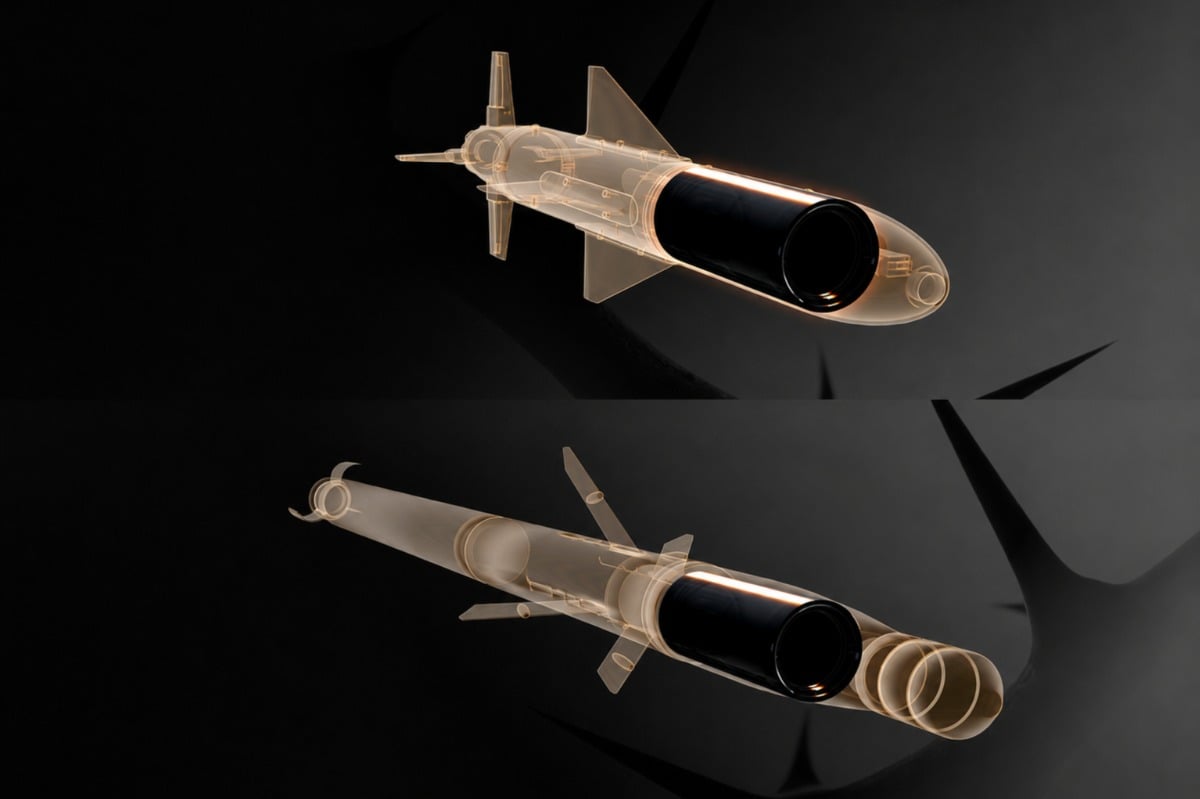
Defense contractor giant BAE Systems unveiled its new BlackThorn warhead family at the Farnborough International Airshow, signalling a fundamental shift in how Western militaries plan to arm cheap drones and interceptors. The modular payload family includes 40mm, 70mm, and 120mm variants engineered specifically for one-way attack drones, counter-unmanned aerial systems, guided missiles, and uncrewed ground vehicles. Early adopting defense firms like Estonia-based Frankenburg Technologies have already signed on to integrate the 40mm enhanced fragmentation variant into short-range air defense interceptors. Yet this unveiling exposes a deeper issue plaguing Western defense manufacturing, which is the struggle to reconcile high-tech, expensive warheads with the brutal arithmetic of high-attrition drone combat.
The Math Problem Destroying Western Missile Inventories
Boutique missiles cost too much. For three decades, Western defense procurement prioritized extreme precision and bespoke manufacturing over volume and unit economics. If you liked this post, you might want to read: this related article.
That strategy crumbled when combatants began firing thousands of cheap, mass-produced strike drones across modern battlefields. Air defense operators quickly found themselves firing multi-million-dollar interceptors to destroy drones that cost less than a used compact car. The math is relentless and unforgiving. When an air defense system spends $2 million to intercept a $20,000 loitering munition, the defender loses the war of financial attrition long before running out of targets.
Military planners call this the cost-exchange asymmetry. Traditional warhead manufacturing relies on complex, handcrafted assemblies that require long lead times and specialized labor. If a sovereign nation needs ten thousand interceptors to guard its infrastructure over a six-month campaign, existing defense assembly lines simply cannot produce them fast enough. For another angle on this story, check out the latest update from Engadget.
The industry built a exquisite, artisanal supply chain optimized for low-rate production. Modern warfare demands high-rate, low-cost throughput.
Inside the BlackThorn Architecture
BAE Systems designed BlackThorn to break that manufacturing bottleneck. Instead of manufacturing custom warheads for every individual drone, missile, or loitering munition, the defense prime developed a standardized modular framework spanning three core physical diameters.
The physical dimensions reflect existing standard military form factors.
- The 40mm lineup features lightweight blast, enhanced fragmentation, and explosively formed penetrator options weighing under 400 grams.
- The 70mm series scales payload weight up to roughly 2.3 kilograms, introducing shaped-charge variants alongside anti-armor penetrators.
- The 127mm variant carries up to 12 kilograms of high explosive or multi-effect shaped charges engineered to defeat armored vehicles and hardened structures.
Every size variant uses a shared electronic safety and arming architecture. By standardizing the electronic architecture and casing geometry across the entire lineup, BAE Systems aims to simplify weapon integration for autonomous platform builders.
The core technical achievement lies in platform-agnostic mounting. A drone manufacturer building a low-cost, one-way attack platform does not need to commission a dedicated warhead development program. Instead, engineers can select an off-the-shelf BlackThorn package, secure the electronic interface, and proceed directly to flight testing.
+-------------------------------------------------------------------+
|               BlackThorn Modular Warhead Architecture             |
+-------------------------------------------------------------------+
| Common Electronic Safety & Arming Mechanism (ESAD)                 |
+-------------------------------------------------------------------+
| Multi-Option Energetics (Blast / Frag / EFP / Shaped Charge)      |
+-------------------------------------------------------------------+
| Form Factors: 40mm  |  70mm  |  127mm                              |
+-------------------------------------------------------------------+
| Target Platforms: One-Way UAVs | Counter-UAS | UGVs | Interceptors |
+-------------------------------------------------------------------+
Digital Engineering versus Real-World Ordnance
Computer models move fast. Physical explosives move slow. BAE Systems claims the BlackThorn family was developed on an accelerated schedule by leaning heavily on digital simulation, computational fluid dynamics, and virtual detonation modeling before pouring energetic material into real metal casings.
Digital engineering reduces iteration cycles during early concept development. Simulation models allow warhead designers to test thousands of fragmentation matrix geometries or shaped-charge liner angles on a server farm in hours rather than spending months preparing live-fire range tests.
However, virtual modeling has distinct limits in terminal ballistics. Real-world explosive behavior depends heavily on batch variations in chemical energetics, casting density, ambient temperature swings, and structural stress during high-G launch acceleration.
Initial testing and evaluation phases for low-rate initial production units remain crucial. BAE Systems is manufacturing early BlackThorn test units at its historic Glascoed ordnance plant in Wales. The facility must demonstrate that digital simulations translate accurately to field performance when mass-produced under commercial manufacturing conditions.
The Frankenburg Test Case
Startups want cheap scale. Tallinn-founded Frankenburg Technologies represents the target customer profile BAE Systems hopes to capture with this modular architecture.
Frankenburg contracted to buy the 40mm enhanced fragmentation variant for its Mark 1 short-range surface-to-air missile. The Mark 1 is designed specifically as a low-cost counter-drone interceptor with an effective range of roughly two kilometers.
To keep the Mark 1 economically viable, Frankenburg needed a warhead supplier capable of delivering mass volume without burdening the missile with expensive custom engineering.
Consider a hypothetical air defense scenario where an autonomous radar detects a swarm of twenty incoming loitering attack drones. If defenders rely on traditional short-range air defense missiles costing $150,000 each, defeating the swarm costs $3 million. If an interceptor like the Mark 1 uses a standardized $5,000 modular warhead mounted on a commercial-grade airframe, the total engagement cost drops by over eighty percent.
This commercial alignment between established defense primes and venture-backed defense startups marks a significant strategic pivot. Primes supply certified energetics and fuzing expertise, while agile startups supply low-cost airframes and rapid software iteration.
The Energetics Supply Chain Bottleneck
Warheads require raw chemical ingredients. Building modular casings and standardized electronic fuzes solves only half of the production problem.
The Western defense industrial base faces severe shortages of critical energetic precursor chemicals. Key ingredients like RDX, HMX, TATB, and specialized nitrocellulose derivatives suffer from restricted production capacity across Europe and North America. Decades of post-Cold War consolidation left only a handful of active energetic manufacturing plants operating across Western nations.
If BAE Systems intends to scale BlackThorn production to tens of thousands of units annually, the company must secure consistent chemical feedstock suppliers. Standardizing casing geometry does not bypass the fundamental physical requirement for energetic compounds.
A modular warhead without explosive fill is merely an expensive metal tube.
Furthermore, safety qualification processes for new energetic payloads remain notoriously slow. Military aviation and ground safety boards require rigorous testing before approving new warheads for transport, handling, and platform mounting. Standardized electronic fuzing helps streamline qualification, but each warhead variant must still pass stringent environmental hazard tests, insensitive munitions assessments, and drop tests before receiving full operational clearance.
Bottlenecks in Mass Production Scaling
High volume sounds simple on paper. In practice, scaling warhead production from low-rate initial testing to mass production presents immense industrial hurdles.
Modern automated warhead filling requires specialized tooling, automated x-ray inspection equipment to detect voids in cast explosives, and strict environmental control systems. When production scales, quality control risks increase exponentially. A single void or defect in a high-explosive fill can cause a warhead to detonate prematurely inside a launching barrel or drone payload bay, destroying the host platform.
Moreover, supply chain dependencies extend beyond raw chemicals to specialized microelectronics. The electronic safety and arming devices embedded in modular warheads rely on hardened microcontrollers and solid-state switches designed to withstand extreme thermal shocks and violent launch acceleration.
Global semiconductor supply chains remain vulnerable to geopolitical disruption, trade frictions, and raw material shortages.
BAE Systems must prove that its manufacturing infrastructure at Glascoed and supporting facilities can maintain tight quality tolerances while pushing throughput up by orders of magnitude. The defense prime is competing not just against traditional military suppliers, but against the sheer velocity of commercial manufacturing lines adapted for wartime production.
Tactical Trade-offs of Universal Design
Flexibility incurs performance costs. A warhead designed to fit five different platform types rarely performs as efficiently as a warhead optimized exclusively for a single mission profile.
When engineers build a platform-agnostic warhead, they accept volumetric and weight compromises. A custom-designed warhead tailored strictly for a specific one-way attack drone can maximize internal volume by conforming precisely to the fuselage structure of that specific drone frame. A modular cylinder like the BlackThorn must fit inside a rigid, standardized dimensional envelope, leaving unused spatial volume inside non-cylindrical drone bays.
Weight distribution creates additional design compromises. The electronic fuzing and mechanical interface components required to make a warhead platform-agnostic add parasitic weight.
In small autonomous platforms like 40mm counter-drone interceptors, every gram of non-explosive structural weight reduces range, acceleration, or loitering endurance.
| Feature / Variable | Bespoke Custom Warhead | Modular Family Warhead |
|---|---|---|
| Integration Cost | High (Requires platform-specific engineering) | Low (Plug-and-play mounting interfaces) |
| Volumetric Efficiency | Maximum (Tailored to specific drone fuselage) | Moderate (Standardized cylindrical envelope) |
| Development Timeline | 2 to 4 Years | Months (Off-the-shelf availability) |
| Supply Chain Resilience | Fragile (Single-source custom parts) | Multi-sourced (Standardized subcomponents) |
| Production Scaling | Slow and labor-intensive | High-rate automated manufacturing |
Military operators must decide whether the speed, availability, and cost savings of modular warheads outweigh the tactical performance loss of a non-customized payload. In high-attrition drone conflicts, sheer availability usually beats marginal engineering performance gains.
The Broad Pivot Toward Attritable Warfare
Modular warheads mark the beginning of a broader transformation across military technology. Armed forces around the globe are coming to terms with the reality that expensive, unreplaceable exquisite platforms are liabilities in long-lasting, high-intensity conflicts.
The shift toward attritable hardware forces defense primes to rethink their long-term business models. Historically, defense contractors made their largest profit margins on long-term maintenance, sustainment, and proprietary upgrade cycles for expensive aircraft and combat vehicles. Cheap, single-use drones and modular warheads do not yield decades of high-margin sustainment contracts.
Instead, profitability in the drone war era relies on manufacturing velocity, automated assembly, and high-volume supply contracts. Defense companies that master automated, high-rate production of cheap energetic payloads will dominate defense procurement over the coming decade. Those stuck relying on boutique manufacturing methods risk irrelevance.
BAE Systems' BlackThorn initiative represents a major defense prime publicly acknowledging that unit economics and supply chain speed now dictate military success. Whether modular warhead architectures can solve the underlying explosive material shortages and scale up manufacturing fast enough remains the open question that will shape the future of autonomous land and air combat.