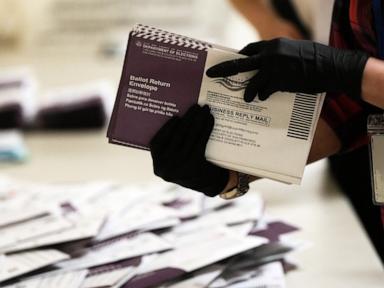
Federal courts evaluate emergency election injunctions through a strict procedural filter that prioritizes administrative finality over speculative audit remedies. When the Trump administration petitioned a federal judge to mandate the physical segregation of 20,000 California ballots, the denial rested on established constitutional and statutory doctrines governing standing, irreparable harm, and the Purcell principle. Standard news coverage reduces this ruling to a binary political victory or defeat, obscuring the operational realities of post-election litigation and the precise evidentiary burdens required to alter state-level ballot processing workflows.
The Structural Friction of Emergency Election Relief
Emergency motions for temporary restraining orders (TROs) or preliminary injunctions in election disputes face an asymmetric burden of proof. Unlike standard commercial litigation, where preserving the status quo through asset freezes carries minimal systemic cost, halting or altering ballot tabulation introduces immediate operational friction into a decentralized administrative apparatus.
To secure injunctive relief, a moving party must satisfy the four-factor test established in Winter v. Natural Resources Defense Council, Inc.:
- Likelihood of success on the merits based on substantive statutory or constitutional violations.
- Irreparable harm in the absence of preliminary relief.
- Balance of equities tipping in favor of the moving party.
- Public interest alignment.
In the context of the 20,000 disputed California ballots, the petition failed at the threshold because the requested remedy—physical segregation—presupposed an underlying legal injury that the plaintiffs could not substantiate with concrete, non-speculative evidence. Under Article III of the U.S. Constitution, federal courts lack jurisdiction to issue advisory opinions or mandate precautionary administrative restructuring based on generalized grievances.
The Operational Reality of Ballot Segregation
Segregating 20,000 ballots across California’s county-based election infrastructure is not a simple clerical sorting task. California operates a decentralized election administration model across 58 counties, each utilizing specific optical scan tabulators, signature verification workflows, and chain-of-custody logs.
When a ballot enters the processing pipeline, it undergoes a sequence of irreversible state transitions:
- Envelope Intake and Verification: Election workers scan the outer return envelope, verify the voter's registration status, and compare the signature against the reference file in the statewide database (VoteCal).
- Extraction and Anonymization: Once the signature is validated, the ballot is separated from the identifying envelope to preserve the constitutional mandate of a secret ballot.
- Batch Tabulation: Extracted ballots are flattened, grouped into batches, and fed through high-speed scanners.
Once step two occurs, linking a specific paper ballot back to an individual voter or a specific sub-category of eligibility becomes mathematically and physically impossible without violating ballot secrecy laws. A judicial order demanding the segregation of 20,000 ballots after extraction requires halting the batching process, manually isolating physical paper stocks, and maintaining parallel chain-of-custody logs. Courts routinely reject such interventions when the plaintiff cannot prove that the targeted ballots share a uniform, identifiable legal defect prior to extraction.
Evidentiary Deficits and the Speculation Trap
The core failure in the administration's petition stems from an evidentiary mismatch between the scale of the requested relief and the specificity of the alleged irregularities. In federal pleading standards governed by Bell Atlantic Corp. v. Twombly and Ashcroft v. Iqbal, factual allegations must cross the line from conceivable to plausible. In emergency election litigation, that standard is functionally even higher.
Plaintiffs seeking to isolate a specific tranche of ballots must demonstrate a direct causal link between an unlawful administrative practice and the exact pool of ballots targeted. When litigation relies on statistical anomalies, generalized allegations of procedural non-compliance, or unverified third-party affidavits, judges classify the alleged harm as speculative.
Consider the distinction between two types of election challenges:
- Facial Statutory Challenges: A plaintiff argues that a specific state rule (such as accepting ballots postmarked by Election Day that arrive within a defined grace period) violates federal law. Here, the pool of affected ballots is clearly defined by objective timestamp metadata, making segregation technically feasible if ordered prior to extraction.
- As-Applied Administrative Challenges: A plaintiff alleges that local officials failed to properly verify signatures or allowed ineligible voters to cast ballots, targeting a rough estimate of 20,000 ballots without individualized proof of error.
The California request fell squarely into the second category. Without a deterministic mechanism to identify which specific envelopes among millions contained defective ballots, an order to segregate 20,000 units operates as a blunt instrument. Judges will not compel county registrars to construct ad-hoc quarantine protocols based on unverified estimates of error rates.
The Purcell Principle and Judicial Restraint
Beyond the immediate evidentiary gaps, federal courts apply the Purcell principle—derived from Purcell v. Gonzalez—which dictates that courts should not alter election rules on the eve of, or immediately following, an election. While originally formulated to prevent voter confusion prior to balloting, federal appellate courts consistently extend Purcell to post-election administrative procedures.
The underlying economic and operational logic of Purcell is the prevention of cascading administrative failure. Election workflows are tightly coupled systems. Altering one variable—such as requiring manual segregation of a specific ballot cohort—forces downstream adjustments in staffing, canvas timelines, and statutory certification deadlines.
California law mandates strict timelines for the official canvass, including mandatory 1% manual tallies, risk-limiting audits, and final certification to the Secretary of State. Introducing a federal court mandate to isolate 20,000 ballots disrupts the critical path of the canvass. If the court subsequently rules against the plaintiffs on the merits, those 20,000 ballots must be re-integrated into the tabulation stream, requiring duplicate processing runs and risking reconciliation errors between total ballots cast and total votes recorded.
The Cost Function of Post-Election Litigation
Evaluating this ruling requires examining the asymmetric cost function faced by litigants versus election administrators. For a political campaign or administration, filing an emergency motion carries a low marginal cost—limited primarily to legal fees—while offering a high potential upside in political narrative or delayed certification.
For the judiciary and state election officials, the cost function is inverted:
- Direct Administrative Costs: Reallocating staff from signature curing and ballot duplication to manual sorting and legal compliance monitoring.
- Systemic Integrity Risks: Increasing the probability of human error by forcing election workers to execute non-standard procedures under intense time pressure.
- Public Confidence Erosion: Validating unsubstantiated claims of systemic failure through judicial intervention, even when the intervention is merely procedural.
Federal judges act as gatekeepers against this asymmetry. By requiring strict adherence to standing and irreparable harm standards, the court shifts the cost of uncertainty back onto the party seeking to disrupt the statutory baseline.
Limitations of the Judicial Shield
While the rejection of the segregation request preserves administrative continuity, relying on procedural denials carries distinct operational vulnerabilities for election administrators.
First, a denial based on the timing or breadth of the requested remedy does not constitute a substantive adjudication of the underlying legal claims. If plaintiffs narrow their focus, gather concrete documentary evidence through public records requests, and refile targeted challenges prior to certification, the Purcell defense weakens.
Second, physical segregation is only irrelevant if the ballots remain unextracted. In jurisdictions with prolonged mail-in ballot receipt windows, the window between envelope arrival and batch extraction is the critical vulnerability point. Once ballots are commingled in high-speed tabulators, no court order can reverse the process. The only remaining remedy in the event of proven, outcome-determinative fraud or error is a voiding of the election—a measure courts treat as an absolute last resort.
Strategic Imperatives for Election Litigation and Defense
For legal teams managing election integrity challenges or defending state certification processes, the California ruling establishes clear operational parameters:
- Front-Load Evidentiary Discovery: Post-election emergency motions fail when built on inferential statistics. Litigants must deploy targeted public records requests and statutory observer protocols during the pre-election and early-voting phases to build an individualized evidentiary record before ballots are separated from their envelopes.
- Target Metadata, Not Volume: Injunctive requests must define the target ballot pool using objective, machine-readable criteria (e.g., specific precinct codes, intake timestamps, or envelope barcode batches) rather than aggregate estimates.
- Audit Chain-of-Custody Logging: Election administrators must maintain granular, real-time batch tracking from envelope scan to tabulator ingestion. Demonstrating to a federal judge that existing statutory logs already provide sufficient auditability neutralizes the argument that physical segregation is necessary to preserve evidence.
Future litigation over ballot processing will increasingly center on the technical architecture of election management systems. Legal strategies that ignore the physical constraints of optical scan workflows and the irreversible nature of ballot anonymization will continue to fail at the injunctive threshold.


