Faster ballot processing in Los Angeles County during the 2026 election cycle did not automatically yield earlier race outcomes, even as county officials defended operations against federal legal challenges and state funding injections. Coverage that frames faster counting as a simple win or a direct defeat of political attacks misses the operational mechanics that govern high-volume election administration. Processing speed, arrival timing, turnout volume, and legal disruption operate as distinct variables that interact under tight statutory deadlines.
Deconstructing the Competitor Narrative
Standard reporting on Los Angeles County vote counting tends to compress a multi-stage industrial workflow into a single binary outcome: officials acted, money arrived, and the count sped up. That framing obscures three structural gaps.
First, standard accounts treat ballot processing velocity as identical to outcome certainty. In high-turnout elections, higher daily processing volume can coexist with a larger total backlog if more ballots arrive late or turnout rises across the county. Second, political framing often treats federal pressure and administrative reform as a simple cause-and-effect pair. In practice, court rulings blocking mid-election ballot segregation, statutory mail-ballot rules, and one-time state funding shaped what officials could execute day to day. Third, surface coverage frequently overlooks the fiscal fragility of temporary upgrades when state grants are non-recurring.
The Four Operational Drivers of Vote Tallying
Election administration in a jurisdiction the size of Los Angeles County functions like a high-throughput logistics network bounded by strict verification rules. Performance depends on four interacting drivers rather than a single metric.
1. Arrival Skew and Front-Loading
California mails ballots well ahead of Election Day and accepts ballots returned by mail or drop box through Election Day, with postmarked mail ballots arriving afterward. When voters wait until the final days or Election Day itself, work concentrates late in the schedule. Early-voting outreach seeks to shift arrivals earlier so batches enter extraction, signature checks, and tabulation before peak volume hits.
2. Verification Bottlenecks and Exception Handling
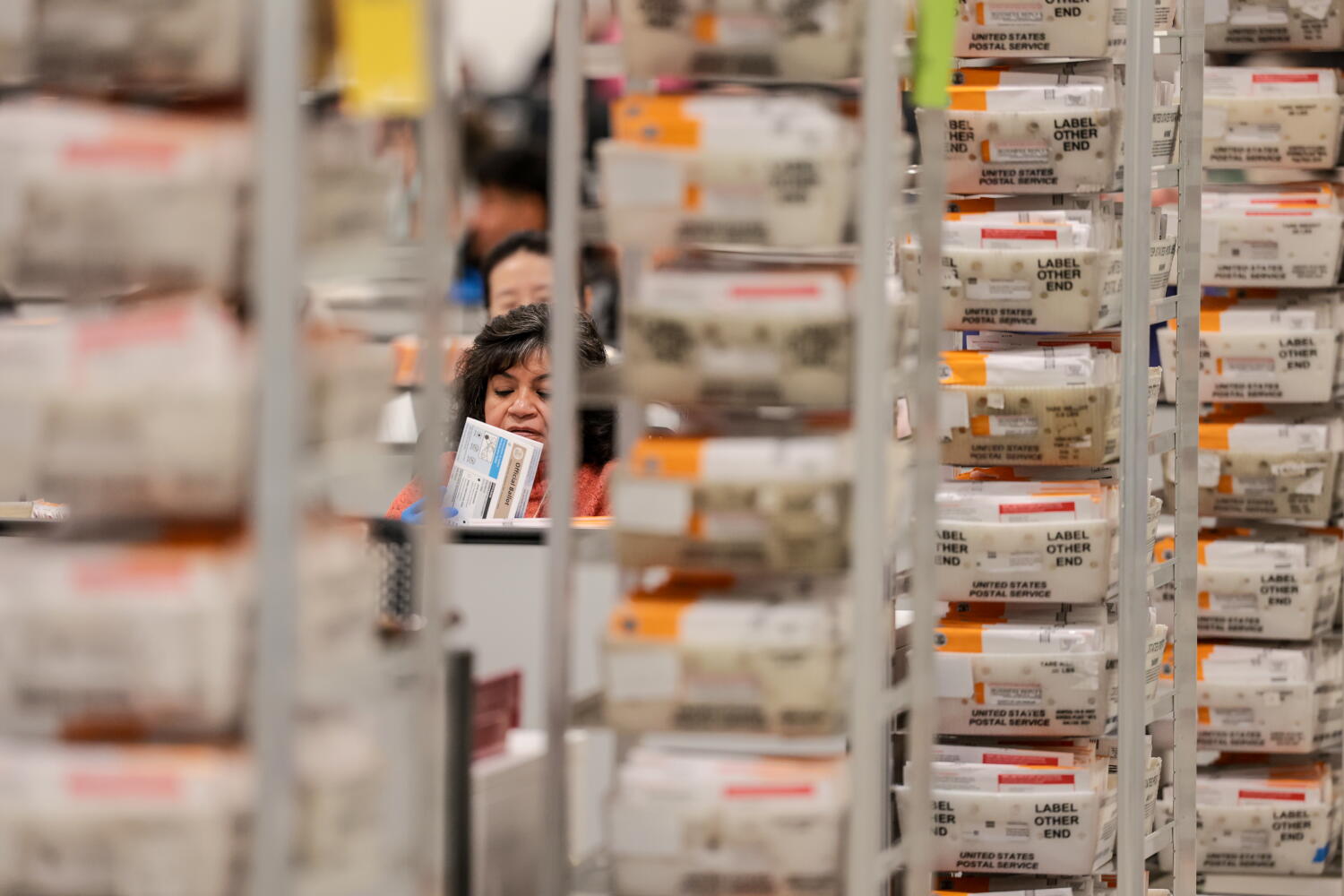
Counting a ballot is not a single pass through a scanner. Envelopes must be opened, signatures verified, damaged or creased ballots handled carefully, and cure windows managed when signature issues arise. Under California law, voters receive an extended cure period to resolve signature discrepancies, which stretches final reconciliation even when initial machine scanning moves briskly.
3. Capacity Scaling vs. Turnout Elasticity
Adding temporary staff, expanding high-speed sorting or signature verification equipment, and running longer shifts raise hourly and daily throughput. Yet turnout is elastic. When total ballots cast climb in a high-interest election, higher per-day processing rates can match or trail total volume, meaning a faster machine rate still leaves substantial uncounted ballots after Election Night.
4. External Shock and Legal Friction
Mid-cycle demands to alter sorting workflows—such as segregating contested or flagged ballots on the fly—introduce non-routine exception paths. In queuing theory, forcing specialized exceptions into a continuous line disrupts batch flow and increases error risk. Court intervention that halts mid-stream workflow changes preserves baseline continuity, while DOJ litigation dismissal removes an immediate court battle without eliminating future political scrutiny.
Why Speed and Finality Diverge
A common point of public confusion is why officials can report faster ballot processing while close races still shift days after Election Day. Three mechanisms explain that gap:
- Late-arriving cohorts: Ballots dropped off near the deadline or received after Election Day within statutory grace rules enter the count later than early mail returns.
- Competitive margin sensitivity: In tight contests, even a small remaining batch with different voting patterns can flip a lead.
- Canvass and cure completion: Official certification requires completing post-election verification, provisional ballot checks, and signature cure windows across a multi-week canvass period.
Tactical Execution Blueprint for Election Operations
To translate speed investments into durable operational resilience across future election cycles, election leaders and oversight teams can apply a structured sequence:
- Map batch bottlenecks by stage. Measure cycle time separately for intake sorting, signature verification, exception/damaged ballot handling, and tabulation rather than tracking only cumulative tally percentages.
- Shift ballot arrival timing earlier. Pair clear voter messaging on early mail and drop-box return with transparent tracking tools so voters understand when their ballot is received and counted.
- Isolate exception workflows. Keep damaged ballots, provisional ballots, and signature cures on dedicated tracks so routine batch processing does not stall.
- Standardize public observation and reporting. Maintain live video feeds, public viewing access, and plain-language schedules explaining what remains to be counted each day.
- Convert one-time grants into modular playbooks. Document staffing ratios, equipment maintenance schedules, and surge protocols tied to one-time state appropriations so future budgets do not start from scratch.
Facts Versus Analytical Hypotheses
What is established rests on public reporting, official election schedules, and statements from election officials and courts: California allocated one-time state funding—reported around $29 million in 2026 election coverage—to support county ballot processing, equipment, staffing, and outreach, with Los Angeles County receiving roughly $6 million of that allocation. Officials reported processing ballots faster relative to prior benchmarks while noting higher turnout and ongoing legal and political pressure ahead of future cycles, including 2028.
What remains an analytical hypothesis is how much of the observed speed gain came from equipment and staffing versus shifts in voter return timing, and whether future federal disputes will target pre-election rules rather than mid-count sorting. Exact causal attribution requires granular daily batch logs comparing arrival timestamps against machine throughput across cycles.
Limitations and Trade-Offs
Operational speed is bounded by statutory design and budget reality. Expanding access through universal vote-by-mail, late drop-off windows, and generous signature cure timelines is a policy choice that prioritizes voter inclusion and accuracy over instant Election Night finality. Furthermore, temporary funding cannot permanently pay for peak seasonal labor unless paired with recurring appropriations or workflow automation that reduces manual handling without sacrificing auditability. Transparency measures like livestreams and public observation also require clear boundaries to protect voter privacy and ballot security.
Strategic Play Ahead of 2028
Treat post-2026 operational gains as a baseline to lock in through codified standard operating procedures and recurring capital/training budgets rather than assuming one-time funding or courtroom pauses will repeat automatically. Pair every speed metric in public communications with a clear breakdown of remaining uncounted ballots by category—early mail, Election Day drop-off, postmarked mail, provisional, and signature cure—so faster processing builds verifiable public confidence instead of unrealistic expectations of overnight finality.