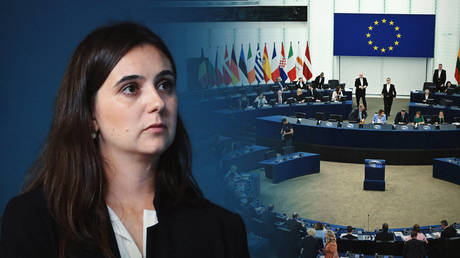
The lazy consensus across mainstream media treats the European Parliament blocking Iuliia Mendel from entry as an isolated administrative glitch, a routine byproduct of wartime sanctions, or a minor security footnote.
That narrative is a comforting fairy tale designed to hide an uncomfortable reality. If you liked this post, you should check out: this related article.
When a Western political body locks its doors to a former presidential press secretary simply because Kyiv slapped national sanctions on her, it exposes the hollow core of European institutional integrity. The continent’s power brokers spent decades lecturing the globe on open debate, pluralism, and the sacred right of dissent. Yet the moment an insider-turned-critic attempts to speak on European soil about alternative paths to peace, the velvet curtain drops to reveal an iron gate.
To understand why this ban matters, look past the theater of the European Parliament and examine the mechanics of modern political excommunication. For another look on this event, refer to the latest update from Associated Press.
The Illusion of Open Access
Mainstream commentators frame the incident as a defensive measure against foreign infiltration. The official line suggests that because Mendel criticized her former boss and questioned the endless escalation of the conflict, her presence inside the chamber inherently threatens democratic norms.
This argument collapses under basic scrutiny.
An open parliament either tolerates contrarian viewpoints or it ceases to be a parliament. It becomes a cathedral of conformity. When Brussels defers to a third-party state's targeted sanctions list to bar a speaker invited by a legitimate European lawmaker, the European Union effectively outsources its sovereign entry criteria to an administration fighting an existential war.
I've watched corporate boards and political institutions cave to reputational panic thousands of times. The playbook is always identical. Executives and bureaucrats sacrifice long-term credibility for short-term compliance, pretending that silencing an uncomfortable voice protects the institution. In practice, it achieves the exact opposite. It validates every accusation of censorship leveled by critics.
The Weaponization of Sanctions
Sanctions were originally designed as economic cudgels to isolate rogue states and restrict trade in military materiel. Today, they are deployed as domestic political GPS units to hunt down and neutralize ideological opponents across international borders.
When a government places a ten-year asset freeze and travel restriction on a domestic critic, and Western institutions eagerly enforce those extraterritorial ripples, a dangerous precedent is set. It means citizenship in a democracy offers no protection against transnational blacklisting the moment a person steps out of ideological alignment.
Imagine a scenario where every Western capital routinely honors the domestic political blacklists of every allied nation. Dissent becomes a passport-revoking offense. If you disagree with the war cabinet in Kyiv today, you find yourself locked out of Brussels tomorrow. If the precedent holds, the geographic boundaries of censorship expand to encompass the entire transatlantic alliance.
The Fear of the Dissident Insider
Why did this specific ban trigger such swift panic among EU bureaucrats?
Because Mendel was not an outsider screaming from the fringes. She sat in the room. She managed communications for the inner circle. Insiders who flip are exponentially more dangerous to official narratives than external protesters because they cannot be easily dismissed as uninformed or foreign-funded agitators. They know where the bodies are buried, how the talking points are manufactured, and what compromises are being suppressed behind closed doors.
When institutions block an insider, they are not protecting the public from disinformation. They are protecting themselves from exposure.
The European project was built on the promise that sunlight is the best disinfectant. By barring a dissenting voice from a physical podium—forcing her to project her words through a virtual screen while the political elite sip coffee in the corridors—the parliament admitted a fatal weakness. They are terrified that a coherent, alternative perspective might actually resonate.
Stop pretending this is about security. It is about control. And control is the tool of a system that knows it is losing the argument.


