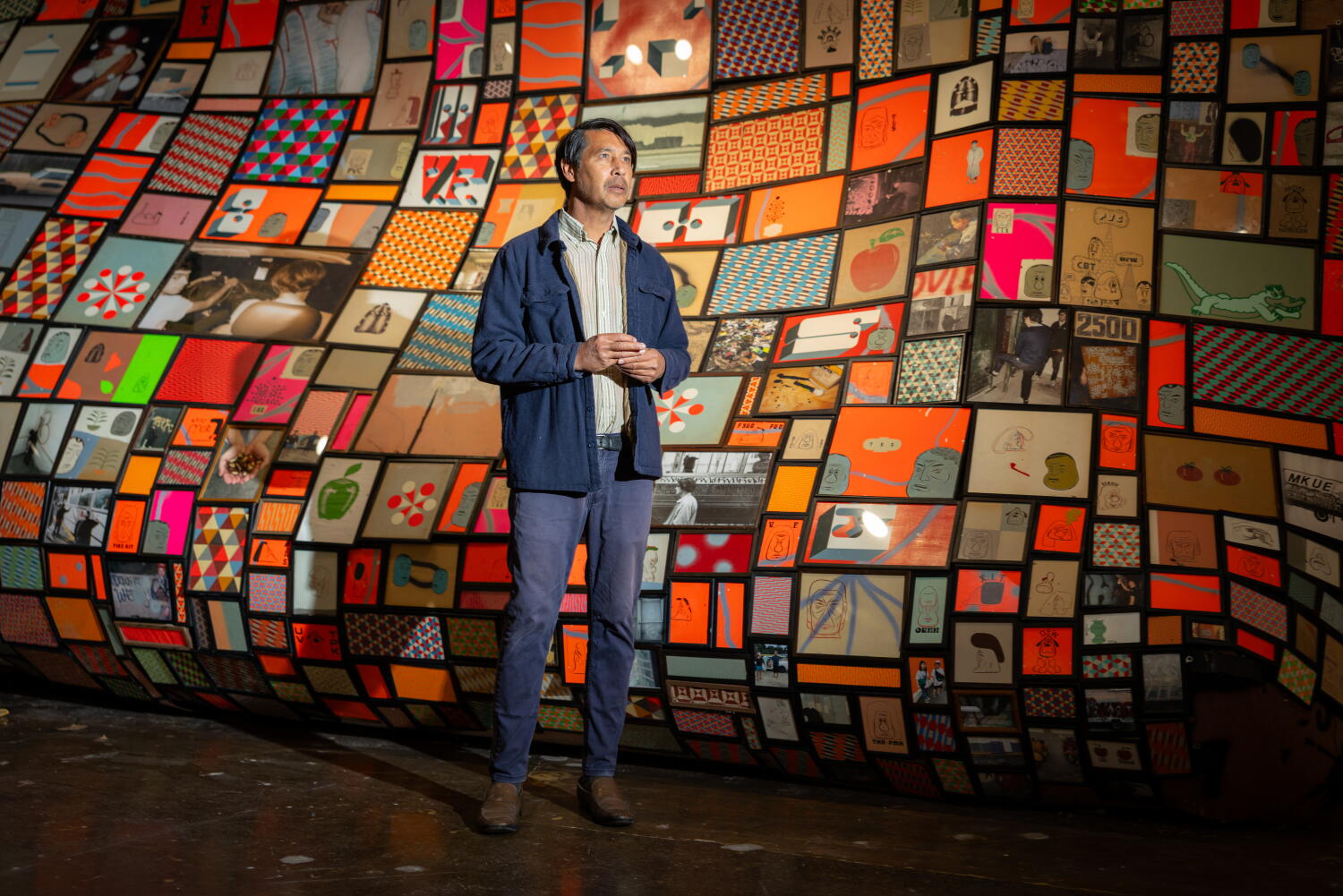
Most people see a street artist enter a high-end gallery and immediately cry "sellout." They're wrong. When San Francisco legend Barry McGee traded a shuttered 99 Cents Only Store for a pristine gallery space, he didn't abandon his roots—he brought the street's chaotic pulse right into the white cube.
To understand why this shift works, you have to look at what McGee actually does. Known in the graffiti world under his tag "Twist," McGee has spent decades blurring the lines between illegal street bombing and institutional fine art. His transition from discount retail interventions to gallery exhibitions isn't a contradiction. It's the exact point.
The 99 Cents Only Store Takeover Was Never Just a Stunt
In early 2020, just before the world locked down, Barry McGee staged an unforgettable guerrilla-style intervention inside a former 99 Cents Only Store in Los Angeles. Working alongside a crew of collaborators, he transformed the fluorescent-lit, linoleum-floored space into a sprawling, immersive installation. It wasn't clean. It wasn't polite.
The project tapped directly into the visual language of urban decay and consumer excess. You walked past rusted metal, clusters of empty liquor bottles, hand-painted signs, and McGee's signature drooping, melancholic faces staring back from salvaged panels. By choosing a defunct discount store, McGee critiqued gentrification and throwaway culture in the exact kind of neighborhood most affected by them.
Many critics treated that takeover as a pure anti-establishment rebellion. Honestly, that's only half the story. McGee has been showing in major museums—including the San Francisco Museum of Modern Art and the Venice Biennale—since the late 1990s. The discount store wasn't a rejection of the art world; it was a reminder of where his visual vocabulary comes from.
Bringing Street Chaos Into the White Cube
When an artist moves from a gritty retail takeover straight into a commercial gallery, the biggest risk is sterilization. Put graffiti on a pristine white wall, slap a five-figure price tag next to it, and the energy usually dies on impact.
McGee avoids this trap by refusing to play by standard gallery rules. Instead of hanging neat, spaced-out canvases at eye level, he treats the gallery architecture like an alleyway waiting to be bombed.
Floor-to-Ceiling Clusters
If you've ever walked into a Barry McGee gallery show, you know the sensory overload hits you immediately. He builds massive, floor-to-ceiling clusters of framed drawings, thrift-store paintings, geometric op-art panels, and found objects. These dense salon-style walls mimic the visual clutter of a city street where wheat-pastes, stickers, and tags compete for every square inch of brick.
Animatronics and Kinetic Elements
McGee frequently incorporates low-tech animatronic figures—often life-sized sculptures of graffiti writers endlessly shaking spray paint cans or tagging a wall. Placing a mechanical tagger inside a quiet, upscale gallery creates a hilarious, slightly uncomfortable tension. Collectors have to literally step around the mess of street culture to look at the art.
Salvaged Materials Over Fine Canvas
Even when his work hangs in a prestigious space, McGee rarely relies on traditional stretched linen. He paints on discarded cardboard, dented metal signs, old wooden doors, and glass bottles. The physical scars of the street remain embedded in the objects themselves.
Why Critics Often Misread the Mission School Legacy
Barry McGee is the most famous figure associated with San Francisco's Mission School, a movement that emerged in the 1990s alongside artists like Margaret Kilgallen, Chris Johanson, and Clare Rojas. If you want to appreciate why his gallery shows feel so urgent, you need to understand this context.
The Mission School wasn't an organized academy with a manifesto. It was a loose community of artists living in San Francisco's Mission District during the first dot-com boom. While tech money flooded the city and pushed out working-class residents, these artists responded by making work out of whatever they could find on the sidewalk.
They looked to folk art, sign painting, skate culture, hobo train graffiti, and comic books rather than European art history. When McGee moves between a 99 Cents Only Store and an international gallery, he's carrying that exact ethos forward. He's proving that outsider visual languages don't need to be polished up to hold their own against traditional fine art.
What Makes a Barry McGee Gallery Show Different From Typical Street Art Exhibitions
Over the last fifteen years, "urban art" has become a massive commercial category. Plenty of street artists have cashed in by printing clean, predictable editions of their street stencils onto canvas. McGee takes the opposite approach.
- Zero separation between high and low: In a McGee installation, a meticulously painted geometric panel sits inches away from a crushed soda can or a rough marker sketch on a scrap of paper. Everything carries equal visual weight.
- Collaboration over ego: Graffiti is built on crews, and McGee treats gallery shows the same way. He regularly invites friends, fellow writers, and emerging artists to contribute directly to his installations, turning solo exhibitions into community takeovers.
- Anti-commodity presentation: By wiring dozens of individual pieces together into massive structural clusters, McGee makes it deliberately difficult for collectors to simply pluck one neat trophy off the wall. You have to engage with the entire environment.
How to Experience Barry McGee's Work Today
You don't need an art history degree or a collector's budget to get something out of McGee's work. Whether he's taking over a vacant storefront or an established gallery, his installations are built to be experienced physically rather than analyzed from a distance.
If you're planning to visit one of his exhibitions—or track down his public murals—keep a few practical things in mind:
- Look up and look down. McGee hides small drawings, stickers, and painted bottles near the baseboards and up near the ceiling rafters. If you only scan at eye level, you'll miss half the show.
- Pay attention to the frames. For McGee, a beat-up, thrift-store wooden frame isn't just a border; it's part of the sculpture. Notice how he pairs specific weathered frames with sharp, vibrant geometric patterns.
- Check museum permanent collections. Even when he doesn't have an active commercial gallery show running, major institutions like SFMOMA, the Walker Art Center in Minneapolis, and the Museum of Modern Art in New York hold significant pieces in their collections.
- Explore the wider Mission School circle. To see the full picture, look up works by his late wife Margaret Kilgallen, as well as Chris Johanson and Alicia McCarthy. Seeing their work alongside McGee's makes the shared visual language of 1990s San Francisco click immediately.
Barry McGee never needed a 99 Cents Only Store to prove his street credibility, and he doesn't need a gallery to validate his talent. Watching him bounce between abandoned retail spaces and elite art institutions is just watching a master vandalize the boundaries of where art is supposed to live.


