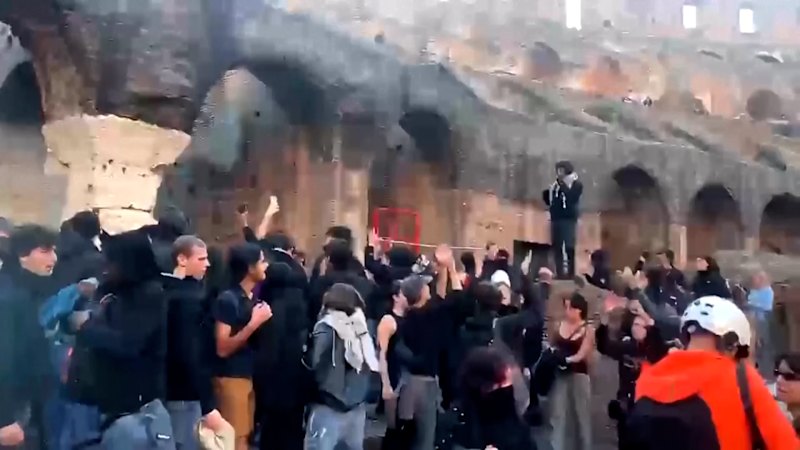
European street policing is trapped in a cycle of escalating force that fails to deter dissent while eroding public trust. Recent clashes in Italy and France—where baton charges and dense clouds of tear gas have become routine responses to civil demonstrations—are not isolated tactical decisions by local commanders. They are the predictable output of rigid crowd-control doctrines, militarized procurement pipelines, and political leaderships that treat street protest as an insurgency rather than a constitutional pressure valve.
Walk down the avenues of Paris or the piazzas of Rome during a major demonstration and the choreography feels grimly familiar. Hours before a single chant echoes off the stone facades, specialized units arrive in heavy body armor, flanked by water cannons and armored personnel carriers. By dusk, the air stings with chemical irritants and the sound of polycarbonate shields banging against truncheons drowns out the megaphones. Media coverage reliably focuses on the immediate flashpoints—a shattered bank window, a line of charging officers, a hospitalized student—treating each eruption as a sudden loss of control. That framing misses the real story. What looks like chaos on the evening news is actually the execution of decades-old operational playbooks designed to dominate physical space through overwhelming sensory and physical force.
The Architecture of Escalation
To understand why French and Italian police reach so quickly for tear gas and batons, you have to look at how these forces are structured and trained. Unlike the British model of policing by consent, which relies heavily on negotiation, liaison officers, and dynamic risk assessment, continental European public order systems grew out of gendarmerie traditions. These are paramilitary forces originally built to defend the state against internal rebellion.
In France, the Compagnies Républicaines de Sécurité (CRS) and the Gendarmerie Mobile operate under a doctrine of spatial containment and dispersion. Their primary objective is rarely to facilitate a march from point A to point B; it is to hold ground and break up crowds before they can reach symbolic political targets like the Élysée Palace or the National Assembly. When a crowd presses against a static perimeter, French doctrine relies on stand-off munitions—specifically CS gas canisters launched fromCougar grenades and GLi-F4 or GM2L sting-ball explosives—to create a chemical buffer zone.
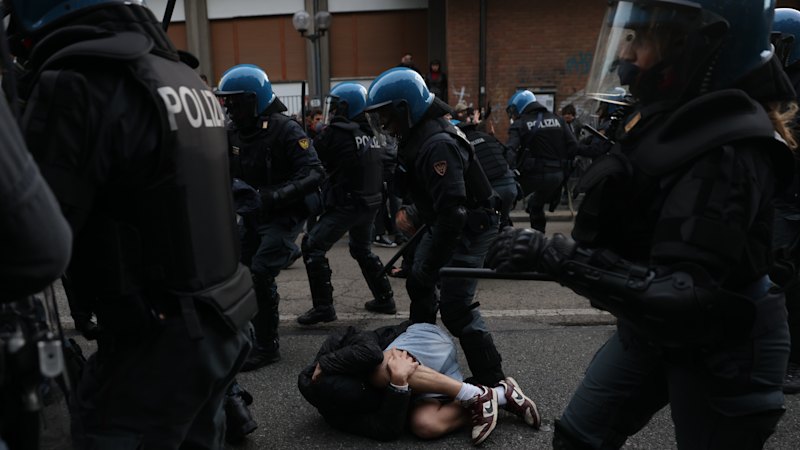
Italy relies on a similar dual-force architecture, splitting public order duties between the Polizia di Stato (specifically its Reparti Mobili units) and the Carabinieri, which remains a branch of the armed forces. While French forces favor chemical dispersion at a distance, Italian riot squads have historically leaned toward rapid, close-quarters baton charges (cariche di alleggerimento) intended to shock a crowd backward and fracture its cohesion.
The problem with both approaches is mechanical. Once a commander orders a gas barrage or a baton charge, tactical nuance evaporates. Tear gas does not discriminate between a masked agitator throwing cobblestones and a retired schoolteacher holding a cardboard sign. A baton charge into a packed avenue does not selectively target lawbreakers; it sweeps through whoever cannot run fast enough. By treating an entire assembly as a unified hostile mass, these tactics routinely convert passive bystanders into angry participants.
Why France Relies on Chemical Saturation
The sheer volume of munitions deployed by French security forces during major protest waves—from the Gilets Jaunes movement to pension reform strikes and environmental demonstrations—has drawn repeated scrutiny from the Council of Europe and the United Nations. During peak protest days in Paris, police have fired thousands of tear gas grenades in a single afternoon.
This reliance on chemical saturation stems from a specific operational bottleneck. French street protests frequently attract a decentralized vanguard of radical activists, often referred to as the black bloc, who embed themselves within larger, peaceful trade union or student marches. Because traditional French policing lines are heavy, slow-moving, and burdened by up to thirty kilograms of protective gear, officers struggle to conduct targeted arrests inside moving crowds.
Instead of deploying agile, plainclothes arrest teams trained to extract specific violent individuals without disrupting the broader march, commanders default to area-denial weapons. They flood entire city blocks with CS gas to clear the streets wholesale.
This creates a self-reinforcing loop. Demonstrators know the gas is coming, so thousands of otherwise peaceful protesters now show up wearing swimming goggles, respirators, and scarves soaked in physiological saline. Police intelligence units observe the protective gear, classify the crowd as pre-armed for confrontation, and deploy even earlier and more aggressively. Meanwhile, the reliance on LBD-40 kinetic impact launchers—which fire 40mm rubber projectiles—has resulted in dozens of severe, permanent injuries, including lost eyes and fractured skulls, turning police tactics themselves into the central grievance of subsequent protests.
The Italian Approach and the Politics of the Street
Across the Alps, the dynamics carry a different historical weight but arrive at the same destination. Italian public order policing is haunted by the ghosts of the 1970s Years of Lead and the catastrophic 2001 G8 summit in Genoa, where police raids on sleeping activists and the fatal shooting of a protester left deep institutional scars.
In the years immediately following Genoa, Italian interior ministries attempted to soften their approach, emphasizing dialogue with protest organizers before major events. Yet over the past several years, political shifts in Rome have pushed policing back toward a hardline posture. New security decrees have criminalized roadblocks and passive resistance—tactics long used by striking workers and climate activists—handing street commanders both the legal mandate and the political cover to clear demonstrations swiftly.
When Italian Reparti Mobili units advance with batons raised, the speed of the escalation often catches international observers off guard. Videos of police charging high school students in Pisa and Florence, or clashing with port workers in Trieste, have sparked fierce national debates over proportionality.
The structural issue inside Italy's riot units is an over-reliance on physical containment combined with chronic underinvestment in de-escalation training. Rank-and-file officers are routinely deployed on exhausting, multi-day rotations across the country with minimal intelligence about the specific groups they are facing. Placed in narrow medieval streets where crowds have nowhere to retreat, an order to clear the square inevitably turns into a bottleneck of swinging truncheons and bruised bodies.
Tactical Doctrine Comparison
| Operational Dimension | French Public Order Model | Italian Public Order Model | Northern European De-escalation Model (e.g., UK, Sweden) |
|---|---|---|---|
| Primary Units | CRS (National Police) and Gendarmerie Mobile | Reparti Mobili (State Police) and Carabinieri | Police Liaison Teams and Public Order Units |
| Core Strategic Goal | Spatial denial and rapid dispersion | Containment and physical clearance | Facilitation of peaceful assembly and targeted intervention |
| Primary Less-Lethal Tool | High-volume CS gas grenades and LBD-40 launchers | Polycarbonate shields and wooden/polymer batons | Verbal negotiation, dynamic cordons, and targeted arrest teams |
| Command Structure | Centralized, rigid chain of command | Dual-command structure (Prefect and Questore) | Flexible, intelligence-led tactical autonomy |
| Primary Failure Mode | Indiscriminate chemical exposure and projectile injuries | Crush injuries and excessive force in confined spaces | Slow response if violent factions overwhelm liaison officers |
The Procurement Pipeline Behind Heavy Policing
Street tactics do not exist in a vacuum; they are shaped by the equipment sitting in police armories. Over the past two decades, European interior ministries have spent hundreds of millions of euros upgrading their public order arsenals, creating a steady procurement pipeline between defense contractors and domestic police forces.
When a police department invests heavily in armored vehicles, acoustic hailing devices, multi-barrel grenade launchers, and full-body composite armor, those tools naturally dictate operational planning. You do not buy fleets of armored crowd-control trucks and warehouses of tear gas canisters to leave them parked during a general strike.
There is also a psychological shift that occurs when an officer steps onto a city street dressed like a soldier entering a combat zone. Criminology research into the weapons effect and militarized policing consistently shows that heavy tactical gear alters threat perception. Encased in helmets, visors, shin guards, and flame-retardant suits, officers experience reduced sensory awareness and diminished interpersonal communication with the citizens standing ten feet away. A crowd stops looking like neighbors, commuters, and students; it looks like an opposing force.
On the other side of the barricade, citizens confronted by an anonymous wall of black armor and shields react with predictable hostility. The visual cues of war invite the behavior of war.
What Happens When De-escalation Is Actually Tried
Critics of reform often argue that soft policing simply surrenders the streets to vandals and extremists. Real-world evidence from elsewhere in Europe tells a different story.
Following severe riots in Gothenburg in 2001, Swedish police overhauled their entire public order philosophy, developing what became known as the Dialogue Police concept. Instead of treating demonstrations as hostile events to be suppressed, Swedish commanders deployed specially trained officers in high-visibility vests to walk alongside protest organizers days before and during marches. Their sole job is to maintain open communication, resolve minor friction points before they ignite, and separate peaceful demonstrators from the small minority intent on violence.
Germany’s federal states have similarly experimented with shifting away from rigid, static police lines toward flexible, intelligence-driven policing—most notably in Berlin and North Rhine-Westphalia. By keeping heavy riot squads out of immediate sight while deploying smaller, mobile units to arrest specific individuals throwing projectiles, German commanders have repeatedly managed massive, politically volatile demonstrations without resorting to blanket tear gas barrages.
This does not mean de-escalation is a magic wand. When organized, well-equipped groups arrive at a demonstration specifically intending to fight the police or destroy property, dialogue alone will not stop them. Even the most progressive European police forces retain heavy tactical reserves for genuine emergencies. The difference lies in the threshold for using them. In Stockholm or Berlin, tear gas and baton charges are treated as a failure of strategy—a last resort when containment has completely collapsed. In Paris and Rome, they are treated as standard operating procedure.
The Hidden Cost to Democratic Legitimacy
Governments in Paris and Rome frequently defend heavy-handed crowd control by pointing to polls showing that the broader public wants order restored and disruption minimized. In the short term, clearing a blocked highway or protecting a government ministry looks like decisive leadership.
Over the long term, however, routinized street violence corrodes the legitimacy of the state. Every time a peaceful demonstrator is caught in a tear gas cloud, or a bystander is struck during a baton charge, the relationship between citizen and state shifts from civic trust to mutual suspicion. Worse, police unions themselves are growing increasingly vocal about the toll this takes on officers. Deployed week after week into volatile standoffs with poorly defined political objectives, rank-and-file police suffer from burnout, plummeting morale, and rising injury rates. They are being asked to solve deep social, economic, and political crises with truncheons and chemical irritants.
Until European interior ministries dismantle the institutional incentives that reward overwhelming force—and rebuild their crowd-control doctrines around targeted accountability rather than collective punishment—the cycle will continue. The protests will keep coming, the helmets will keep going on, and the streets of Europe's capitals will remain battlegrounds where nobody actually wins.