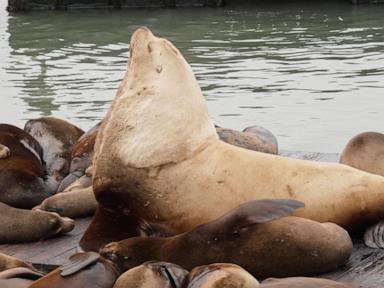
San Francisco’s waterfront is currently defined by a 1,500-pound problem named Chonkers. This massive male California sea lion has become the unofficial face of Pier 39, anchoring a record-breaking surge of pinnipeds that has overwhelmed the city’s most famous tourist trap. While local headlines celebrate the "cuteness" of the record-breaking population, the reality on the ground—and in the water—is a complex collision of environmental shifts, predatory math, and the fragile mechanics of urban tourism.
The crowds are back, but they aren't looking at the Golden Gate Bridge. They are staring at a splintering wooden dock held together by hope and heavy-duty bolts, where hundreds of barking, fighting, and sleeping mammals have claimed sovereign territory. This isn't just a seasonal fluke. It is a loud, pungent signal that the Pacific ecosystem is shifting in ways that the tourist brochures aren't prepared to explain.
The Anatomy of an Apex Attraction
To understand why a sea lion like Chonkers matters, you have to look past the blubber. These animals are opportunistic predators. For decades, the population at Pier 39 hovered at manageable levels, but recent months have seen numbers spike toward the thousand-mark. The cause is simple: food. Large schools of anchovies and herring have moved deep into the bay, turning the marina into an all-you-can-eat buffet that requires zero effort to access.
Chonkers earned his moniker not just through size, but through sheer dominance. In the world of Zalophus californianus, space is the only currency that matters. A male of his stature doesn't just sit on a dock; he defends a zip code. By claiming the prime real estate on the K-Dock, he forces smaller males and juveniles into tighter clusters, creating the carpet of brown fur that looks so good on social media. It is a display of biological power that costs the city a fortune in infrastructure maintenance.
The weight is the issue. A standard marine dock is designed to handle the buoyancy of the structure and perhaps a few dozen humans passing through. It is not engineered to support twenty tons of shifting, wet muscle. The Port of San Francisco and the Pier 39 management team are in a constant race to repair the wooden "haul-out" floats before they succumb to the sheer mass of the inhabitants.
The Anchovy Fever Driving the Surge
The sea lions aren't here because they like the view of Alcatraz. They are here because the California Current is behaving strangely. When cold, nutrient-rich water wells up along the coast, it brings the baitfish. This year, the baitfish didn't just stay in the ocean; they flooded the Bay.
Scientists who track these movements see this as a mixed blessing. While a high population suggests a healthy birth rate in the Channel Islands—where these males migrate from—it also indicates that the open ocean might be becoming less hospitable or more unpredictable. If the fish move, the sea lions follow. If the fish disappear, the "Chonkers" of the world become the first to suffer. Their presence at the pier is a high-definition readout of the health of the Pacific, yet most onlookers only see a photo opportunity.
The Hidden Cost of the Bark
The noise is constant. A sea lion’s bark can reach 100 decibels, roughly the volume of a jackhammer. For the retail tenants and restaurant owners on the pier, this is the sound of money, but it is also a logistical nightmare. The smell, a pungent mixture of fermented fish and salt spray, is unavoidable.
Maintaining this delicate balance requires a "look but don't touch" policy that is increasingly hard to enforce. As the animals grow bolder and more accustomed to human proximity, the risk of negative interactions rises. A sea lion is not a dog. It is a carnivore with a bite force that can rival a large bear. When a 1,500-pound animal decides it wants to move, humans are nothing more than obstacles.
The Tourism Trap and the Wildlife Dilemma
San Francisco is a city currently obsessed with its own "doom loop" narrative, fighting to bring foot traffic back to a downtown core that has struggled since the pandemic. In this context, Chonkers is a godsend. He is free marketing. He is a viral sensation that requires no city funding to maintain.
However, relying on wildlife as a cornerstone of urban recovery is a dangerous game. Wildlife is fickle. In the late 1980s, the sea lions arrived overnight following the Loma Prieta earthquake. They could leave just as quickly. If the anchovy schools migrate north toward Monterey or south toward San Diego, the crowds at Pier 39 will vanish with them, leaving behind nothing but empty docks and expensive repair bills.
Territorial Disputes and Dock Dynamics
The social structure on the docks is a brutal meritocracy. You will notice that Chonkers rarely moves. He doesn't have to. The younger males engage in "neck-fencing," a ritualized form of combat where they swing their heads at each other to test strength. This isn't play. They are vying for a spot that allows them to conserve the most energy.
Energy conservation is the key to survival for a marine mammal. Every calorie spent fighting or swimming is a calorie taken away from their ability to survive the trek back to the breeding grounds. By providing these artificial platforms, the city has inadvertently created a high-energy nursery that alters the natural behavior of the species. They are becoming "urbanized," a shift that biologists watch with a mix of fascination and dread.
The Logistics of Coexistence
How does a city manage a guest that refuses to leave and weighs as much as a Fiat? The Marine Mammal Center, located just across the bridge in Sausalito, acts as the primary watchdog. They monitor the health of the colony, looking for signs of domoic acid poisoning—a neurotoxin produced by algae blooms that can turn a peaceful sea lion into an aggressive, disoriented danger to itself and others.
The infrastructure side is handled by the pier’s private maintenance crews. They have moved away from trying to deter the animals and have instead leaned into "sacrificial architecture." They build docks specifically intended to be destroyed. These wooden platforms are designed to be easily replaced, accepting the fact that the sea lions own the water's edge.
The Economic Impact of a Viral Pinniped
The presence of a "mega-fauna" celebrity like Chonkers has a measurable impact on local commerce. Foot traffic data suggests that the K-Dock area sees a 30% higher density of visitors than any other section of the pier. This translates to millions in revenue for nearby kiosks selling everything from sourdough bowls to miniature plush sea lions.
But this economic windfall comes with a caveat. The density of people creates a bottleneck that makes the pier feel overcrowded and "cheap." High-end travelers often avoid the area, leaving it to the budget tourists and day-trippers. This shift in demographic changes the types of businesses that can survive on the waterfront. We are seeing a slow transformation of the Embarcadero into a theme park that happens to have a working port attached to it.
Beyond the Social Media Hype
If you want to understand the real story of the San Francisco sea lions, stop looking at the phone screens of the people around you. Look at the water line. Watch the way the smaller animals hover at the edge of the docks, waiting for a gap that never comes because Chonkers and his lieutenants refuse to budge.
This is a story of survival in a changing world. The sea lions are thriving at Pier 39 because we have provided them with a perfect, predator-free fortress surrounded by food. It is a biological anomaly that has become a permanent fixture of the city's identity. But it is also a reminder that nature doesn't care about our property lines or our tourism budgets. It moves in, it barks, and it stays as long as the fish are biting.
The city isn't "saving" the sea lions by letting them stay. The sea lions are, in a very real sense, saving the pier’s relevance in a digital age. As long as Chonkers remains the king of the K-Dock, the crowds will keep coming, oblivious to the fact that they are witnessing a massive ecological shift disguised as a roadside attraction.
Keep your distance, watch the tide, and realize that the barking isn't a greeting; it’s a warning that the dock is full.


