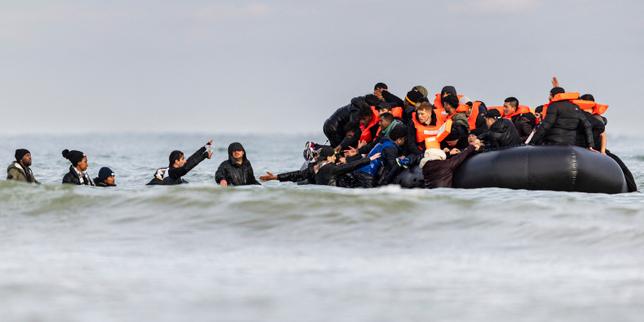
Four more bodies pulled from the freezing water of the English Channel. The headlines roll out with predictable, exhausted outrage. Politicians stand behind podiums, expressing deep sorrow, pointing fingers across international boundaries, and swearing that tighter security, heavier policing, and more sophisticated surveillance will finally stop the tragedy.
It is a comfortable lie. It is a narrative built for television screens, designed to soothe the conscience of a public that wants a neat villain and a simple fix.
The lazy consensus says that maritime migration is a border control problem. If we just lock the gates tighter, people will stop trying to climb over them.
History shows the exact opposite.
The Economics Of Desperation
When you choke off legal avenues of movement while demand remains absolute, you do not eliminate the market. You simply hand a complete monopoly to organized crime.
Economics one-on-one tells us that tightening supply while demand stays constant drives up the price. In the underground economy of human smuggling, that price is paid in currency and human lives. Smugglers do not care about maritime safety; they care about margins. They pack rubber dinghies past the point of structural failure because every extra body crammed into a cheap hull increases profit.
Every time a government announces a new naval blockade or a harsher deterrent, they are not discouraging desperate people. They are forcing those people to rely on riskier, more clandestine operators.
Pretending that walls and coast guard cutters can outwit basic human survival instincts is economic illiteracy. People fleeing systemic collapse, violence, or destitution do not look at a reinforced border fence and calculate actuarial tables. They calculate that the risk of drowning in the dark is lower than the certainty of death or misery back home.
The Failure Of Deterrence Theory
Policy makers love deterrence theory because it requires zero imagination. The core assumption is mechanical: make the journey painful enough, and the traffic stops.
Criminology has spent decades proving this model broken. Deterrence only works when the alternative is acceptable. When the alternative is total erasure, deterrence becomes a background noise.
Imagine a burning building. The exit door is locked, but a window on the third floor opens out into jagged rocks below. Security guards stand beneath the window yelling that jumping is dangerous and illegal. Some people will break their legs on the rocks. The guards response is not to unlock the door, but to buy taller megaphones and barbed wire for the window ledge.
That is current immigration policy.
Focusing solely on the crossing point treats a symptom while ignoring the structural failures of global mobility. If wealthy nations genuinely wanted to stop deaths in the Channel, they would render the smugglers obsolete overnight by establishing secure, processed transit hubs on the French coast.
Of course, that solution lacks the theatrical performance of toughness that politicians rely on to win election cycles. Admitting that safe legal pathways crush illegal smuggling operations requires abandoning ideological posturing in favor of functional logistics.
Dismantling The Border Illusion
Borders are administrative lines, not physical laws of nature. Yet modern states treat them like impenetrable force fields, believing that a piece of legislation can repeal supply and demand.
When boats capsize, the collective grief is real, but the institutional hypocrisy is staggering. The same governments lamenting these deaths continue to enforce policies that guarantee them. By treating movement as a criminal conspiracy rather than a humanitarian reality, authorities ensure that every crossing is a high-stakes gamble.
The uncomfortable truth is that wealthy nations rely on undocumented labor while publicly decrying it. The underground economy runs on cheap, unprotected workers who have no legal recourse.
Stop pretending this is a security crisis. It is a market failure engineered by bad policy. Until leaders stop treating geography like a moral shield, the Channel will remain a mass grave of political cowardice.