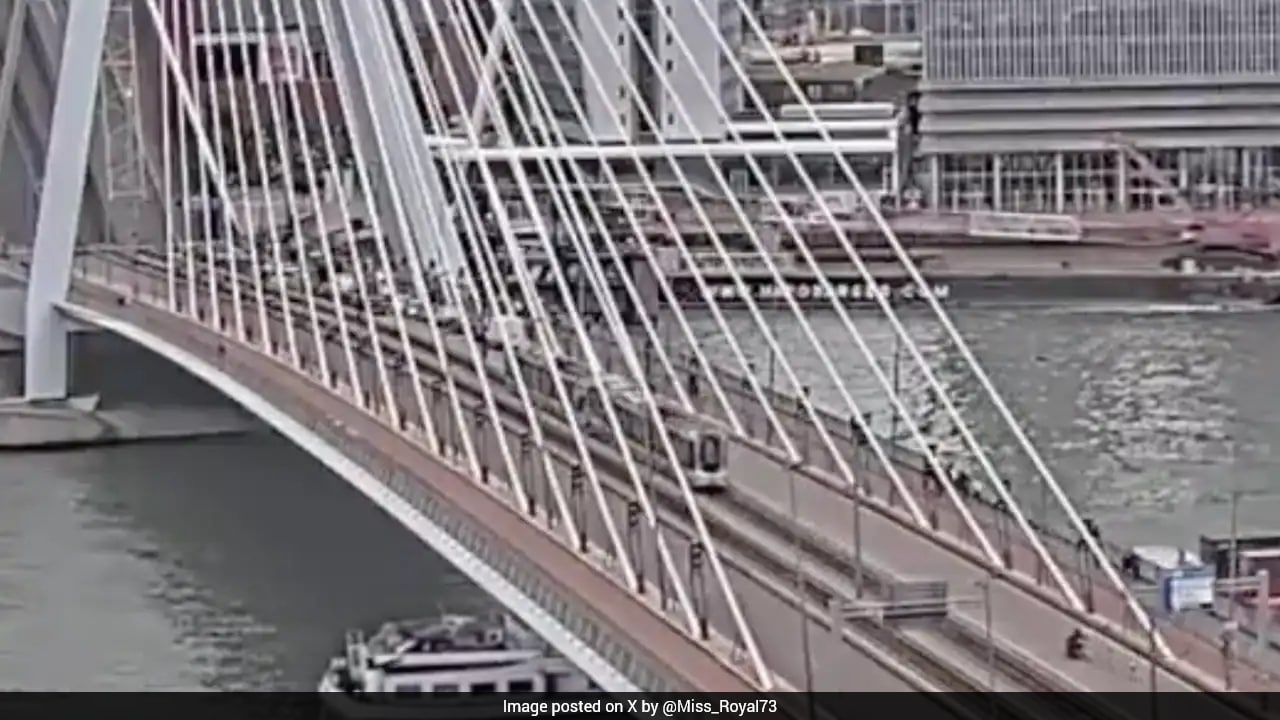
The Rotterdam Crash Was Not an Accident
Fifteen people were injured when two trams collided on Rotterdam’s Erasmus Bridge. The immediate public reaction followed a predictable pattern: local media questioned driver alertness, transit authorities promised an internal investigation into signaling protocols, and commentators debated whether speed limits on transit corridors are too high.
This reaction is fundamental misdirection.
Focusing on individual operator error or isolated mechanical failure misses the systemic reality. Modern urban transit networks do not fail because a driver misses a signal or a brake pad wears out. They fail because municipal authorities insist on treating complex, heavily automated transit systems as legacy, manually operated railways while continuously squeezing headway intervals to hit efficiency targets.
When you push a transit corridor to maximum capacity without modernizing its core safety architecture, collisions are not unfortunate accidents. They are mathematical certainties built into the schedule.
The Myth of the Attentive Operator
For decades, public transit authorities have hidden behind operator liability. If two multi-ton vehicles collide on a fixed line, the easiest PR move is to suspend the driver, cite human error, and issue a press release about updated training modules.
I have sat in planning sessions where transit executives acknowledged off the record that their signaling infrastructure was thirty years out of date, yet their response was simply to instruct drivers to "stay vigilant."
Vigilance does not defeat human biology. Human visual processing fails under fatigue, repetitive visual field monotony, and sudden weather variations.
[System Load] -> [Reduced Headway Intervals] -> [Increased Operator Cognitive Strain] -> [System Shock]
Placing the burden of collision avoidance entirely on human operators driving 40-ton vehicles on shared urban infrastructure is an operational cop-out. In automotive development, reliance on human intervention to prevent high-speed impact was abandoned decades ago in favor of automated emergency braking (AEB). Urban rail, however, routinely operates with system gaps that permit manual overrides under conditions where safety margins are virtually non-existent.
The Real Culprit: Headway Optimization Without Failure Isolation
The fundamental tension in modern public transport lies between two competing metrics:
- Headway Minimization: Reducing the time between vehicles to increase passenger throughput without building new infrastructure.
- Safety Margin Maintenance: Preserving absolute stopping distances based on worst-case braking physics.
When urban planners want to increase capacity without spending billions on new rail lines, they tighten headways. Instead of a tram crossing a bridge every seven minutes, they schedule one every two minutes.
On dry tracks with perfect equipment, a two-minute headway is safe. Add rain, worn rail friction, a minor signaling lag, or a momentary human delay, and that safe interval evaporates.
Stopping Distance Formula:
d_stop = (v * t_response) + (v^2 / (2 * a_braking))
If wet steel rails drop the deceleration rate ($a_{\text{braking}}$) by 40%, a safe stopping distance doubles immediately. If the signaling software does not dynamically force larger intervals during adverse weather, collision risk skyrockets exponentially.
| Variable | Standard Condition | Degraded Track Condition |
| :--- | :--- | :--- |
| *Braking Deceleration* | ~1.3 m/s² | ~0.7 m/s² |
| *Required Gap at 40 km/h* | ~47 meters | ~87 meters |
| *System Buffer Adjustment* | Static | Non-existent (Legacy Rail) |
The competitor narratives surrounding events like Rotterdam focus on the immediate triggers—who didn't stop in time. The real discussion should center on why the network architecture allowed two tram units to occupy the same movement block without automatic power suppression triggering miles before the hazard point.
Why Full Automation Is Not the Easy Answer
The standard counter-argument from tech advocates is immediate, total automation: strip the driver out of the cab, install Positive Train Control (PTC) or Communications-Based Train Control (CBTC), and let algorithms run the bridge.
This viewpoint ignores real-world implementation hurdles.
Fully automated CBTC systems excel in closed, grade-separated environments like subterranean subways. On surface corridors like Rotterdam's Erasmus Bridge, transit vehicles share physical space with cyclists, pedestrians, emergency services, and extreme weather variables.
Installing fully automated systems on legacy surface rail presents distinct trade-offs:
- Sensor Blindness: Optical and LiDAR sensors struggle with high-reflectivity environments (like wet suspension cables and open water bridges) and heavy marine fog.
- Hyper-Conservative Braking: Autonomous surface systems set to absolute safety standards trigger emergency stops for false positives—like loose trash or heavy snowfall—paralyzing city transit lines.
- Capital Cost Imbalance: Retrofitting historical bridge structures with continuous radio-frequency positioning hardware costs millions per kilometer, money transit budgets rarely possess.
The answer is not pretending technology can instantly fix the problem, nor is it blaming the driver. The fix requires rethinking route design and accepting structural trade-offs.
Fixing Transit Infrastructure: Operational Requirements
Stop treating high-density transit lines as continuous conveyor belts. If a transit system cannot afford complete physical grade separation or automated signal interlocks that physically cut power to trailing vehicles, it must change its operational priorities.
Enforce Mandatory Failure-Zone Spacing
High-risk bottleneck areas—bridges, tunnels, and dense intersections—must operate under strict single-occupancy block rules, regardless of schedule delays. Two surface trams should never occupy the same structural span simultaneously unless speed is hardware-capped at under 15 km/h.
Upgrade to Decentralized Short-Range Telemetry
Instead of waiting decades for top-down, multi-million-dollar CBTC network overhauls, transit agencies can deploy vehicle-to-vehicle (V2V) short-range mesh radio units. If Tram B detects Tram A decelerating unexpectedly on the same track vector, Tram B's emergency brakes trigger via direct physical relay, bypassing central signaling delays entirely.
Prioritize Safety Margins Over Theoretical Capacity
City councils must stop selling the public the illusion that surface light rail can handle heavy-rail passenger volumes without sacrificing safety margins. If a corridor reaches capacity, the solution is building secondary routes or subterranean tunnels, not squeezing vehicle intervals down to dangerous thresholds.
Until transit planners accept that efficiency targets directly trade off against safety margins, collisions on major bridges will keep happening. The driver isn't the problem. The system architecture is.


