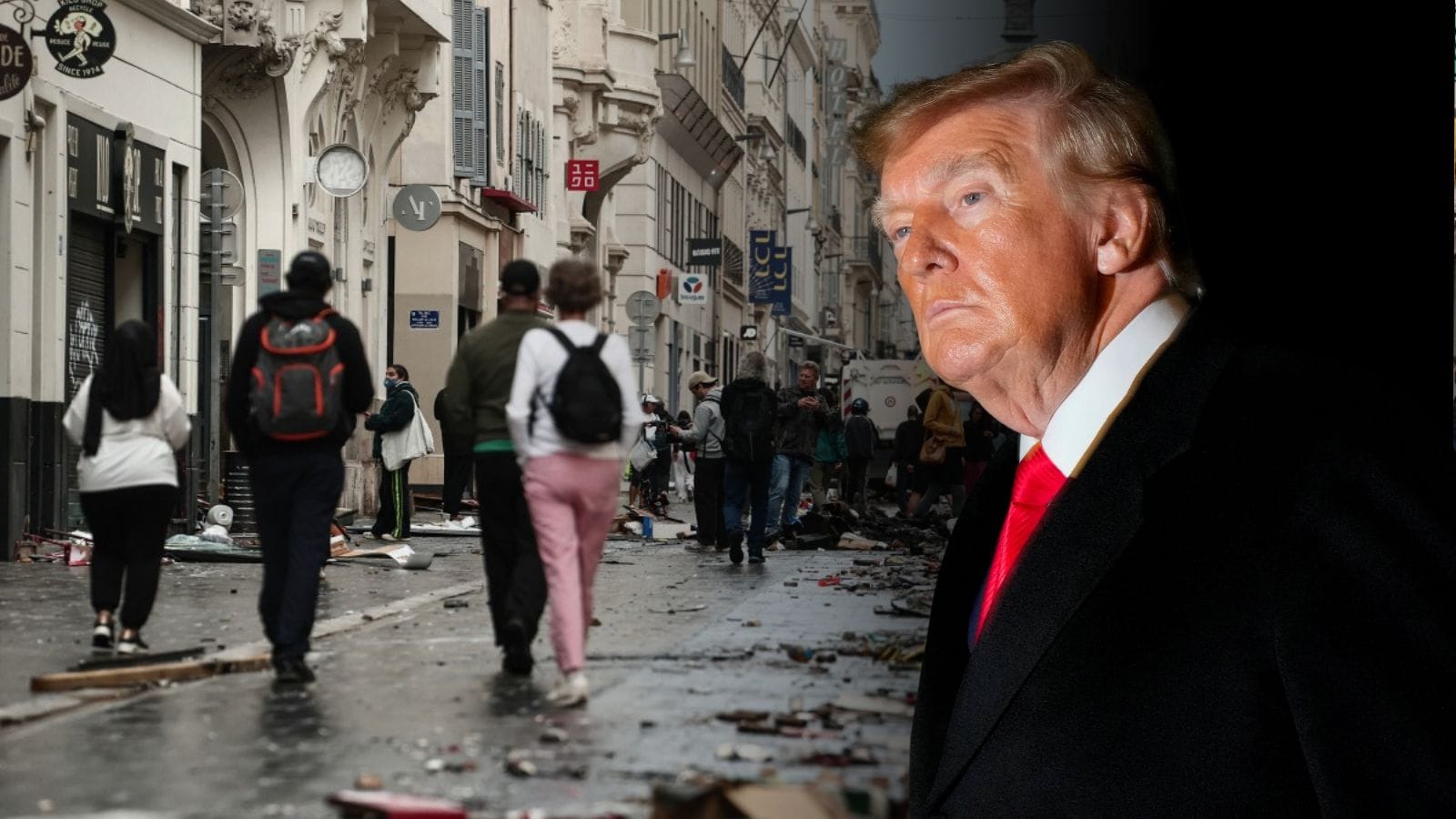
Blaming immigrants for unrest in France is lazy politics. Defending the French status quo is lazy analysis. Both sides are fighting over a decoy.
When Donald Trump points at immigration and claims hatred is driving French street violence, he hands cable news a tidy villain and hands French leaders a convenient shield. Headlines follow the script. A headline like "Hatred In Their Hearts" tells you everything about how cheap outrage works: take a complex political fracture, slap a moral label on an entire group of people, and call it a day.
Here is the problem. The standard counter-argument—that immigration is good, diversity is a strength, and blaming newcomers is xenophobia—is just as flat. Neither argument explains why cars burn in the banlieues, why tear gas hangs over Paris boulevards, or why French politics keeps lurching from crisis to crisis regardless of who sits in the Élysée.
I have spent years watching political analysts, policy consultants, and media commentators misread European civil unrest from thousands of miles away. I have seen think tanks burn budgets producing thick reports that treat complex social mechanics like moral scorecards. They ask whether a statement is cruel or accurate, when the more useful question is what structural pressure cooker made the statement politically potent in the first place.
If you want to understand French unrest, stop asking whether immigrants are to blame. Start asking why France keeps manufacturing alienation across generations, including among citizens whose families have lived there for decades.
The Wrong Question Everybody Keeps Asking
Scroll through search results whenever unrest flares up in France and you will see the same predictable questions. Are immigrants causing riots in France? What did Trump say about French immigration? Why is there so much unrest in France?
Each of those questions starts from a flawed premise or a narrow frame.
Take the first one: Are immigrants causing riots in France? That question already confuses categories. "Immigrant" is a legal and demographic status—someone born abroad without French citizenship at birth, according to standard definitions used by INSEE, France's national statistics institute. Many people involved in French urban riots are French citizens born in France, often the children or grandchildren of immigrants from North and West Africa. Calling everyone with an immigrant background an "immigrant" erases citizenship, flattens generational differences, and turns a domestic structural failure into an external invasion narrative.
Then look at What did Trump say about French immigration? Treating a political soundbite as the centerpiece of analysis is a trap. Politicians outside a country use foreign crises as mirrors for their own domestic coalitions. Trump's rhetoric is aimed at American voters who already view migration through a sharp security and cultural lens. Obsessing over his phrasing tells you about American political messaging. It tells you very little about housing policy in Seine-Saint-Denis, policing tactics in dense urban estates, or economic stagnation in mid-sized French towns.
Even Why is there so much unrest in France? is too vague if you treat every protest as the same phenomenon. France has at least two distinct engines of unrest that people routinely mash together:
- Pension, tax, and cost-of-living protests, like the gilets jaunes (yellow vests) movement or nationwide strikes against pension reform, which often start in smaller towns and peri-urban areas where fuel costs, stagnant wages, and disappearing public services squeeze working-class households.
- Urban estate unrest, concentrated in high-density banlieues around major cities, where clashes frequently ignite after police encounters with young men, compounded by unemployment, overcrowded schools, and strained trust between residents and law enforcement.
Conflating all of this into a single story about "immigrant hatred" is intellectual malpractice. It mistakes a spark for the whole electrical grid.
Why Both Sides Miss the Mechanics
To understand what is actually happening, we have to separate rhetoric from structure.
Politicians like Trump rely on cultural and identity framing because it compresses blame into a single word. If "hatred" is the root cause, policy becomes simple on paper: close doors, talk tough, deport more, project strength. It feels decisive. It gives anxious voters a clear target.
On the flip side, defenders of conventional multicultural orthodoxy often treat any mention of integration strain or crime in certain neighborhoods as dog-whistle racism. By refusing to talk candidly about friction—over secularism (laïcité), policing, educational segregation, or concentrated poverty—they leave a vacuum. Populists walk straight into that vacuum and own the vocabulary of frustration.
Concentration Is Not Culture
One of the clearest mistakes in commentary on France is treating cultural background as a fixed destiny while ignoring spatial concentration.
In France, public housing policies over decades concentrated low-income families—disproportionately from former colonies—into large housing estates on the outskirts of major cities. When jobs shift, when local schools struggle with high turnover and resource strain, and when young people feel boxed into neighborhoods with fewer economic pathways, frustration builds even without "hatred" being imported from abroad.
Sociologists who study urban marginality, such as Loïc Wacquant in his work on banlieues and hyper-ghettoization, have long pointed out that spatial isolation interacts with labor markets and state institutions in ways that create sharp insiders-and-outsiders dynamics. You do not need a grand conspiracy theory to see how a teenager who feels invisible at a job interview and harassed at a police checkpoint reacts differently to the state than a teenager in an affluent Paris arrondissement.
At the same time, pretending cultural and religious tensions do not exist in French public life is equally dishonest. France has a distinct, militant tradition of secularism (laïcité) that shapes debates over dress, public space, and civic identity in ways that look unfamiliar—and sometimes jarring—to outsiders, including Americans. When economic exclusion and cultural friction overlap, resentment compounds.
The Policing Flashpoint
Look closely at major episodes of urban unrest in France over the past two decades—from 2005 to the wave of riots in mid-2023—and you see a recurring trigger: a fatal or violent incident involving police during a stop or pursuit.
That does not mean every rioter is a political theorist, nor does it excuse arson, looting, or attacks on public buildings and officers. Anyone who romanticizes property destruction or ignores the real harm done to local shopkeepers, transit workers, and ordinary residents living in those same neighborhoods is ignoring reality. The people who suffer most when buses stop running or a local pharmacy burns are usually working-class residents of those exact areas.
Still, ignoring the friction between young men in dense housing estates and overstretched police units misses how the fire actually catches. When trust between communities and law enforcement is already thin, a single confrontation can turn a local tragedy into a multi-night conflagration.
A Thought Experiment in Misdiagnosis
Imagine a scenario where a city mayor faces repeated late-night disturbances in one district. Every time trouble breaks out, a pundit on television announces that the problem is caused entirely by newcomers from a specific region who "hate the city's way of life." The mayor responds by launching a press campaign insisting that newcomers are wonderful and anyone who notices trouble is a bigot.
Meanwhile, nobody fixes the broken streetlights, nobody addresses chronic youth unemployment, nobody reforms aggressive stop-and-search practices, and nobody builds actual pathways into skilled trades.
Two years later, the disturbances happen again. The pundit claims vindication because trouble returned. The mayor claims vindication because no one proved cultural hatred was the sole cause. Both are right about their narrow point and completely wrong about the cure.
That is the loop France and its commentators keep running. Loud moral arguments substitute for boring, hard institutional work.
What Actually Works (and Why It Is Hard)
If you want less unrest and stronger social cohesion in a country like France, slogans will not save you. Neither will pretending every policy choice carries zero trade-offs.
Here is what real fixes look like—and why politicians avoid them:
- De-concentrate poverty instead of building political theater. Warehousing low-income populations in isolated housing blocks sets up long-term social strain. Better housing distribution, mixed-income neighborhoods, and real investment in local schools take decades, not news cycles.
- Fix policing accountability and training without gutting public order. Law enforcement needs clear rules, de-escalation standards, and fast, transparent accountability when misconduct happens—paired with backing for officers who face genuine danger. Treating policing as either pure oppression or pure heroism guarantees failure.
- Create real economic ladders for young people without degrees. Youth unemployment and underemployment fuel alienation fast. Expanding apprenticeships, vocational training, and hiring access in regions outside major hubs does more to cool anger than any speech.
- Talk plainly about integration and civic norms without scapegoating. A liberal society can expect shared adherence to the law and basic civic rules while still protecting religious freedom and treating minorities fairly. Refusing to discuss assimilation strains just hands the mic to extremists.
The Cost of My Own Argument
Let me be candid about the downside of taking a structural, nuanced view like this. It does not win viral clips. Nuance rarely trends on social media, and "it's complicated because of housing, policing, labor markets, and identity politics" does not fit on a bumper sticker.
There is another risk, too: over-explaining structural causes can slide into making excuses for people who commit real crimes or embrace real extremism. Pointing out root causes is not the same as absolving individuals of responsibility. A rock thrown through a storefront window or an attack on a firefighter is still a choice made by a person, even inside a flawed system.
Still, if your goal is accuracy rather than applause, structural clarity beats partisan comfort every time.
Stop Buying the Decoy
When foreign leaders talk about unrest in France, listen to what they are trying to win at home. When domestic defenders brush off every warning sign, listen to what they are trying to protect.
France's unrest is not a simple story of immigrant hatred, and it is not a simple story of innocent institutions misunderstood by outsiders. It is the predictable result of unresolved economic pressure, geographic segregation, strained policing, and fierce cultural debates colliding in public view.
Stop arguing over the cartoon version of the crisis. Fix the machinery underneath it.