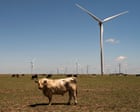
The wind off the coast of Ohio doesn't care about politics. It blows cold and hard, whipping across Lake Erie, smelling of freshwater and heavy industry. For decades, men in towns like Lorain and Cleveland looked out at that water and saw a reminder of what used to be. They saw the ghosts of steel mills and foundry fires that had kept their grandfathers middle-class and their fathers housed.
Then came the turbines.
To a certain kind of politician, those massive white towers spinning against the gray sky are symbols of a coastal elite's fantasy. They see an expensive, unreliable luxury pushed by bureaucrats who have never held a wrench. But if you walk into the union halls of the International Brotherhood of Electrical Workers (IBEW) or the ironworkers' locals in the Rust Belt, you hear a completely different story. You hear the story of a lifeline.
Jason Vance knows the weight of that lifeline. His hands are calloused, his boots stained with grease and dirt. For fifteen years, he chased traditional energy construction jobs across three states, living out of motels and missing his daughter’s birthdays. When construction started on regional wind components, he landed a job closer to home. It paid thirty-six dollars an hour, came with healthcare that covered his family, and allowed him to sleep in his own bed every night.
Now, that security is facing an existential threat.
The political rhetoric surrounding renewable energy has shifted from a policy debate into an outright war. Promises to dismantle the Inflation Reduction Act, halt offshore wind permits on day one, and choke off subsidies for clean energy are staples of the current campaign trail. The justification is always the same: protecting American jobs and traditional industries.
The irony is suffocating.
The very people these policies claim to protect are the ones standing on the chopping block. The reality on the ground has evolved far past the talking points of 2016. Clean energy is no longer an experimental playground for tech startups. It is heavy industry. It is manufacturing. It is, fundamentally, blue-collar work.
Consider the anatomy of a single wind turbine. The steel tower requires the same precision welding that built our skyscrapers. The nacelle houses complex gearboxes and generators that demand highly skilled machinists. The foundations require thousands of tons of concrete and American-made rebar, mixed and poured by union laborers. When a political platform vows to crush the wind industry, it isn't hurting wealthy investors in Silicon Valley. It is halting the assembly lines in Ohio, Pennsylvania, and Michigan.
The data backs up the anxiety humming through the union halls. Over one hundred thousand Americans now work in the wind energy sector. A significant portion of these positions are unionized, offering wages that match or exceed traditional fossil fuel jobs. These are not the "green jobs" of past political promises—the kind that vanished into thin air once a government grant ran out. These are stable, multi-year infrastructure projects.
But the fear of a sudden policy reversal is already chilling the market.
Companies hesitate to greenlight the next phase of manufacturing facilities when the regulatory ground beneath them keeps shifting. Investors hate uncertainty. When a frontrunner for the highest office in the world declares a personal vendetta against wind turbines, claiming they cause cancer and kill all the birds, boards of directors pause. They freeze hiring. They delay expansions.
The human cost of that hesitation is measured in quiet kitchens late at night. It is the sound of a calculator tapping at 2:00 AM as a welder tries to figure out how to pay for a mortgage if the local component plant downscales.
The argument against wind often centers on reliability and cost, wrapped in a nostalgic longing for the peak of coal and oil. It is an appealing narrative. It suggests we can simply turn back the clock to a simpler era of American dominance. But history doesn't move backward. While American politicians debate whether wind turbines are a passing fad, the rest of the world is building. China, Europe, and India are scaling their manufacturing capabilities at breakneck speed.
If America abandons its domestic clean energy manufacturing now, we will not return to a golden age of fossil fuels. We will simply cede the next century of industrial leadership to our global competitors. We will end up importing the components we refuse to build ourselves.
The union workers fighting back against this anti-wind crusade are not eco-warriors. They don’t carry protest signs at climate rallies. They carry lunch boxes. Their loyalty isn't to a specific ideology; it is to the survival of their communities. They look at the wind and see a resource that cannot be outsourced, depleted, or shipped overseas.
The wind belongs to the place where it blows.
On the docks of the Great Lakes, the massive blades sit stacked, waiting for installation. They look like the ribs of some ancient, prehistoric creature, massive and silent. If the political winds shift toward destruction, these blades will remain where they are, rusting reminders of another American industry choked out before it could fully walk.
Jason Vance looks out at the water as the shift ends. The sun is dipping below the horizon, catching the tops of the distant turbines, turning the white fiberglass to a warm, glowing amber. His phone buzzes in his pocket—a text from his wife about dinner. He walks toward his truck, knowing that tomorrow is promised, but the day after that remains entirely up in the air.