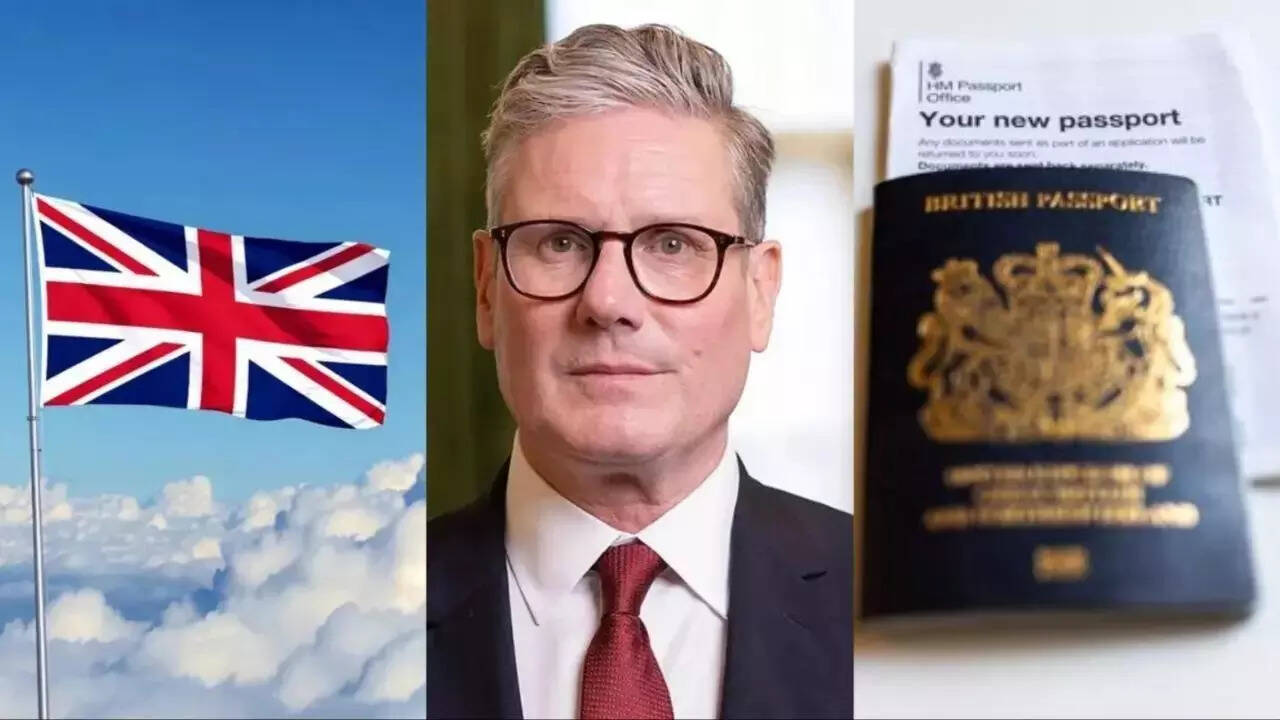
The coffee in the departure lounge was stone cold by the time the realization hit. Imagine standing in a queue you have joined a thousand times before—the familiar hum of rolling suitcases, the flickering blue light of flight boards, the scent of expensive perfume and jet fuel. You reach for your passport, the little burgundy or navy book that serves as the physical proof of your existence in the eyes of the state. You present it. You expect a stamp, a nod, a "welcome home."
Instead, you get a polite, firm wall.
This isn't a story about a lost document or a missed flight. It is a story about the shifting tectonic plates of British border law, and how a woman born in London, raised in its parks, and educated in its schools, suddenly found herself a stranger to her own soil. She is a dual national. For decades, that status was a badge of global fluidity. Now, it has become a trap.
The Invisible Red Line
The mechanics of the disaster are deceptively simple. Under updated UK Home Office rules, the grace period for dual nationals traveling on non-British passports has effectively evaporated. Previously, a British citizen holding a second passport—perhaps from an EU nation or a Commonwealth country—could travel back to the UK using that secondary document, often providing alternative proof of their right to reside if questioned.
The system now demands digital perfection.
The UK is rapidly transitioning to a fully digitized border system, headlined by the Electronic Travel Authorisation (ETA) and the phasing out of physical immigration documents. For those who are "only" British, the path remains clear. But for the millions of dual citizens who live their lives across borders, the requirements have tightened into a knot. If you arrive at a check-in desk in Rome, Dubai, or New York with a foreign passport and no digital link to your British citizenship, the airline—facing heavy fines for boarding "undocumented" passengers—will simply refuse you entry to the plane.
The woman at the heart of this recent storm found this out at the worst possible moment. Born in London, she held a foreign passport through her parents. When she tried to return to the city of her birth, the system flashed red. She was told she needed a British passport to prove she was British. The irony is a jagged pill to swallow: you must spend hundreds of pounds to prove you are what you already are, just to return to the place you never truly left.
The Architecture of Exclusion
To understand why this is happening, we have to look at the machinery of the "Hostile Environment" turned digital. The government’s goal is "security through data." Every traveler must be pre-screened. Every right to enter must be verified before a foot touches the tarmac.
For a dual national, this creates a bureaucratic pincer movement. If you apply for an ETA on your foreign passport, you are technically declaring yourself a visitor—a status that contradicts your legal right as a citizen. If you don't apply for one, the airline sees a passenger with no valid "authority to travel." The only airtight solution provided by the Home Office is to carry a British passport or a "Certificate of Entitlement."
But look at the reality of that "solution." A standard British passport currently costs £88.50 if applied for online from within the UK, but prices climb significantly for overseas applications and emergency documents. If you are stranded, the Emergency Travel Document (ETD) is a temporary fix that costs over £100 and often takes days or weeks to process.
Wait times are the silent killer of stability. We are talking about weeks of hotel bills. Weeks of missed work. Weeks of children missing school. The cost of being "stranded" isn't just the price of a new passport; it’s the compounded interest of a life put on hold.
A London Heart in a Foreign Folder
Consider the psychological weight of this. A person born in a London hospital, who grew up listening to the rhythm of the Underground, is suddenly told that her accent, her birth certificate, and her history are secondary to a database entry.
History is filled with moments where the definition of "belonging" shifted overnight. We saw it with the Windrush generation—people who lived, worked, and paid taxes for decades, only to find the paperwork of their lives was suddenly deemed insufficient. While the current rules for dual nationals are framed as modern border management, the underlying pulse is the same: the burden of proof has shifted entirely onto the individual.
The government argues that these rules prevent illegal immigration and streamline the experience for the "vast majority." But the "vast majority" is a cold comfort when you are the outlier sitting on a plastic chair in a foreign consulate, watching your bank account drain.
The Logistics of the Trap
Why not just get the British passport?
It seems like an obvious fix. Yet, many dual nationals living abroad or traveling frequently haven't needed one for years. They used their other passport for ease of travel within certain blocs, or perhaps they simply let their UK document expire, thinking their birthright was a permanent shield.
The new system doesn't care about your "thinking." It functions on binary code. 1 or 0. Citizen or Visitor.
If you find yourself in this position, the options are a menu of bad choices:
- The Emergency Route: Pay for an ETD. It gets you home, but it’s a one-way ticket to a bureaucratic headache.
- The Certificate of Entitlement: A "Right of Abode" sticker in your foreign passport. It costs over £500. It is a staggering "tax" on citizenship.
- The Long Game: Apply for a standard renewal and wait. Hope you have a friend with a couch in a foreign city.
The friction is the point. By making the process slow and expensive, the state ensures that only the most prepared—or the most affluent—can navigate the cracks in the system without falling through.
The Friction of a Digital Identity
We are moving toward a world where our identity is no longer something we carry in our pockets, but something managed in a cloud we cannot see. The digitisation of the UK border is intended to make travel "seamless." But "seamless" is a word used by people who don't have complicated lives.
For the woman born in London, the system was the opposite of seamless. It was a jagged edge. She represents a growing class of "accidental foreigners"—people who are legally British but administratively invisible.
The stakes are higher than a missed holiday. We are talking about the right to return to an elderly parent’s bedside. The right to attend a funeral. The right to exist in the place where your memories were formed. When a government makes it this difficult for its own citizens to enter the country, it is sending a message about who it considers "truly" British.
The Price of Belonging
There is a specific kind of silence that happens when a border guard hands back your passport and shakes their head. It is a silence that feels like the world shrinking.
The London-born woman eventually found a way back, but only after a grueling ordeal of costs and delays. Her story is a flare sent up for everyone else. If you hold two passports, the time for complacency ended with the last update to the border manual. The "Home" in Home Office is starting to feel like a gated community with an increasingly temperamental intercom.
Check your documents. Check the dates. Don't assume that the city that raised you will recognize your face without the right piece of paper to prove it.
The border is no longer just a line on a map. It is a line in a database. And if the computer says you don't belong, your birthright is just a collection of stories that no one at the gate is interested in hearing.
The lights of London are beautiful from thirty thousand feet, but they are a haunting sight when you aren't allowed to land.