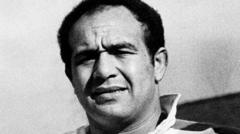
The rain in South Wales has a specific texture, heavy and gray, smelling of coal dust and salt. It was under that persistent drizzle on Angelina Street in Tiger Bay, Cardiff, where a legend was quietly forged.
Imagine a cramped terraced house filled with eleven children, the floorboards humming with the raw energy of a working-class household. Here lived young Billy Boston. To understand why men wept when he walked onto a rugby pitch, you have to understand the boundaries placed around him before he even laced a pair of boots.
He was a boy of mixed heritage—his mother Cardiff-Irish, his father a merchant seaman from Sierra Leone. In the late 1940s and early 1950s, doors in Welsh sporting establishments were frequently dead-bolted by prejudice. His hometown club, Cardiff RFC, passed over talented young players of color, leaving an invisible glass ceiling hanging low over the local fields. Yet, Billy possessed an innate, kinetic grace. When he ran, gravity seemed to negotiate terms with him. He played for the famed local "Invincibles" of the Cardiff Internationals Athletic Club, slicing through defensive lines with a deceptive, gliding speed that left opponents grasping at thin air.
He dreamed of the traditional rugby union jersey. He wanted nothing more than to represent Cardiff and Wales under the union code. But history had a different, more industrial destination in mind.
National service with the Royal Signals called him north to Yorkshire. Away from the Welsh valleys, the radar of northern rugby league scouts locked onto him. They saw a phenomenon wrapped in modesty.
Consider the afternoon of March 13, 1953. Two emissaries from the Wigan club—Chairman Joe Taylor and vice-chairman Billy Gore—traveled all the way to Angelina Street. They sat in the modest family parlor and placed an offer on the table: one thousand pounds. To a working-class family, it was a king's ransom.
Nellie Boston, his mother, looked at the men, looked at the money, and said no.
The executives returned, desperate, spreading a stack of five-pound notes across the table totaling fifteen hundred pounds in hard cash. Still, the young man hesitated. He did not want to go. Moving north meant crossing an unbridgeable chasm. At the time, switching to rugby league meant a lifetime ban from rugby union. It meant severing ties with the dreams of his boyhood.
Seeing her son's quiet anguish, Nellie stepped in. She decided to scare the executives away. She named an astronomical figure, double their last bid: three thousand pounds.
Within sixty seconds, the directors agreed.
The deal was struck. And as the ink dried, the teenager sat down and wept. He cried because he knew his union dream was dead. He had no idea he was about to give birth to a much larger immortality.
The transition to the northern code changed the sport forever. Moving to Wigan, Boston became an avalanche wrapped in a jersey. He played with a unique style—massive thighs, an explosive sidestep, and an uncanny ability to read the intentions of defenders before they even formed them.
The numbers stagger the imagination. In 488 appearances for Wigan, he scored 478 tries. Across his entire career, he amassed an astonishing 571 tries, making him the second-highest try scorer in rugby league history. When he toured Australia and New Zealand with Great Britain in 1954 as the first black player to wear the Lions shirt, he crossed the try line 36 times in 18 tour matches, shredding international record books.
Opponents feared him. Fans adored him. Yet, away from the roaring terraces of Central Park, he remained remarkably gentle. He was a soft-spoken trailblazer who bore the weight of racial barriers not with anger, but with supreme dignity and a devastatingly effective pair of boots.
Decades rolled by. The mud of old grounds turned to modern turf. Statues were cast in his honor—one in Wigan, another in Cardiff Bay, and a permanent fixture at Wembley Stadium, freezing his iconic stride in bronze.
Then came June 2025. King Charles III, recognizing a lifetime of cultural and athletic seismic shifts, bestowed upon him a knighthood. Sir William John Boston became the first rugby league player in history to receive the honor. It was a monumental closing of a circle that began seventy years prior in a damp Cardiff alleyway.
When the final whistle blew on his magnificent life at the age of ninety-two, coming just weeks after the passing of his beloved wife Lady Joan, the sports world paused.
They did not just mourn a scorer of tries. They mourned the passing of an era when character was forged in iron and soot.
The rain still falls on Angelina Street. But the footprints left by the boy from Tiger Bay remain etched into the bedrock of British sporting history, glowing brighter with every passing generation.