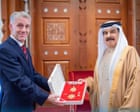
British foreign policy has a transparency problem, and it just walked right into a photo opportunity in Manama.
Alastair Long, the British ambassador to Bahrain, stood smiling next to King Hamad bin Isa al-Khalifa as he accepted the Order of Bahrain (First Class). On paper, it looks like standard diplomatic back-patting. In reality, it marks a flagrant violation of the UK government's own rules, sparking a fierce backlash from politicians and human rights advocates who argue that British diplomats have essentially become cheap marketing tools for authoritarian regimes.
The Foreign, Commonwealth and Development Office (FCDO) operates under a clear, non-negotiable policy. Heads of UK missions are strictly forbidden from accepting foreign awards during, on, or after leaving their posts. Furthermore, foreign states must formally request permission before attempting to hand out medals to British nationals.
According to internal sources, the Bahraini government didn't bother asking. They just handed it over. And Long took it.
The Rulebook That Nobody Follows
This isn't an isolated mistake. It's an ongoing habit. Long is the fourth consecutive British ambassador to Bahrain to accept this exact honour, following in the footsteps of his predecessors Iain Lindsay, Simon Martin, and Roderick Drummond.
Liberal Democrat peer Lord Scriven didn't hold back in a scathing letter sent to Foreign Secretary Yvette Cooper. He pointed out a predictable strategy where the Bahraini administration systematically ignores British protocol because they know there won't be any consequences.
"This sends a clear message: our diplomats and civil servants are up for grabs," Scriven stated. "It’s quite clear that the foreign secretary and politicians are not in charge."
What makes this situation worse is that the FCDO knows exactly what’s happening. Freedom of Information requests previously exposed internal emails from 2023, back when Roderick Drummond was the envoy. Foreign Office staff explicitly advised that the medal should be declined. Yet, the internal guidance shifted to suggesting the ambassador should politely take the award "to avoid embarrassment" and keep it as a private souvenir.
When institutional etiquette matters more than international rules, the rules become entirely useless.
Whitewashing Human Rights Violations
The timing of these ceremonies makes the compliance of British diplomats look incredibly bad. Bahrain's domestic human rights situation is actively deteriorating. Human Rights Watch has documented an unrelenting crackdown on dissent, featuring the arbitrary detention of political opposition leaders and rights defenders.
Specific atrocities highlight the human cost behind the diplomatic handshakes:
- Mass citizenship revocations: The state has repeatedly stripped Shia Muslims of Iranian heritage of their nationality, leaving families and children legally stateless.
- Targeted arrests: Clerics and peaceful activists are routinely jailed for criticizing the regime.
- Fatalities in custody: The recent torture and death of Sayed Mohamed Almosawi in state custody put a spotlight on the horrific conditions inside Bahraini prisons.
Sayed Ahmed Alwadaei, an activist and advocacy director at the Bahrain Institute for Rights and Democracy (BIRD), fled persecution in Bahrain after surviving torture. He described Ambassador Long as "morally compromised" for accepting the medal, especially after Long previously praised King Hamad’s "visionary leadership."
You can't claim to represent British values of liberty and human rights while wearing a medal gifted by a ruler who oversees the systemic torture of political dissidents.
Who Do British Envoys Actually Work For
The cosy relationship between British officials and the Bahraini state runs much deeper than shiny medals. The entire system looks increasingly compromised.
Consider the case of Lord Ahmad, the former UK Middle East minister. In 2025, he faced intense scrutiny after taking a paid advisory role with an organization directly tied to the Bahraini government. While the Advisory Committee on Business Appointments (ACOBA) ultimately cleared him, critics labeled the decision a total whitewash.
When ministers jump straight from government benches into paid consulting gigs for foreign states, it compromises the integrity of British foreign policy. It creates a revolving door where the line between serving the British public and serving a foreign monarchy becomes completely blurred.
The UK government relies on a weak loophole to handle these situations. FCDO policy states that if an ambassador receives an honour without prior permission, they aren't allowed to wear it or officially accept it, but they can keep it. There's zero requirement to return the item.
This passive stance gives foreign governments total control. They get the positive press coverage and the photo of a British diplomat endorsing their rule. The diplomat gets a nice medal for their mantelpiece, and the UK government looks completely powerless.
To fix this, the Foreign Office needs to change its approach immediately:
- Enforce mandatory returns: The FCDO must update its civil service code to mandate that any unapproved foreign honour must be returned immediately to the issuing government.
- Implement financial penalties: Diplomats who accept unapproved awards should face immediate disciplinary action, including salary freezes or demotions.
- Establish a strict cooling-off period: Former ministers and diplomats must be barred from taking paid advisory roles with foreign governments or state-linked entities for at least five years after leaving office.
If the Foreign Secretary wants to prove that British diplomats aren't up for grabs, the government needs to stop hiding behind polite diplomatic protocol and start enforcing its own rules.