The United States Navy is running out of places to fix its ships. Decades of industrial attrition, workforce hollow-outs, and legislative restrictions have left domestic public and private shipyards drowning in a backlog of maintenance overhauls.
To keep the Seventh Fleet operational in the Western Pacific, Washington relies heavily on the formidable industrial capacity of allied shipyards in Japan, South Korea, and the Philippines. This arrangement is not merely a matter of administrative convenience. It represents a desperate structural necessity for an overstretched maritime force attempting to deter a rapidly expanding Chinese fleet without the domestic ship-repair capacity to back it up.
Domestic public shipyards are congested. The Government Accountability Office has repeatedly documented that naval vessels face extensive maintenance delays, often sitting pier-side for months past their scheduled completion dates waiting for dry-dock availability and specialized labor. When a guided-missile destroyer or a logistics ship requires a major overhaul in a domestic yard, the queue stretches for years.
This bottleneck breaks the fundamental math of naval readiness. A warship sitting in a maintenance backlog cannot patrol the Taiwan Strait or the South China Sea.
Enter the dry docks of Yokohama, Geoje, and Subic Bay.
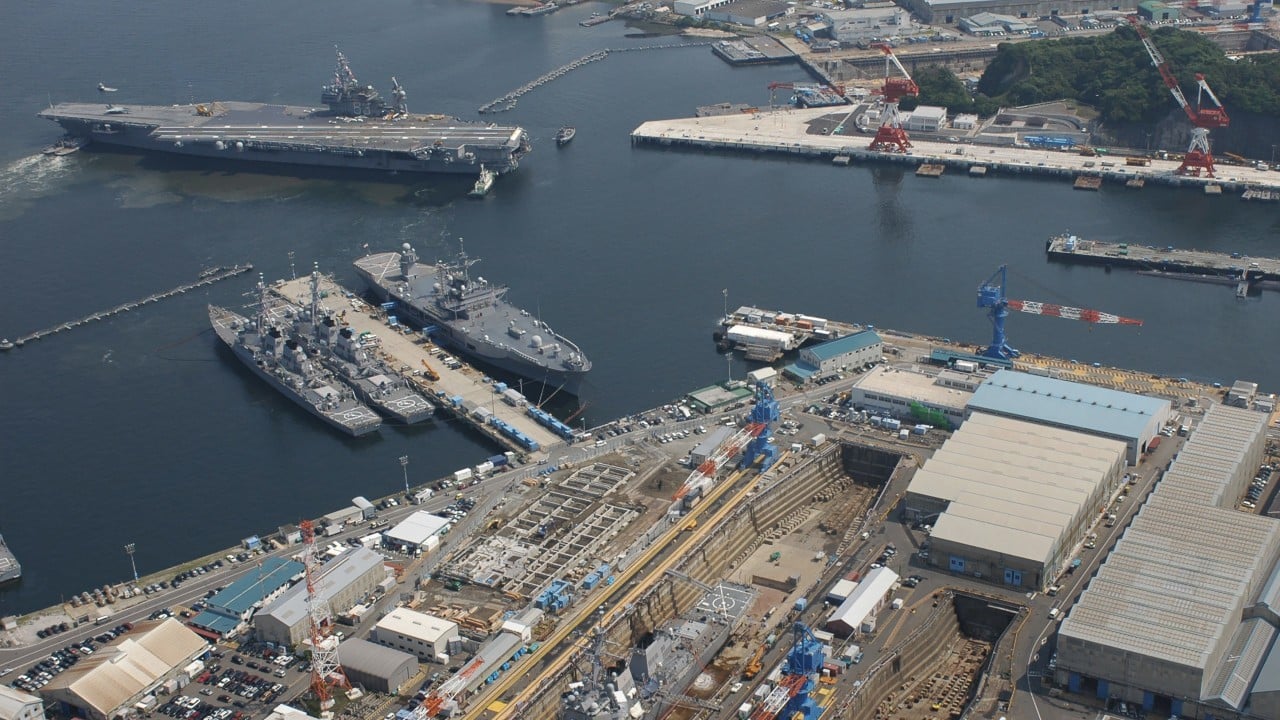
Japanese heavy industries have long provided maintenance for forward-deployed naval forces stationed at Yokosuka and Sasebo. Facilities operated by Mitsubishi Heavy Industries and other major contractors possess the crane capacity, dry docks, and skilled metalworkers that the U.S. industrial base lost generations ago. When a Military Sealift Command replenishment vessel or an expeditionary mobile base requires a regular overhaul, sending it to a Japanese or South Korean commercial yard cuts transit times and avoids stateside shipyard congestion entirely.
South Korea represents a newer, more potent pillar in this equation. Major industrial conglomerates like HD Hyundai Heavy Industries and Hanwha Ocean have secured Master Ship Repair Agreements with the U.S. Navy. These agreements allow commercial yards in South Korea to bid on and execute complex maintenance, repair, and overhaul work for American naval and auxiliary vessels.
Consider the logistical reality. For a Military Sealift Command logistics ship operating in Asian waters, steaming across the Pacific back to a West Coast yard for routine dry-docking burns months of operational availability and strains fuel budgets. Entrusting that same vessel to a South Korean commercial shipyard reduces downtime from months to weeks, executing the work inside facilities capable of constructing liquefied natural gas carriers and massive container ships with terrifying efficiency.
The Philippines adds a crucial geographic node to this web of sustainment. The former naval installations around Subic Bay, once abandoned by the United States at the end of the Cold War, are experiencing a quiet operational renaissance. Commercial ship-repair facilities operating within the Subic Bay Freeport Zone provide accessible dry-docking and maintenance options closer to potential flashpoints in the South China Sea. While these facilities do not possess the advanced combat-systems integration capabilities found in Yokosuka or Busan, they offer essential real estate for hull repairs, inspections, and minor corrective maintenance.
Yet, leaning on foreign industrial capacity exposes acute legal and strategic vulnerabilities.
United States federal law heavily restricts foreign repair work for vessels homeported in the continental United States. While ships permanently forward-deployed to Japan or Guam, alongside Military Sealift Command auxiliary ships, enjoy broader latitude to utilize foreign yards, the statutory framework remains bound by protectionist legislation designed to protect domestic maritime unions and builders. Pushing against these legal boundaries requires persistent waivers and high-level political friction.
The labor equation tells an even grimmer story. South Korean and Japanese shipyards maintain massive pools of skilled welders, naval architects, and marine electricians. This workforce is anchored by robust vocational pipelines and decades of continuous commercial shipbuilding demand.
American shipyards face a generational demographic cliff. Recruiting young talent into heavy industrial manufacturing environments has proven immensely difficult, leaving domestic yards short-staffed and reliant on an aging core of master craftsmen nearing retirement. No amount of naval appropriations acts can instantly conjure fifty thousand experienced marine welders out of thin air.
Strategic competitors are watching this industrial outsourcing closely. Relying on foreign allies for warship maintenance introduces foreign supply chain dependencies into the core of American naval power. If a major regional crisis erupts in East Asia, commercial shipyards in allied nations will face competing priorities. Defending their own maritime domains while simultaneously servicing damaged U.S. warships will test the limits of bilateral agreements.
Washington is attempting to bridge this gap through initiatives like the U.S.-Japan Ship Repair Working Group and expanded industrial cooperation pacts with Seoul. These diplomatic channels aim to streamline regulatory hurdles and integrate allied repair infrastructure into joint war-planning frameworks.
The strategy works because the alternative is complete operational stagnation. Without allied dry docks, the fleet would wither at its moorings, choked by a domestic industrial base that forgot how to build and maintain at scale.
The security of the Indo-Pacific does not rest solely on the flight deck of an aircraft carrier or the vertical launch systems of a destroyer. It rests on the concrete floors of foreign dry docks, where allied workers weld steel and turn wrenches to keep the American Navy afloat.