The smell of scorched rubber and stale beer clings to the pavement long after the sirens fade. On a Saturday afternoon in Belfast, the air should smell of rain and fried food from the markets. Instead, it carries the sharp, metallic tang of a city on edge.
A brick shatters the window of a local supermarket. It is a small, family-run business, the kind of place where the owner knows how most customers take their tea. Within hours, that shattered glass becomes a catalyst. The tremors felt on the streets of Northern Ireland do not stop at the Irish Sea. They ripple outward, morphing into a wave of civil unrest that transforms high streets across the UK into ideological battlegrounds.
This is not a sudden burst of random violence. It is a flashpoint. To understand why thousands of people are choosing to spend their weekends shouting at neighbors across a thin line of riot police, you have to look past the headlines. You have to look at the people standing on the asphalt.
The Anatomy of the Crowd
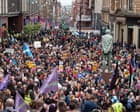
Picture two men standing fifty yards apart on a street in Manchester or Bristol. They have never met. They likely never will. Yet, their entire weekend is defined by the other’s existence.
On one side stands a man in a hooded jacket. Let us call him Mark, a hypothetical composite of the young men filling the ranks of the sudden right-wing mobilizations. Mark feels forgotten. He looks at his decaying town center, the lack of affordable housing, and the long waiting lists at the local surgery. He has been told online, through a relentless stream of algorithms and thirty-second videos, that his hardships have a single, simple cause. He is angry, and the anger feels better than the powerlessness he carries on weekdays.
On the other side stands a woman holding a hand-painted cardboard sign. Let us call her Sarah. She grew up in a multicultural Britain that she views as a triumph of modern history. When she sees the banners across the street, she does not just see a political disagreement; she sees an existential threat to her friends, her coworkers, and the fabric of her community. She is terrified of what happens if her side stays home.
Between them stands a wall of fluorescent jackets. The police officers are exhausted. Their shields are dented by flying bottles, bricks, and firecrackers.
The numbers tell part of the story, but the numbers are cold. Over the course of a single week, dozens of separate protests erupt across major urban centers, including Liverpool, Hull, Leeds, and Bristol. In Whitehall, London, police arrest over a hundred individuals in a single evening. The charges range from violent disorder to assault on emergency workers.
But a spreadsheet of arrests cannot capture the terror of a restaurant worker locking the doors from the inside while a crowd roars past, or the anxiety of a mother deciding it is safer to keep her children indoors on a sunny afternoon.
The Digital Echo Chamber
How does a localized tragedy or a specific grievance in one corner of the United Kingdom instantly ignite a nationwide conflagration? The answer lies in the invisible architecture of our daily lives.
In the past, organizing a mass demonstration required weeks of physical effort. It took leaflets, committee meetings, and word of mouth. Today, it requires a smartphone and an incendiary rumor.
Consider what happens next when a false piece of information is injected into the digital bloodstream. It does not circulate like traditional news, which undergoes a process of verification and editorial oversight. Instead, it spreads via weaponized outrage. An unverified claim about the identity of a suspect in a crime or the motive behind an incident is viewed millions of times before official sources can even draft a press release.
By the time the truth emerges, the crowd has already gathered. The algorithm does not care about nuance; it cares about engagement. Anger is the most engaging emotion we possess.
This digital reality creates a profound disconnect on the physical street. The people marching often believe they are defending their country from imminent ruin. The counter-protesters believe they are standing on the front line against a rising tide of fascism. Because neither side reads the same news, shares the same digital space, or trusts the same institutions, they are not merely debating politics. They are living in entirely different realities.
The Cost of the Conflict
The immediate damage of these clashes is easy to quantify. Councils can calculate the cost of replacing melted tarmac, repairing broken shopfronts, and paying overtime to emergency services. The deeper erosion is harder to measure.
When a community experiences this level of visceral division, the psychological scars linger. Trust is a fragile commodity. It takes decades to build a neighborhood where people of different backgrounds, faiths, and political persuasions can coexist in casual harmony. It takes an afternoon of rioting to shatter that trust entirely.
In towns that saw heavy fighting, the atmosphere changes. People begin to look at their neighbors with a subtle, corrosive suspicion. The local shop keeper wonders if the teenager walking past was one of the people throwing stones at the mosque. The immigrant family wonders if the silence from the house next door signifies agreement with the anti-immigration slogans chanted down the road.
The UK has navigated periods of intense social friction before. The tensions of the 1970s and 1980s left deep marks on the national psyche. History suggests that violence rarely solves the underlying anxieties that fuel it. It merely hardens the boundaries between groups, making dialogue more difficult and reconciliation a distant prospect.
Beyond the Front Lines
While the television cameras focus on the smoke and the shouting, a different kind of story unfolds in the quiet hours after the crowds disperse.
On Sunday mornings, before the street sweepers arrive, ordinary citizens emerge from their homes. They do not bring flags or megaphones. They bring stiff brushes, bin bags, and dustpans.
In Liverpool, residents gathered outside a damaged library to salvage books and sweep up glass. In Belfast, community leaders from different sides of the traditional divide met quietly in community centers to ensure the violence would not trigger a return to the dark days of sectarian conflict.
These actions lack the dramatic tension required to lead the evening news broadcast. They are quiet, tedious, and profoundly important. They represent the quiet majority of people who have to live in these cities long after the professional provocateurs have boarded their trains home.
The future of these streets will not be decided by who shouts the loudest on a Saturday afternoon. It will be decided by whether the structural issues driving the anger—economic neglect, digital misinformation, and social isolation—are addressed with the same urgency that is currently used to deploy riot police.
A single sneaker lies abandoned in a gutter, soaked through by the evening drizzle, surrounded by the plastic remnants of police tape and the gray ash of a bin fire.