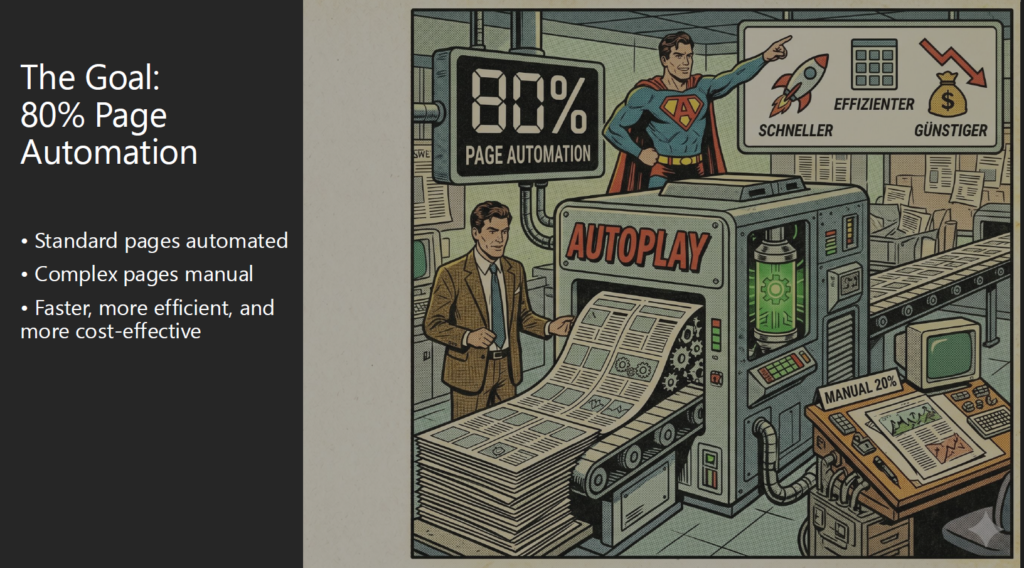
Legacy print publishing operates under an inverted cost structure where physical distribution and manual layout labor scale linearly with page volume, creating a persistent margin compression crisis as print circulation declines. When regional publishers like Weser-Kurier migrate newspaper page production into the browser and claim an 80 percent layout automation rate, the shift represents more than a software upgrade. It exposes the structural bottlenecks of traditional editorial workflows and tests the limits of deterministic layout engines against the chaotic requirements of daily journalism. Deconstructing this transition requires analyzing the economic trade-offs of browser-based document architectures, the operational mechanics of template-driven pagination, and the hidden costs that remain untouched by automated layout pipelines.
The Economics of Legacy Pagination
The traditional newspaper production pipeline is a labor-intensive sequence of human interventions. Reporters file copy, copy editors trim text to fit pre-calculated column inches, designers place articles and advertisements into desktop publishing software, and proofreaders check for overflows or hyphenation errors. Each page is a bespoke artifact requiring manual synchronization between advertising inventories and editorial budgets.
This model creates a fixed labor overhead per edition regardless of advertising revenue fluctuations. As print advertising yields contract, the cost of human pagination remains static, eroding operating margins. Automating eighty percent of layouts eliminates the manual placement phase for standard editions, shifting editorial labor from spatial assembly to exception handling.
The economic rationale rests on two distinct variables: throughput velocity and error reduction
Browser Based Newspaper Production Mechanics And Structural Automation Economics
technology, business
Legacy print publishing operates on an inherently broken cost structure characterized by fragmented software ecosystems, high friction manual layout, and an unsustainable labor overhead relative to shrinking newsroom revenues. When regional publishing entities like Weser-Kurier shift their production environments directly into web browsers and claim an eighty percent automation metric for routine page layouts, they are not merely adopting a new software tool. They are fundamentally restructuring the publishing supply chain. This transition exposes the mechanics of how traditional news operations can decouple layout expenditure from page volume output, transforming print production from a bespoke artisanal craft into a standardized, programmatic assembly process.
The Operational Bottlenecks of Legacy Print Workflows
Traditional newspaper production relies on desktop publishing software that isolates layout designers from reporters and editors. Content generation occurs in content management systems, while layout assembly happens in specialized desktop applications. This architectural split requires manual copy-fitting, iterative re-exporting, and continuous visual verification across separate platforms.
The primary friction points in this workflow include:
- Version Control Drift: Multiple stakeholders modifying text outside the layout grid lead to truncation errors, necessitating manual line-by-line cutting by night-shift subeditors.
- Talent Allocation Mismatch: Highly trained journalists and designers spend a significant percentage of their shift on mechanical formatting—dragging text boxes, adjusting leading, and aligning image crops—rather than investigative reporting or high-level visual storytelling.
- High Latency Cost Function: The time required to close an edition scales linearly with the number of pages and the frequency of late-breaking news changes, creating tight production bottlenecks that restrict distribution flexibility.
The Economic Mechanics of Browser-Based Automation
Shifting the production environment into the browser allows publishers to centralize the asset pipeline. A browser-based architecture eliminates local client installation overhead, unifies font rendering engines across distributed teams, and enables real-time collaborative editing without file-locking conflicts.
The eighty percent automation threshold achieved in such transformations relies on a parametric layout engine. Instead of manually designing every page, the system evaluates incoming text length, image dimensions, and section priority against predefined layout templates governed by strict typographic constraints.
The Tripartite Framework of Automated Layout
- Semantic Tagging and Content Ingestion: Articles enter the system pre-tagged with metadata defining structural importance, word counts, and visual assets. The automation engine ingests these inputs without human intervention regarding typographic hierarchy.
- Constraint-Based Template Fitting: Rather than relying on human aesthetic choices for standard pages, the layout engine uses algorithmic rules to place content within designated grid geometries. If text overflows or underflows a slot, the system automatically adjusts parameters within safe typographic boundaries or flags the anomaly for human review.
- Exception-Based Human Workflow: By automating eighty percent of predictable, template-driven pages (such as classifieds, stock listings, sports scores, and standard wire briefs), the operation restricts human intervention to the remaining twenty percent. Human editors focus exclusively on front-page lead stories, complex investigative pieces, and high-impact visual spreads where editorial discretion remains economically viable.
Systemic Limitations and Operational Risks
Total reliance on automated layout engines introduces distinct failure modes that publishers must manage. Algorithmically generated layouts lack contextual awareness. Without explicit human oversight, an automated pagination engine can pair an inappropriate headline treatment with sensitive news content, or miscalculate the visual weight of competing stories on a regional page.
Furthermore, standardized templates run the risk of visual homogenization. If every regional insert uses identical algorithmic grid distributions, the distinct visual identity of local journalism erodes. Publishers must calibrate their automation parameters to preserve flexibility for breaking news updates that defy standard geometric constraints. The transition does not eliminate human labor; it reallocates it from mechanical execution to exception management and algorithmic tuning.
Strategic Execution for Scaled Media Operations
Transitioning newspaper page production to browser-based automation requires a systematic dismantling of legacy habits. Organizations attempting this shift must first standardize their metadata taxonomy before deploying layout algorithms. Without clean inputs, automated pagination engines amplify formatting errors across dozens of editions simultaneously.
Publishers should audit their current page output to isolate the eighty percent of predictable production volume from the twenty percent requiring bespoke design. Capital expenditure should target robust template design systems rather than incremental software licenses for legacy desktop applications. The long-term viability of print operations depends on aligning labor costs directly with value-adding editorial output, rendering automated pagination the baseline operational standard for modern publishing houses.


