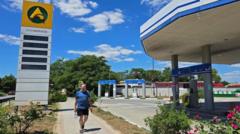
Dry pumps tell only half the story. As images of shuttered gas stations and stranded civilian vehicles circulate out of Russian-occupied Crimea, the immediate assumption is simple logistics. Western headlines quickly chalk up the crisis to a highly successful Ukrainian interdiction campaign. But a deeper examination of the peninsula’s energy infrastructure reveals a more calculated, asymmetrical strategy at play. Kyiv isn't just trying to starve Russian tanks of diesel. It is exposing a structural dependency that Moscow cannot easily fix.
The immediate reality on the ground is stark. Retail fuel across Crimea has effectively dried up, forcing local occupation authorities to ration supplies for emergency vehicles and military personnel. Yet, this is not merely the result of a few lucky drone strikes on oil depots. It is the culmination of a systematic, multi-layered blockade targeting the very specific, fragile transit corridors that connect the isolated peninsula to the Russian mainland.
The Anatomy of an Energy Choke Point
Crimea has always been an logistical nightmare for occupiers. Geographically isolated, it relies entirely on external inputs for its daily survival. Before 2014, the vast majority of its water, electricity, and refined petroleum came via mainland Ukraine. Post-annexation, Russia spent billions attempting to reroute these supply lines through the Krasnodar Krai region, anchoring their entire strategy on the Kerch Strait Bridge.
That bridge was designed as a symbol of permanent integration. It is also a massive single point of failure.
By combining long-range missile strikes, maritime drone deployments, and guerrilla sabotage on mainland rail links, Ukrainian forces have successfully severed the heavy rail capacity of the Kerch Bridge. While passenger cars can occasionally crawl across, the heavy freight trains carrying fuel tankers have ground to a halt.
This forces Russia to rely on two highly vulnerable alternatives:
- The Land Corridor: The rail and road networks running through occupied southern Ukraine (Zaporizhzhia and Donetsk oblasts). These routes sit well within the firing arc of Ukrainian precision artillery and high-mobility artillery rocket systems. Moving a multi-ton fuel convoy through this corridor is essentially a suicide mission.
- Maritime Ferries: Large landing ships and commercial ferries operating across the Kerch Strait. However, recent Ukrainian Neptune missile strikes on the Kavkaz and Crimea ferry terminals have effectively taken these vessels off the board, leaving Russia without a viable backup plan.
When you cut the rail lines and sink the ferries, the fuel stops. It is basic math.
The Refined Product Trap
A common counter-argument is that Russia, as a global energy superpower, possesses more than enough oil to keep a small peninsula running. This misses a critical distinction in energy logistics. Oil in the ground is not gasoline in a tank.
Crimea does not possess significant domestic refining capacity. It is entirely dependent on refined products—specifically diesel and high-octane gasoline—transported from refineries in southern Russia, such as the Tuapse facility. Refining processes require stable infrastructure, and once those refined products are loaded into specialized rail tankers, they become highly volatile targets.
Russia cannot simply truck in enough gasoline to sustain both an active army corps and a civilian population of over two million people. A standard fuel truck carries roughly 30,000 liters. A single military offensive can consume millions of liters in days. The math favors the blockade.
The Brutal Choice Facing Moscow
The tightening noose around Crimea’s energy supply forces the Kremlin into a zero-sum calculation. Every drop of fuel allocated to keep a civilian hospital open or a grocery delivery truck running is a drop taken away from a T-90 tank or a logistical supply vehicle on the northern front.
Currently, the military is winning the priority argument.
Reports from inside the peninsula indicate that the remaining strategic reserves, stored in underground bunkers away from the vulnerable coastal depots, have been completely requisitioned by the Russian Ministry of Defense. Civilian stations are left with nothing. Occupation authorities have attempted to downplay the crisis, claiming "technical delays in delivery," but the long lines at the few remaining functional stations tell a different story.
This creates a profound political problem for Moscow. For a decade, Crimea was held up as the crown jewel of Russia’s modern imperial expansion—a stable, prosperous paradise fully integrated into the state. Now, the population is discovering that their connection to the mainland is a fragile thread.
The Black Market Factor
Whenever a critical commodity disappears, a shadow economy emerges to fill the void. In Crimea, this is already happening with alarming speed.
Local military commanders, notoriously corrupt and poorly paid, are reportedly siphoning off military fuel reserves to sell to commercial enterprises at exorbitant markups. This creates a highly distorted market where only the wealthiest citizens or critical businesses can afford to operate. The long-term economic impact of this black-market shift is devastating for local agriculture and tourism, the two pillars of the peacetime Crimean economy. Without fuel, harvesting machinery sits idle, and the summer tourist season is effectively dead.
A Blueprint for Modern Siege Warfare
What we are witnessing in Crimea is a shift in how modern sieges are conducted. Historically, a siege required completely surrounding a city or region with physical forces. In the twenty-first century, precision strike capabilities allow a military to achieve the same effect from hundreds of kilometers away.
Kyiv does not need to boots on the ground in Sevastopol to control the destiny of the city. By systematically dismantling the energy distribution network, they are rendering the territory ungovernable and unsustainable for the occupying force.
The strategy is not without risks for Ukraine. Complete economic strangulation of a territory inhabited by civilians always carries a heavy humanitarian burden. Kyiv must walk a fine line, ensuring that the blame for the hardship falls squarely on the occupying forces who failed to secure the supply lines, rather than on the forces executing the blockade.
Why Conventional Countermeasures are Failing
Russia has attempted to deploy advanced air defense systems, including the S-400, to protect its remaining fuel infrastructure in Crimea. These systems have proven largely ineffective against the saturation tactics employed by Ukraine, which frequently use cheap decoy drones to expose radar positions before launching Western-supplied cruise missiles or indigenous ballistic weapons.
Furthermore, air defense cannot fix a broken railway. Even if Russia could intercept every single missile, the physical damage to the transport nodes requires specialized engineering equipment and months of uninterrupted repair work to fix. Time is a luxury Moscow does not have.
The energy crisis in Crimea is not a temporary bottleneck. It is a structural collapse. As long as Ukraine maintains fire control over the transit corridors, the peninsula will remain a logistical black hole for Russia, sucking in resources that are desperately needed elsewhere on the front lines. The pumps will remain dry, not because there is no oil, but because the cost of moving it has become too high to bear.